
Icons of Christ
Christ the Saviour
Christ Pantocrator (the Almighty)
Ιησούς Χριστός ο Παντοκράτωρ · Гдⷭ҇ь Вседержи́тель · Господь Вседержитель (Спас Вседержитель)
Christ the Saviour is remembered on 25 December (7 January on the Old Calendar). Orthodox Christians pray to Christ the Saviour for mercy and forgiveness of sins (the Jesus Prayer: Lord Jesus Christ, Son of God, have mercy on me), salvation of the soul and healing of body and soul, as King Abgar of Edessa was healed through the Holy Face.
Feast days
- Feast
- Nativity of Christ
- Kept on
- 25 December (7 January on the Old Calendar)
- Next, New Calendar
- Next, Old Calendar
- Feast
- Theophany (Baptism of the Lord)
- Kept on
- 6 January (19 January on the Old Calendar)
- Next, New Calendar
- Next, Old Calendar
- Feast
- Transfiguration of the Lord
- Kept on
- 6 August (19 August on the Old Calendar)
- Next, New Calendar
- Next, Old Calendar
- Feast
- Translation of the Image Not-Made-by-Hands from Edessa (third 'Saviour' feast of August)
- Kept on
- 16 August (29 August on the Old Calendar)
- Next, New Calendar
- Next, Old Calendar
- Feast
- Pascha (Resurrection of Christ)
- Kept on
- Pascha (Easter Sunday)
- Next
- Feast
- Ascension of the Lord
- Kept on
- the Ascension, forty days after Pascha
- Next
The New Calendar is kept by the Greek, Antiochian, Romanian and Bulgarian churches, the OCA and most converts; the Old Calendar by the Russian, Serbian and Georgian churches, Jerusalem and Mount Athos, 13 days later on the civil calendar.
The icon of Christ
The Pantocrator, "the Almighty, Ruler of all," is the oldest and most central image of Orthodox iconography: Christ raising His right hand and holding the Gospel in His left, as He looks down from the dome of every Orthodox church. The letters IC XC are the first and last letters of "Jesus Christ" in Greek; with NIKA they proclaim "Jesus Christ conquers," the confession stamped on prosphora, crosses and medallions. In Russia the beloved Zvenigorod Saviour, from the early fifteenth-century Deesis tier traditionally linked with St Andrei Rublev, was found near Zvenigorod in 1918 and is now in the Tretyakov Gallery; its gentle, searching gaze has made it one of the most loved faces of Christ in the world. Orthodox Christians keep an icon of the Saviour in the place of honor in every home, pray before it morning and evening, and make the sign of the Cross over a bridegroom with it on his wedding day. Through His icon the faithful turn to the Lord Himself, asking for mercy, healing and the salvation of their souls.
What the faithful ask of Christ the Saviour
The faithful pray for
- mercy and forgiveness of sins (the Jesus Prayer: Lord Jesus Christ, Son of God, have mercy on me)
- salvation of the soul
- healing of body and soul, as King Abgar of Edessa was healed through the Holy Face
- the protection of the home, where the icon of the Saviour holds the place of honor in the icon corner
- strength to keep the Gospel commandments
- victory over sin and temptation (IC XC NIKA: Jesus Christ conquers)
- the enlightenment of the mind by the uncreated Light of Tabor
- a bridegroom on his wedding day (the Saviour icon of the wedding pair)
- a peaceful Christian end and a good defense at the Last Judgment
Christ the Saviour protects
- from the power of the devil and every evil
- from despair, for Christ has conquered death
- the household that keeps His icon
- from sickness of body and soul
Miracles
King Abgar of Edessa, stricken with leprosy, received a cloth on which the Lord had imprinted His face after washing it; pressing it to his face, Abgar was healed.
Source: OCA: Translation of the Image Not-Made-by-Hands from Edessa
On Mount Tabor the Lord shone with Divine Light before Peter, James and John, revealing the glory granted to those who unite the mind with God in prayer.
In 944 the Image Not-Made-by-Hands was solemnly carried from Edessa to Constantinople, an event the Church still keeps as a feast.
Source: OCA: Translation of the Image Not-Made-by-Hands from Edessa
Where the traditions differ
IC XC NIKA is pan-Orthodox (Greek and Slavic). The Zvenigorod Saviour's attribution to Rublev is traditional but now disputed by Tretyakov Gallery specialists (2017 council; Nersesyan and Sverdlova 2022), so say 'attributed to' or 'school of' Rublev. Name days for Christos/Sotirios are a Greek custom only.
Christ the Saviour: icons and items in our shop
 Folding diptychChrist Pantocrator & Our Lady of Kazan Folding Diptych
$99$69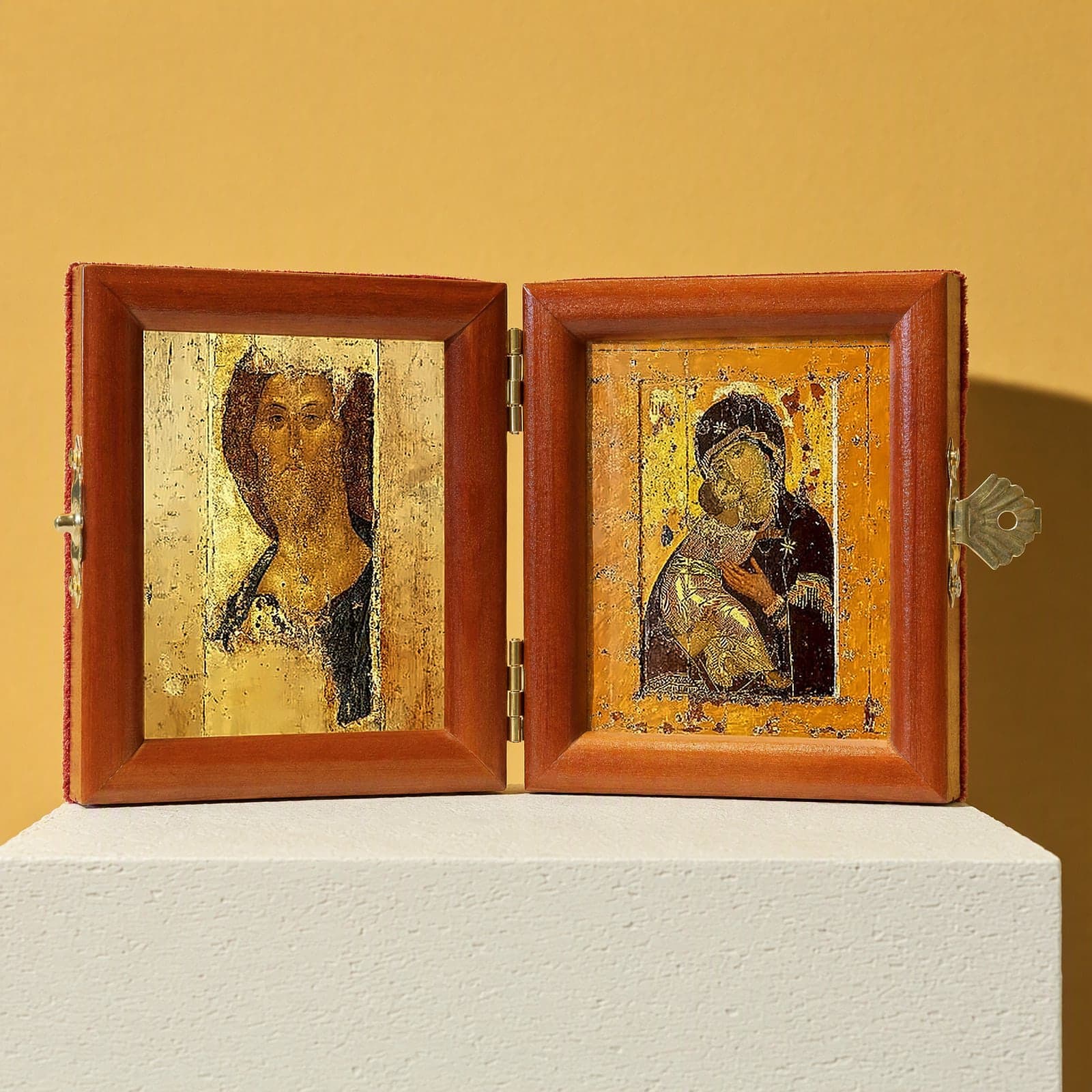 Folding diptychChrist (Zvenigorod Saviour) & Vladimir Mother of God Folding Diptych
$99$69 Folding diptychHoly Trinity (Rublev) & Christ (Zvenigorod Saviour) Folding Diptych
$99$69 MedallionOrthodox IC XC NIKA - Gold Color - Stainless Steel Medallion
$56$39 MedallionOrthodox IC XC NIKA - Silver Color - Stainless Steel Medallion
$56$39 IconOrthodox Jesus Christ and Virgin Mary - Folding Wooden Icon
$56$39 IconOrthodox Jesus Christ Pantocrator - Silver&Gold Color - Icon
$42$29 IconOrthodox Christ & Virgin Mary - Silver&Gold Color - Folding Wooden Icon
$56$39 IconOrthodox Jesus Christ Pantocrator - Gold Color - Wooden Icon
$42$29 IconOrthodox Jesus Christ Pantocrator - Silver&Gold Color - Wooden Icon 12х9cm
$42$29 IconOrthodox Mother of God & Christ - Wooden Icon 14х9cm
$49$34 IconOrthodox Virgin Mary & Child, Jesus Christ - Wooden Icon
$42$29 IconOrthodox Virgin Mary & Jesus - Hanging Icon 20x13cm
$42$29 IconOrthodox Diptych Virgin Mary & Jesus Christ - Folding Wooden Icon
$56$39
Have it consecrated by our priest before it reaches you — Consecration, $49.
Ask our priest
Our priest can serve a moleben to Christ the Saviour for the people and the need you name.
Name days
These names keep their name day on a feast of Christ the Saviour:
Prayed to for
Related saints

Questions
When is the feast day of Christ the Saviour?
Nativity of Christ: 25 December (7 January on the Old Calendar); Theophany (Baptism of the Lord): 6 January (19 January on the Old Calendar); Transfiguration of the Lord: 6 August (19 August on the Old Calendar); Translation of the Image Not-Made-by-Hands from Edessa (third 'Saviour' feast of August): 16 August (29 August on the Old Calendar); Pascha (Resurrection of Christ): Pascha (Easter Sunday); Ascension of the Lord: the Ascension, forty days after Pascha.
What do Orthodox Christians pray to Christ the Saviour for?
Orthodox Christians pray to Christ the Saviour for mercy and forgiveness of sins (the Jesus Prayer: Lord Jesus Christ, Son of God, have mercy on me), salvation of the soul, healing of body and soul, as King Abgar of Edessa was healed through the Holy Face, the protection of the home, where the icon of the Saviour holds the place of honor in the icon corner, strength to keep the Gospel commandments and victory over sin and temptation (IC XC NIKA: Jesus Christ conquers).
What does Christ the Saviour protect from?
Christ the Saviour protects from the power of the devil and every evil, from despair, for Christ has conquered death, the household that keeps His icon and from sickness of body and soul.
Whose name day is on a feast of Christ the Saviour?
The name day of Christos (Greek, kept at Christmas), Sotirios (Greek, kept at the Transfiguration) and Sotiria (Greek, kept at the Transfiguration).
Sources
- OCA: Translation of the Image Not-Made-by-Hands from Edessa (read 14 October 2026)
- OCA: The Holy Transfiguration of Our Lord (read 14 October 2026)
- Wikipedia: Christ Pantocrator (read 14 October 2026)
- Wikipedia: Christogram (IC XC NIKA) (read 14 October 2026)
- Википедия: Звенигородский чин (read 14 October 2026)