Dove Symbolism: what it is and how Orthodox Christians use it
What is the dove, and how do Orthodox Christians treat it? The facts below come from Wikipedia and OrthodoxWiki, one fact to a line, with the Orthodox and Western uses kept in separate places.
- At the Baptism. The Gospels say the Spirit came down on Jesus like a dove at his baptism (Matthew 3:16, Mark 1:10, Luke 3:22, John 1:32), and for this reason the dove became a sign of the Holy Spirit.
- Noah. In the story of the flood a dove brings Noah an olive leaf (Genesis 8:11), and this scene reminded the Church Fathers of the saving work of Christ on the cross.
- Peace. Early Christians in Rome carved or painted on tombs a dove with an olive branch in its beak, often alongside the word ‘Peace’; the article traces the dove-and-olive-branch sign of peace back to them.
- Augustine. By the 5th century Augustine of Hippo wrote that the olive branch the dove carried shows lasting peace.
- The soul. The dove can also stand for the Christian soul, understood as a soul in which the Holy Spirit lives.
- A sign of Christ. In the 2nd century Irenaeus pointed out that the Greek word for dove, περιστερά, adds up to 801, the same total as the letters Alpha and Omega, both standing for Christ.
- Early texts. Clement of Alexandria advised readers to engrave their seals with a dove or a fish.
- On lamps. Small lamps in the early catacombs were decorated with the dove among other Christian symbols.
- Trinity art. In Christian art the Trinity is most often shown with the Spirit as a dove, nearly always with wings spread.
In Western churches. A common later Western picture, the Throne of Mercy, shows the Father holding the crucified Son, with the Dove hovering above or between them. Medieval Western churches kept the Eucharistic bread in a dove-shaped vessel, the Eucharistic dove; many are Limoges or Spanish enamel work.
Facts come from Wikipedia (Doves as symbols, Christian symbolism, Ichthys, Trinity and Peristerium) and OrthodoxWiki (Catacombs, Holy Spirit and Theophany), put into our own words.
What the Orthodox Church does with the dove
OrthodoxWiki says icons often show the Spirit as a dove, following the account of the baptism in the Jordan; the account of Pentecost speaks of wind and fire, so a flame can also stand for the Spirit. At Theophany the Church celebrates the baptism of Christ in the Jordan, where the Spirit comes down as a dove; the festal hymn speaks of the Spirit, in dove form, confirming the Father’s testimony. The article on Christian symbolism says the peristerium, a dove-shaped vessel for the Eucharist, was common long ago and in the East still sometimes serves as a tabernacle in churches.
Trinity pieces: a crucifix and a folding icon
No catalogue item is described as the dove. The two pieces whose text names the Holy Trinity are the Crucifixion cross with the Trinity above it, $54, and the Rublev Holy Trinity folding diptych, $109, each open to the Blessing by an Orthodox priest. With the Blessing, $93 and $158 respectively.
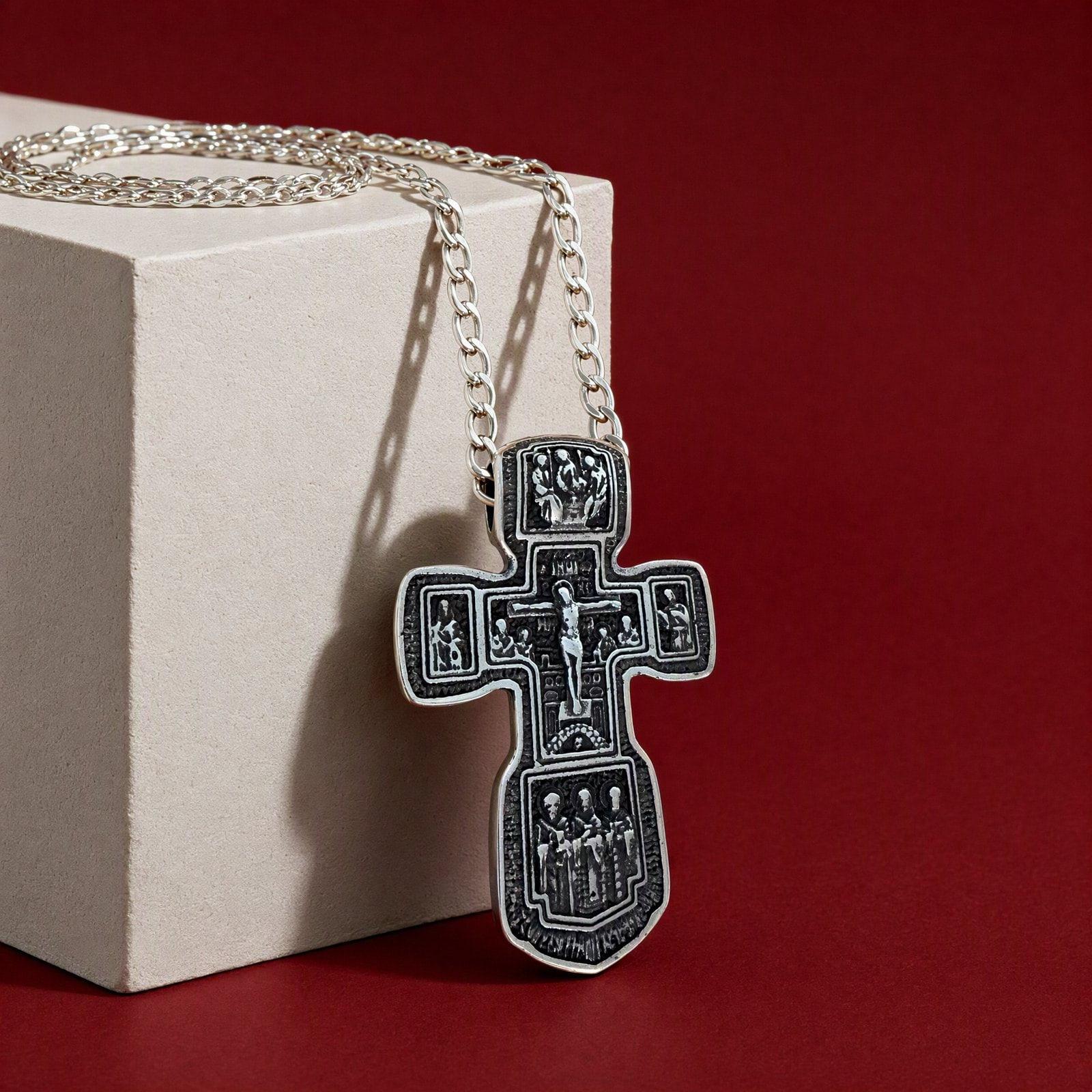 Cross
Holy Trinity Slate
Stainless steel, silver finish$78$54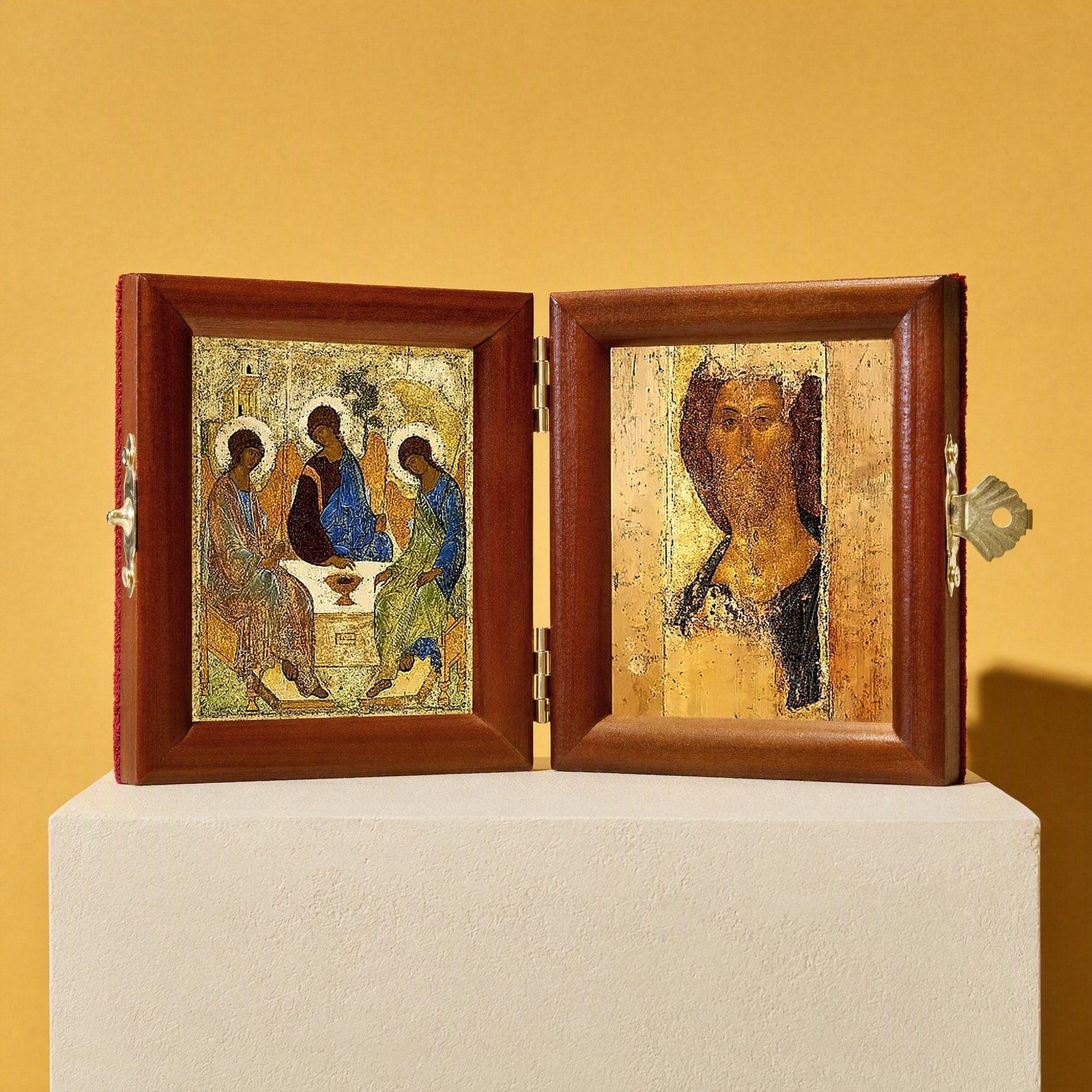 Folding diptych
Rublev Trinity & Zvenigorod Saviour
$156$109
- Blessing, from $39. Blessed by an Orthodox priest before it ships.
- Gift packaging, $20
Questions
What is the dove as a Christian symbol?
The Gospels say the Spirit came down on Jesus like a dove at his baptism (Matthew 3:16, Mark 1:10, Luke 3:22, John 1:32), and for this reason the dove became a sign of the Holy Spirit.
What does the dove mean to Christians?
Early Christians in Rome carved or painted on tombs a dove with an olive branch in its beak, often alongside the word ‘Peace’; the article traces the dove-and-olive-branch sign of peace back to them.
How does the Orthodox Church treat the dove?
The article on Christian symbolism says the peristerium, a dove-shaped vessel for the Eucharist, was common long ago and in the East still sometimes serves as a tabernacle in churches.
Do Western churches use the dove as well?
Medieval Western churches kept the Eucharistic bread in a dove-shaped vessel, the Eucharistic dove; many are Limoges or Spanish enamel work.
Does Lampada sell anything that shows the dove?
No item in the catalogue is described as the dove, going by the titles and descriptions. The items on this page are the nearest we carry.