Eagle Symbolism: what it is and how Orthodox Christians use it
The eagle is a symbol that Christians of East and West both know. Here are the facts the reference sources give, followed by the Orthodox use and the Western use, each in its own place.
- What it is. John the Evangelist, who wrote the fourth Gospel, is signified by an eagle, a creature of the sky that some Christian scholars thought could gaze at the sun.
- Where it comes from. Ezekiel 1 and Revelation 4:6-9 supply the four winged creatures; shown together they are the tetramorph, a favourite of Romanesque church wall paintings.
- What it stands for. In John’s case it signifies the Ascension and Christ’s divinity, and is a call to face eternity without flinching.
- Why the eagle. One idea is that each creature was first seen as the finest of its class: a man among humans, a lion among wild beasts, an ox among farm animals, and the eagle among birds.
- Early writers. Jerome offered an early version of these meanings, which Rabanus Maurus later developed into three layers.
- How it is drawn. The evangelist’s eagle often wears a halo.
In Western churches. Queen Isabella of Castile took Saint John’s eagle as the supporter of her arms because of her devotion to the evangelist, and it later became part of the arms of Spain’s Catholic Monarchs. Catherine of Aragon and Philip II of Spain also used the Eagle of Saint John in their arms. Early medieval Gospel books, church portals and apses carry the four creatures, and they usually flank Christ in Majesty.
Facts come from Wikipedia (Four Evangelists and Eagle of Saint John) and OrthodoxWiki (Double-headed eagle), put into our own words.
The eagle in Orthodox worship and art
The late Byzantine Empire used the double-headed eagle as its state emblem, and the article credits the 11th-century emperor Isaac Komnenos with first taking it up. The Ecumenical Patriarchate’s flag today shows a double-headed eagle gripping a cross and an orb, and the Church of Greece and the Church of Cyprus carry it in their emblems. OrthodoxWiki ranks it second only to the cross as the most recognisable Orthodox symbol, a sign of the Byzantine unity of Church and State.
A cross with no figure on it
Nothing in the catalogue is described as the eagle, so this page offers its plainest cross instead, a three-bar Orthodox cross with no figure, silver-tone at $64, gold-tone at $64 and black at $64, each on a chain. An Orthodox priest can bless it before it ships. With the Blessing, $103.
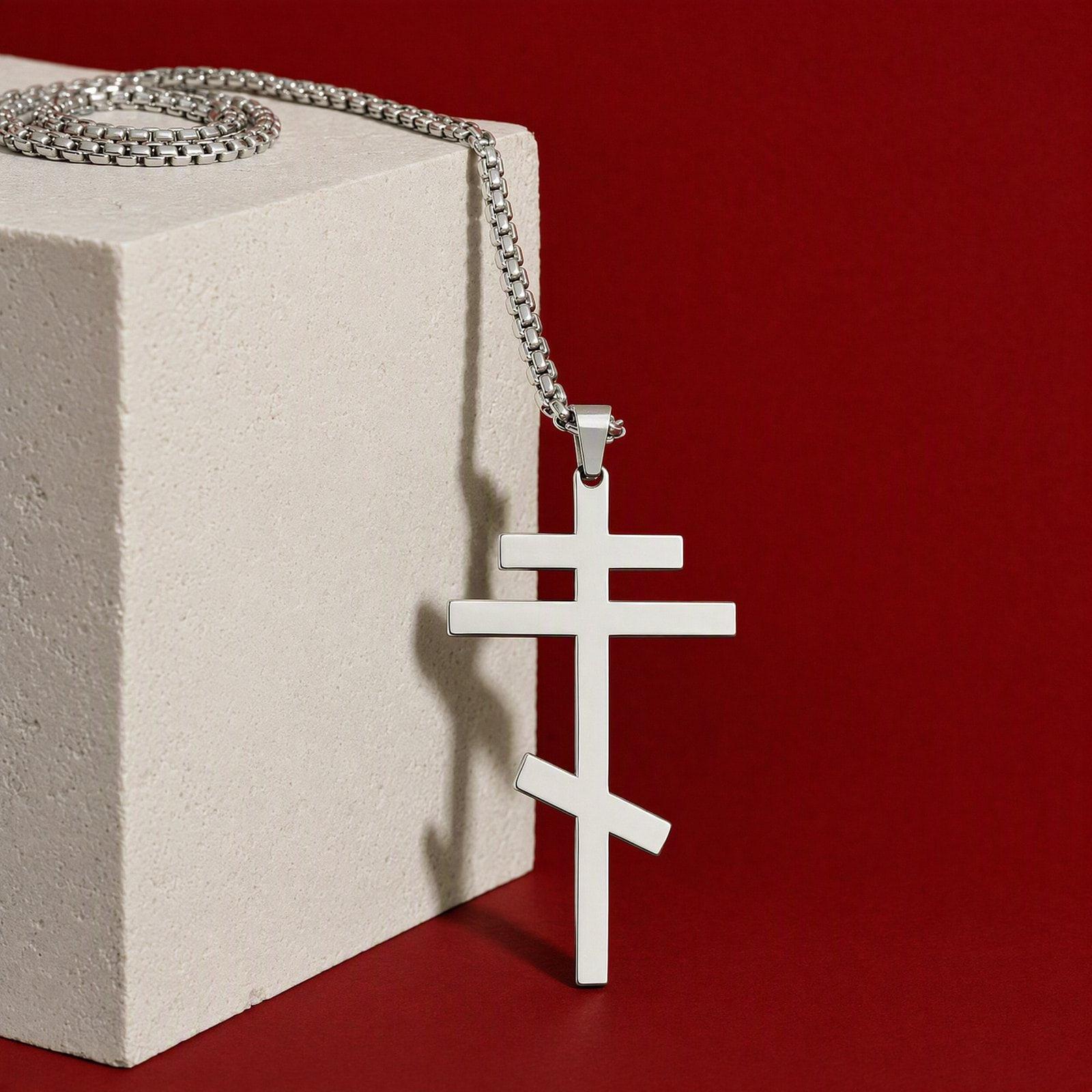 Cross
Three-Bar Bright
Stainless steel, silver finish, 24 in chain$92$64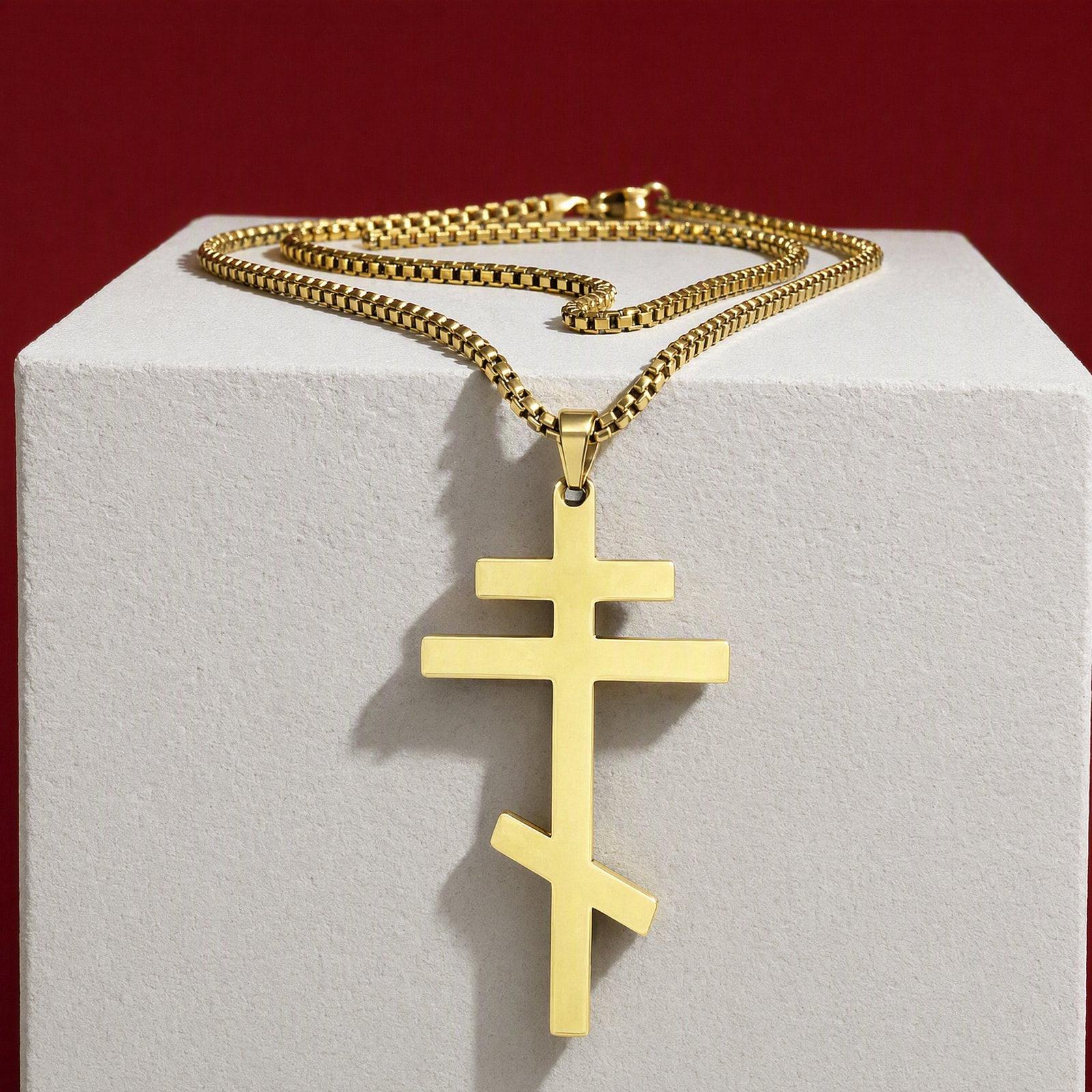 Cross
Three-Bar Lamplight
Stainless steel, gold finish, 24 in chain$92$64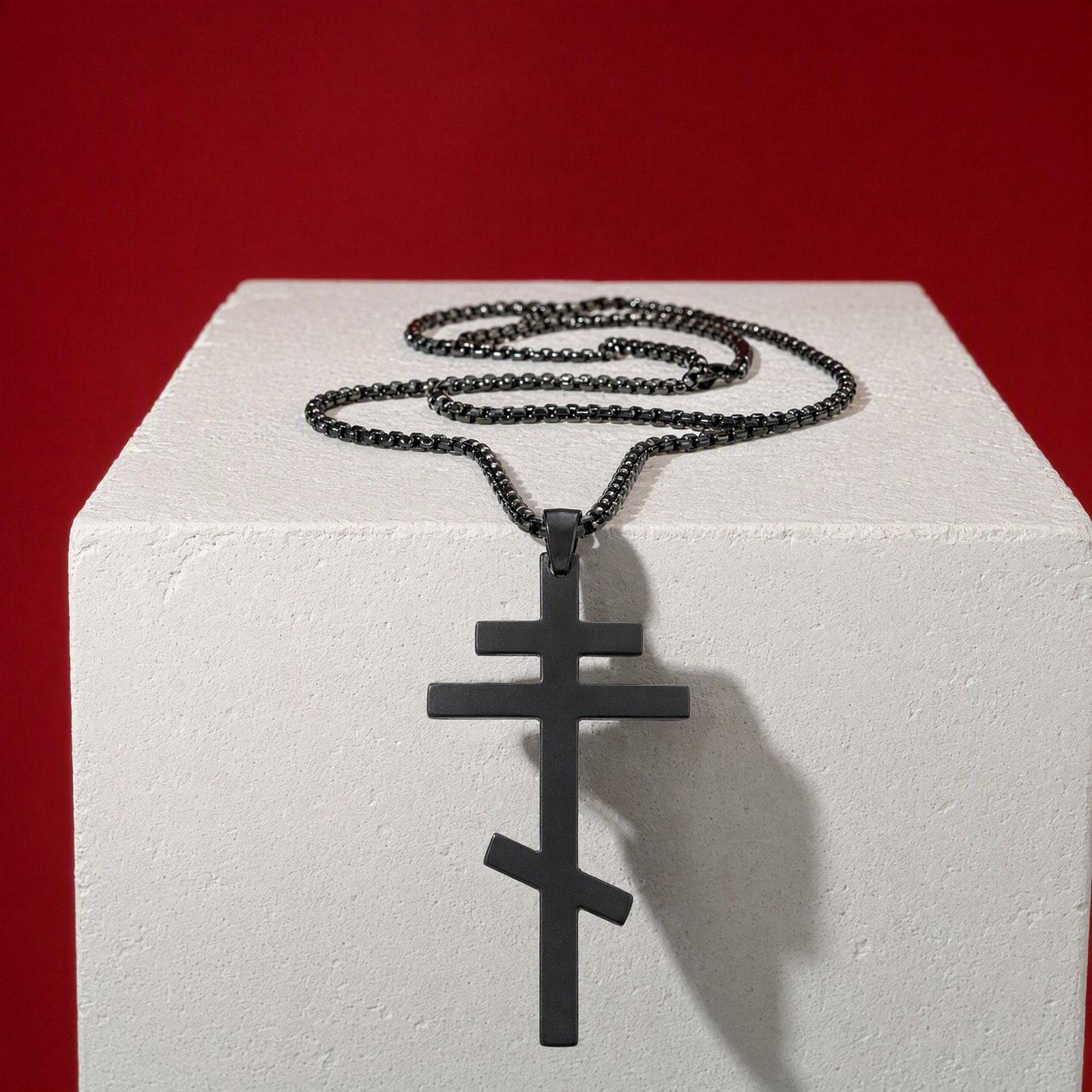 Cross
Three-Bar Midnight
Stainless steel, black finish, 24 in chain$92$64
- Blessing, $39. Blessed by an Orthodox priest before it ships.
- Gift packaging, $20
Questions
What is the eagle as a Christian symbol?
John the Evangelist, who wrote the fourth Gospel, is signified by an eagle, a creature of the sky that some Christian scholars thought could gaze at the sun.
What does the eagle mean to Christians?
In John’s case it signifies the Ascension and Christ’s divinity, and is a call to face eternity without flinching.
How does the Orthodox Church treat the eagle?
The late Byzantine Empire used the double-headed eagle as its state emblem, and the article credits the 11th-century emperor Isaac Komnenos with first taking it up. The Ecumenical Patriarchate’s flag today shows a double-headed eagle gripping a cross and an orb, and the Church of Greece and the Church of Cyprus carry it in their emblems.
Do Western churches use the eagle as well?
Early medieval Gospel books, church portals and apses carry the four creatures, and they usually flank Christ in Majesty.
Does Lampada sell anything that shows the eagle?
No item in the catalogue is described as the eagle, going by the titles and descriptions. The items on this page are the nearest we carry.