Memory eternal: the deacon's petition and the choir's answer
Memory eternal. These are the words that close the General Panikhida, the Requiem Service: a petition from the deacon and a short answer from the choir. This is the translation in Isabel F. Hapgood’s Service Book of the Holy Orthodox-Catholic Apostolic Church (Boston, 1906), as printed on page 569:
The deacon: “Give rest eternal, in blessed falling-asleep, O Lord, to the souls of thy servants, NN., departed this life; and make their memory to be eternal.”
The choir: “Memory eternal.”
Where the book prints it. Hapgood prints this at the close of the General Panikhida (Requiem Service), on page 569. The book gives the parts to the choir and the deacon.
The deacon’s petition asks the Lord to give rest eternal, in blessed falling-asleep, to the souls of his servants departed this life, and to make their memory eternal. NN. in the text stands for the names of those prayed for. The choir answers with two words, memory eternal.
Reading the petition. The deacon’s petition has two requests. The first is for rest, given eternal, in blessed falling-asleep, which is the book’s way of speaking of those who have died. The second is for memory: that the memory of the departed be made eternal. The text calls them servants of the Lord, and names them only by the letters NN., so the same words serve for any person or any number. The choir’s answer repeats the second request in two words, memory eternal, and so the service ends on remembrance.
In the petition the departed are called thy servants and are named by NN.; in the answer they are not named at all, since the answer is the memory itself. The petition is a full sentence and the answer is two words, and between them stands the whole request of the service, that the departed rest and be remembered.
About this translation. The book is Hapgood’s, printed in Boston in 1906. We compared two readings of the printed page and settled every disagreement against an image of the page itself. The letters N. and NN. stand for the names of those prayed for, and the book’s brackets, such as him (her), give the words to use for a woman, a man or several. Spaces before marks of punctuation have been tidied and an exclamation mark is set as a full stop; the words are exactly the book’s.
How the service closes
The service book puts this petition at the close of the General Panikhida, so the Requiem ends with the dead being remembered by name and the choir taking up the words. The book gives the petition to the deacon and the answer to the choir. The words ask that the memory of the departed be eternal. That is a petition, addressed to the Lord, and this page keeps to what the book says.
In memory of someone dear
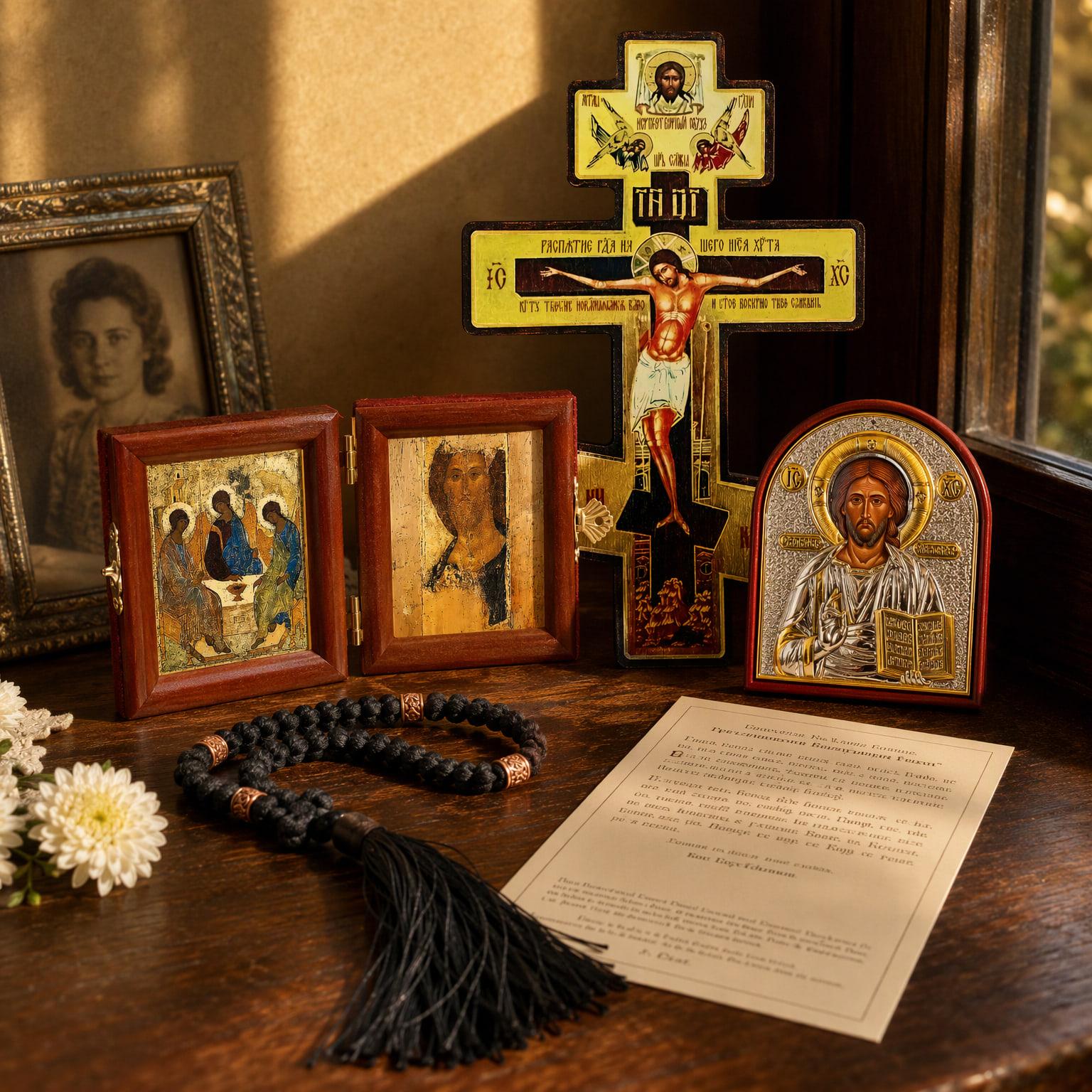
The Memorial Set, $229, holds a folding icon of the Holy Trinity and Christ, a wooden wall crucifix, a Christ Pantocrator icon in silver and gold, a prayer rope and a printed prayer with the names you give us. The printed prayer in the set carries the names you give us. With the Blessing, $278 (normally $377).
- Blessing, $49. Blessed by an Orthodox priest before it ships.
- Gift packaging, $20
Questions
What does memory eternal mean in the Orthodox Church?
The words are the choir’s answer to the deacon’s petition that the Lord give rest eternal to the souls of his servants and make their memory eternal.
Where does the book print it?
At the close of the General Panikhida, on page 569 of Isabel Hapgood’s Service Book.
Who says each part?
The book gives the petition to the deacon and the words memory eternal to the choir.
Can the Memorial Set be blessed before it ships?
Yes. Choose the Blessing on its page and an Orthodox priest blesses it before it ships. With the Blessing, $278 (normally $377).