Name day
Mary: Name Day
Mary keeps the name day on 15 August, or 28 August on the Old Calendar: the feast of the Dormition of the Mother of God.

- New Calendar
- 15 August
- Old Calendar
- 28 August
- Next name day
- 15 August 2027 (New Calendar) · 28 August 2027 (Old Calendar)
- In the feast calendar
- The feasts of August
The feast: the Dormition of the Mother of God
Kept on 15 August, or 28 August on the Old Calendar · Dormition of the Mother of God
The Most Holy Theotokos, the Virgin Mary who gave birth to God the Word in the flesh, is honored by Orthodox Christians “more honorable than the Cherubim and beyond compare more glorious than the Seraphim.” Her icons follow types the Church received from antiquity: the Hodegetria, “She who shows the way,” pointing to her Son as the path of salvation, and the Eleousa, “Tenderness,” in which the Child presses His cheek to His Mother’s. Her great feasts trace her life: her Nativity, her Entry into the Temple, the Annunciation and her Dormition, and the Slavic churches keep the Protection, when she was seen spreading her veil over the faithful at Blachernae. Orthodox Christians end almost every service crying, “Most Holy Theotokos, save us!” They pray to her for their children, their families, healing and comfort, and above all ask her to pray to her Son for their souls.
What the faithful pray for
- her intercession before her Son for the salvation of our souls (‘Most Holy Theotokos, save us’)
- protection under her veil from enemies visible and invisible
- the health and wellbeing of children
- comfort in sorrow and grief
- a good marriage and a peaceful family
- healing of illness
- guidance on the right path (Hodegetria, ‘she who shows the way’)
- a peaceful Christian death
Protection
- from enemies visible and invisible
- the family and the home
- children and mothers
- from despair
- travelers who ask her guidance
Miracles
- In tenth-century Constantinople, during the vigil in the Blachernae church, St Andrew the Fool-for-Christ saw the Theotokos spread her veil over the people, protecting them from enemies visible and invisible; this is the feast of Pokrov. (source)
- The original Hodegetria, said to have been painted by St Luke, was the most venerated icon of Byzantium; the Smolensk Hodegetria in Russia is held by many to descend from it. (source)
Other saints named Mary
the Mother of God
Kept on 8 September, or 21 September on the Old Calendar · Nativity of the Theotokos
The Most Holy Theotokos, the Virgin Mary who gave birth to God the Word in the flesh, is honored by Orthodox Christians “more honorable than the Cherubim and beyond compare more glorious than the Seraphim.” Her icons follow types the Church received from antiquity: the Hodegetria, “She who shows the way,” pointing to her Son as the path of salvation, and the Eleousa, “Tenderness,” in which the Child presses His cheek to His Mother’s. Her great feasts trace her life: her Nativity, her Entry into the Temple, the Annunciation and her Dormition, and the Slavic churches keep the Protection, when she was seen spreading her veil over the faithful at Blachernae. Orthodox Christians end almost every service crying, “Most Holy Theotokos, save us!” They pray to her for their children, their families, healing and comfort, and above all ask her to pray to her Son for their souls.
What the faithful pray for
- her intercession before her Son for the salvation of our souls (‘Most Holy Theotokos, save us’)
- protection under her veil from enemies visible and invisible
- the health and wellbeing of children
- comfort in sorrow and grief
- a good marriage and a peaceful family
- healing of illness
- guidance on the right path (Hodegetria, ‘she who shows the way’)
- a peaceful Christian death
Protection
- from enemies visible and invisible
- the family and the home
- children and mothers
- from despair
- travelers who ask her guidance
Miracles
- In tenth-century Constantinople, during the vigil in the Blachernae church, St Andrew the Fool-for-Christ saw the Theotokos spread her veil over the people, protecting them from enemies visible and invisible; this is the feast of Pokrov. (source)
- The original Hodegetria, said to have been painted by St Luke, was the most venerated icon of Byzantium; the Smolensk Hodegetria in Russia is held by many to descend from it. (source)
the Royal Passion-Bearers
Kept on 17 July · Martyrdom at Yekaterinburg (1918)
The last Tsar of Russia, Nicholas, his wife Alexandra and their five children, Olga, Tatiana, Maria, Anastasia and Alexei, lived as one household of the Church of Christ, bound together by love. The Church’s hymns praise how they built their home on love, kept their marriage honorable, and raised their daughters as wise virgins for Christ. Their son Alexei bore a grave illness from infancy as a cross from the Lord, without complaint. During the war the Empress and her elder daughters served the wounded as sisters of mercy. After the Tsar’s abdication in 1917 the family was held in captivity. They bore humiliation with Christian meekness, prayed together, and forgave their persecutors. In the night of 16-17 July 1918 they were killed together at Yekaterinburg. The Russian Church Abroad glorified them in 1981, and the Moscow Patriarchate glorified them in 2000 as passion-bearers, those who imitate Christ by meekly accepting suffering and death.
What the faithful pray for
- love and unity in the family
- a faithful and honorable marriage
- raising children in the faith
- healing of sick children
- comfort for parents grieving over children in sickness or sin
- patience and meekness in suffering
- forgiveness of enemies
- the spiritual welfare of Russia and her people
Protection
- the family hearth
- children from sickness and the passions of this age
- the persecuted
- Orthodox families from division
Miracles
- Tsarevich Alexei was born, after long prayer, as ‘the fruit of the prayers of the Wonderworker of Sarov’, the longed-for heir of his royal parents. (source)
- Collections of testimonies record many healings and answered prayers through the intercession of the Royal Passion-bearers since their glorification. (source)
St Mary Magdalene
Kept on 22 July, or 4 August on the Old Calendar · Holy Myrrh-bearer Mary Magdalene
St Mary Magdalene came from Magdala, a town on the shore of the Sea of Galilee. The Gospel tells that the Lord drove seven demons out of her, and from that day she began a new life as His faithful disciple. With Joanna, Susanna and other women she followed Christ through Galilee and Judea and served Him from her own means. When the other disciples fled, she stood at the Cross with the Mother of God and the Apostle John, and she watched as His body was laid in the tomb. At dawn on the first day of the week she came with myrrh and found the stone rolled away. Weeping by the tomb, she saw the risen Lord, who called her by name, and she ran to tell the apostles, “I have seen the Lord!” This was the first proclamation of the Resurrection, and so the Church calls her Equal to the Apostles. Tradition says she later preached in Rome and brought a red egg to the Emperor Tiberius as a sign of new life, from which comes the Paschal custom of red eggs. In old age she went to Ephesus, where the Apostle John laboured, and there she reposed. The Church keeps her memory on 22 July (4 August on the Old Calendar). The faithful turn to her for her love of Christ, her loyalty in suffering and her joy in the Resurrection.
What the faithful pray for
- deliverance from the power of sin and evil
- those who mourn and seek Christ in their grief
- faithfulness to Christ in hard times
- courage to share the joy of the Resurrection
- women who serve the Church
Mary in other languages
| Language | The name | Short forms |
|---|---|---|
| English | Mary, Maria, Marie, Mariam, Miriam, Maryam, Marion, Mariah, Maura, Marya, Moira, Maire, Mariya, Mare, Mia | Molly, Polly, Mae, May, Mamie, Minnie, Mimi, Masha, Marika, Maureen |
| Greek | Μαρία, Maria | Μαρίκα, Μαίρη, Μαρίτσα, Μαρούλα, Μάρω, Μαριγώ, Marika, Mairi, Maritsa, Maroula, Maro |
| Russian | Мария, Марья, Mariya, Maria, Marya | Маша, Машенька, Маруся, Маня, Муся, Masha, Mashenka, Marusya, Manya, Musya |
| Ukrainian | Марія, Mariia, Mariya | Марійка, Маруся, Mariyka, Marusia |
| Belarusian | Марыя, Maryia | |
| Bulgarian | Мария, Mariya | Мими |
| Serbian | Марија, Marija | Мара, Mara, Marica |
| Romanian | Maria | Mărioara, Mia |
| Georgian | მარიამ, Mariam, Maiko | |
| Arabic | مريم, Mariam, Maryam, Mariamne | |
| Spanish | María | |
| Italian | Maria | |
| Polish | Maria | Marysia |
| Irish | Máire |
Icons of the Dormition of the Mother of God
 Folding diptych
Christ (Zvenigorod Saviour) & Vladimir Mother of God
$99$69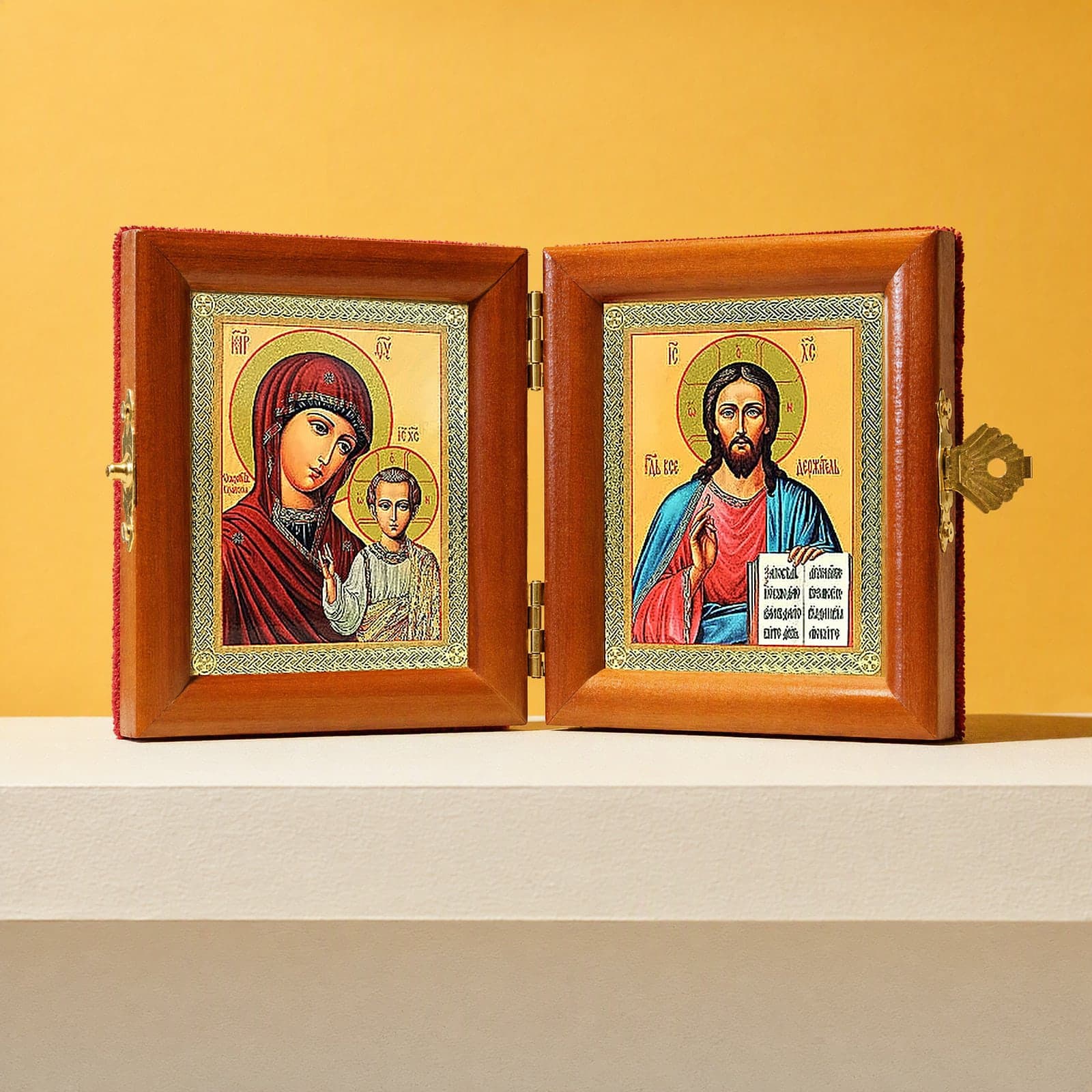 Folding diptych
Christ Pantocrator & Our Lady of Kazan
$99$69 Folding diptych
Royal Passion-Bearers (Romanov family) & Feodorovskaya Mother of God
$99$69 Folding diptych
Royal Passion-Bearers (Romanov family) & Guardian Angel
$99$69 Folding diptych
Sts Nicholas II & Alexandra (Royal Passion-Bearers)
$99$69 Icon
IconOrthodox Virgin Mary Holding Jesus
Gold Color · Icon$41$29 Icon
IconOrthodox Virgin Mary and Child Jesus
Silver&Gold Color · Icon$41$29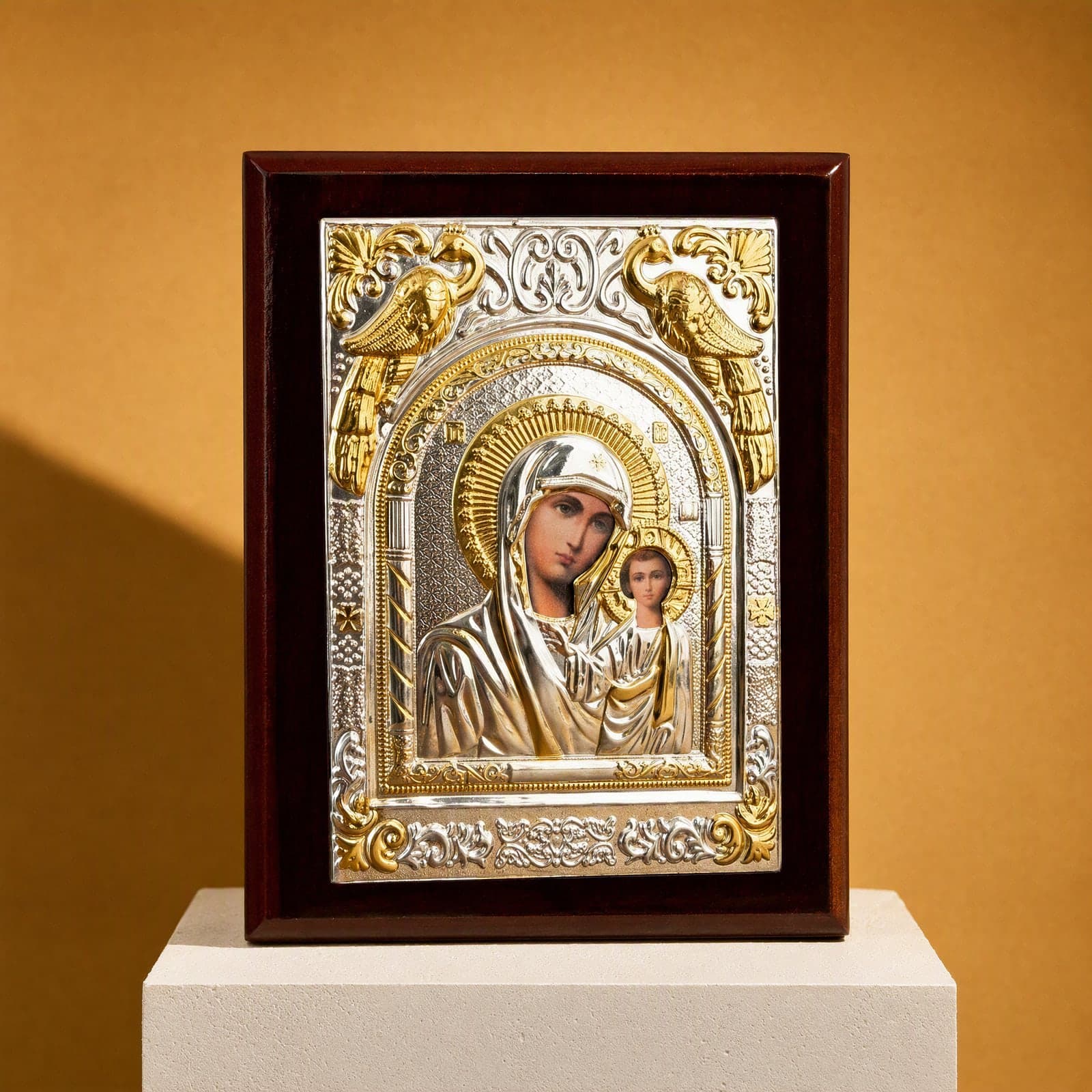 Icon
IconOrthodox Virgin Mary (Our Lady of Kazan, Rectangular)
Silver&Gold Color · Wooden Icon$41$29
Have it consecrated by our priest before it reaches you: Consecration, $49.
A name-day gift for Mary
Name-Day Gift Set $213$149
A patron saint's folding diptych chosen by first name, a stainless steel crucifix and a prayer rope, in a gift box with a card giving the saint's life and feast day.
the Dormition of the Mother of God's diptych is chosen and the name is filled in.
Other names with this saint
Questions
When is Mary’s name day?
Mary keeps the name day on 15 August on the New Calendar and on 28 August on the Old Calendar, the feast of the Dormition of the Mother of God.
Which feast is Mary’s name day?
the Dormition of the Mother of God. The Most Holy Theotokos, the Virgin Mary who gave birth to God the Word in the flesh, is honored by Orthodox Christians “more honorable than the Cherubim and beyond compare more glorious than the Seraphim.” Her icons follow types the Church received from antiquity: the Hodegetria, “She who shows the way,” pointing to her Son as the path of salvation, and the Eleousa, “Tenderness,” in which the Child presses His cheek to His Mother’s.
How is Mary written in other languages?
Greek: Μαρία (Maria), Russian: Мария (Mariya), Ukrainian: Марія (Mariia), Belarusian: Марыя (Maryia), Bulgarian: Мария (Mariya) and Serbian: Марија (Marija). Every form of the name keeps the same saint.
What is a good name-day gift for Mary?
An icon of the Dormition of the Mother of God, the saint Mary bears: the Christ (Zvenigorod Saviour) & Vladimir Mother of God Folding Diptych ($69), or the Name-Day Gift Set ($149) with that diptych, a crucifix and a prayer rope in a gift box.
More about name days
- Name Days Explained: What They Are, How Families Keep Them, and Gifts
A name day is the feast of the saint whose name you carry. Here is how to find yours on either calendar, how Greek and Russian families keep it, and what to give.
- Orthodox Patron Saint: How to Find Yours (by Name, Day or Choice)
Your Orthodox patron saint is the saint whose name you were given at baptism. Here is how to find yours by name, by the day of your birth or baptism, or by choice, and how to keep the name day.
- Find another name
Sources
- OCA: The Protection of Our Most Holy Lady the Mother of God
- Азбука веры: Богородица
- Акафист святым царственным страстотерпцам (Азбука веры)
- Акафист святому страстотерпцу царевичу Алексию (Азбука веры)
- OCA Lives of the Saints, 17 July
- OCA: Lives of all saints commemorated on July 22 (Myrrh-bearer and Equal of the Apostles Mary Magdalene)
- Holy Trinity Orthodox Mission: Saint Mary Magdalene, Myrrh-bearer and Equal of the Apostles
- eortologio.net, Greek name-day calendar (Εορτολόγιο)
- azbyka.ru, Месяцеслов (the Russian Church's calendar of saints by name)