
Name Days Explained: What They Are, How Families Keep Them, and Gifts
Updated 15 October 2026
A name day is the feast of the saint whose name you were given at baptism. That is the whole name day meaning in one line: once a year the Church remembers your saint, and you celebrate with them. In many Orthodox homes it matters as much as a birthday, sometimes more, because it marks the day you were joined to a saint for life.
What does a name day mean in the Orthodox Church?
Every Orthodox Christian is baptized (or chrismated) with the name of a saint. That saint becomes your heavenly patron, the one you ask to pray for you and the one whose life you try to learn from. The day the Church keeps that saint’s memory is your name day.
Different peoples have different words for it:
- Greek: giortí (feast) or onomastíria (name day).
- Russian: imeniny, the name day, often called den angela, “angel’s day.” Strictly, Azbuka Very notes that “angel’s day” properly means the day of your baptism, but in everyday speech the two are used for the same feast.
- English: the OCA calls it your “Name Day” or “Patronal Feast Day.”
A Serbian slava is a different custom
If you have Serbian friends, you may know the krsna slava. It is not a personal name day. A slava is the feast of the whole family’s patron saint, kept for generations and passed down through the male line, in memory of the saint on whose day the first ancestor was baptized. The table holds the slava bread, the saint’s icon, a candle, red wine and zito (boiled wheat). For most Serbs the slava takes the place of a personal name day.
What is my name day? How to find yours
Start with the simplest question: which saint were you baptized for? Your baptismal certificate may say. If not, ask your parents, your godparents or the priest who baptized you.
If you know only your name and several saints share it, here is what the tradition offers:
- The Russian custom: the nearest feast after your birthday. Azbuka Very, the Russian Orthodox encyclopedia, says to find the saint of your name whose memory falls first after your birthday. That saint’s feast is your name day. The feasts of other saints with your name become your “small name days.”
- The Greek custom for names without a saint. In Greek parishes, if your name matches no saint, your name day is usually kept on the Sunday of All Saints, the Sunday after Pentecost.
- Converts. If you chose your saint at Chrismation, that saint’s feast is your name day.
Our name finder can help: find a patron saint by first name. For a longer walk through the choices, read how to find your patron saint.
The Orthodox name day calendar: two dates for one feast
Some Orthodox churches keep the New Calendar and some keep the Old (Julian) Calendar, so many feasts fall on two civil dates, thirteen days apart. Your saint is the same either way; your parish’s calendar decides the day. Common examples:
| Name | Saint or feast | New Calendar | Old Calendar |
|---|---|---|---|
| Nicholas, Nikolai, Nikos | St Nicholas | 6 December | 19 December |
| Peter, Paul | Holy Apostles Peter and Paul | 29 June | 12 July |
| George, Georgios, Yuri | St George | 23 April | 6 May |
| Maria, Despina, Panagiota | Dormition of the Theotokos | 15 August | 28 August |
| Maria (in some families) | Nativity of the Theotokos | 8 September | 21 September |
A note on Maria: in Greece, Maria, Despoina and Panagiota celebrate on the Dormition, 15 August (28 August on the Old Calendar). Other families keep a different feast of the Mother of God, or the feast of another holy woman named Mary, depending on whom the child was baptized for. When in doubt, ask your priest.
The Old and New Calendar guide explains why there are two dates.
How families keep a name day
In church
The heart of the day is the Divine Liturgy. Azbuka Very says the faithful go to church on their name day and, having prepared, go to confession and receive Communion. In the old Russian custom, the person also asked the priest to serve a molieben (moleben), a short prayer service, for their health. If your parish has no Liturgy that day, go to the nearest service you can, or to Sunday Liturgy.
If you live far from a parish, our priest reads your names at the Divine Liturgy and can serve a moleben to your saint.
At home
- The icon. Put the icon of your saint in a place of honor, often in the icon corner, with flowers and a lit candle.
- The troparion. Sing or read your saint’s troparion and kontakion at family prayer. Every saint has one; your parish or the OCA website will have it.
- The life. Read your saint’s life aloud together.
- The meal. A family dinner, the celebrant’s favorite dish, and very often a cake with candles. If the day falls in a fast, keep the meal meatless.
- Godparents. Invite them, or call them. They stood with you at your baptism.
The Greek open house
In Greece the name day is famously open. Friends, neighbors and relatives stop by without an invitation to wish the celebrant Chronia polla. The host sets out sweets and drinks, and guests bring a small gift: flowers, chocolates, a bottle of wine, a book. On big feasts like St Nicholas or the Dormition, half the street seems to be celebrating.
Greetings: how to say happy name day
- Greek happy name day: Χρόνια πολλά (Chronia polla), “many years.”
- Russian: С днём ангела (S dnyom angela), “on your angel’s day.” The family may sing Многая лета (Mnogaya leta), “Many years.”
- English: “Happy name day,” or “God grant you many years.”
Name day gifts
The gift that fits a saint name day best is the saint. An icon of the person’s own patron lasts long after the cake is gone, and it goes straight into their prayer corner.
- Name-Day Gift Set, $149. A patron saint’s folding diptych chosen by first name, a stainless steel crucifix and a prayer rope, with a card giving the saint’s life and feast day.
- Patron Saint & Cross, $99. The patron saint and Guardian Angel diptych with a three-bar crucifix and the saint’s card, in a gift box.
- St Nicholas Gift, $99. For every Nicholas, Nikolai and Nikos on 6 December (19 December on the Old Calendar).
- A saint diptych on its own, $69. For example St Nicholas, St Herman of Alaska or St Patrick.
- Printed Prayer Card with Your Names, $24. A printed prayer card with the names you give us.
- A name read at the Liturgy. Through prayer services, our priest reads the names you send at the Divine Liturgy.
For more ideas by age and budget, see name day gifts.
The best gift of all is the one the tradition asks for: go to church, pray to your saint, and keep the day with the people you love.
From our shop
 Gift set
Name-Day Gift Set
$213$149 Gift set
Patron Saint & Cross
$142$99 Gift set
St Nicholas Gift
$142$99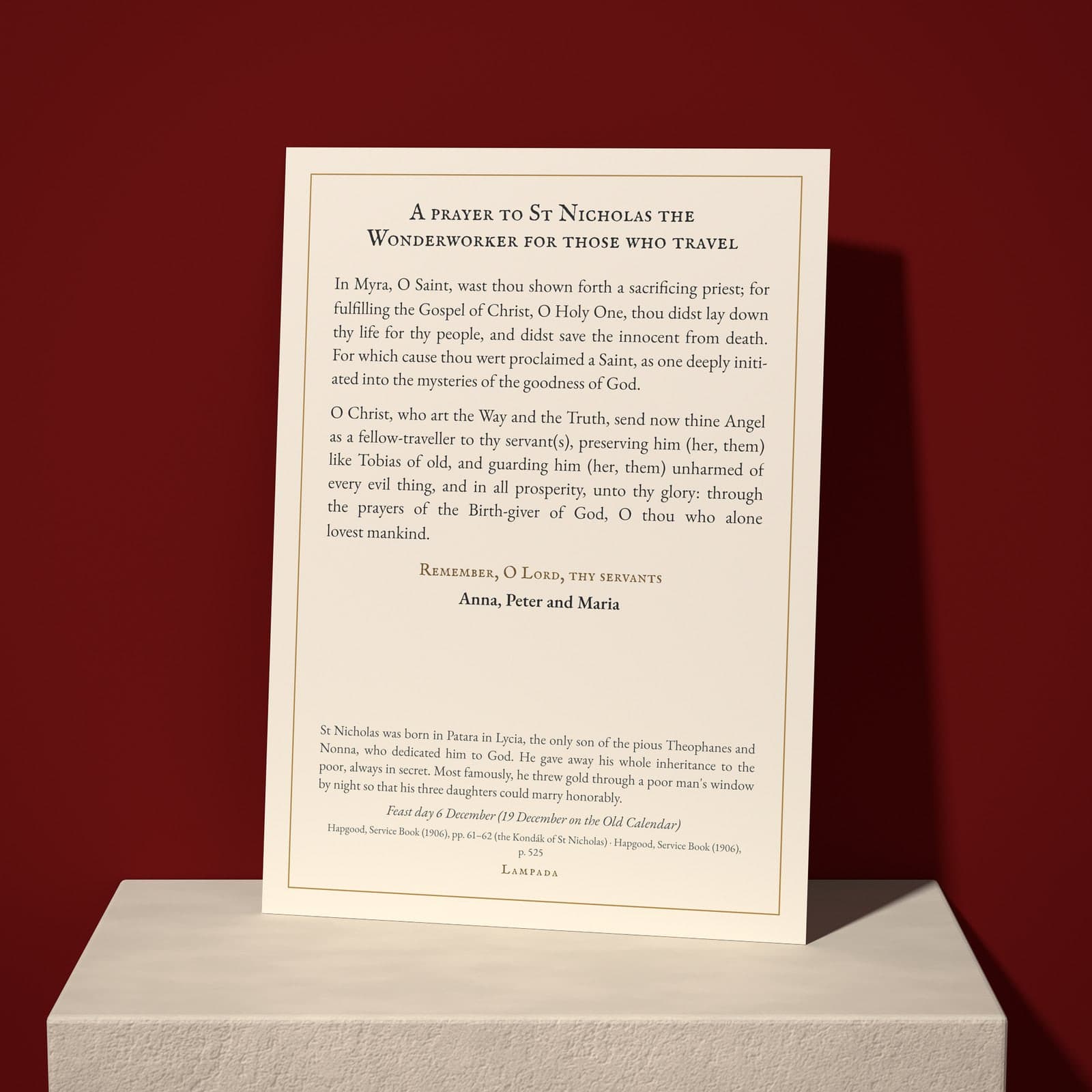
Printed Prayer Card with Your Names
$24 Folding diptych
St Nicholas the Wonderworker & Guardian Angel
$99$69 Folding diptych
St Herman of Alaska & Guardian Angel
$99$69 Folding diptych
St Patrick of Ireland & Guardian Angel
$99$69
Have it consecrated by our priest before it reaches you: Consecration, $49.
The saints in this guide
Questions
What is my name day if I share a name with several saints?
Your name day is the feast of the saint you were baptized for, so ask your parents, godparents or the priest who baptized you. If no one knows, the Russian custom is to take the saint of your name whose feast comes first after your birthday. The other feasts of saints with your name become your small name days.
What if my name has no saint?
In Greek parishes, a person whose name matches no saint usually keeps the name day on the Sunday of All Saints, the Sunday after Pentecost. Many converts and adults simply take a saint at Chrismation, and that saint’s feast becomes the name day.
How do you say happy name day in Greek and Russian?
In Greek you say Χρόνια πολλά (Chronia polla), “many years.” In Russian you say С днём ангела (S dnyom angela), “on your angel’s day,” and the family may sing Многая лета, “Many years.”
Is a name day the same as a Serbian slava?
No. A name day belongs to one person and their saint. A slava is the feast of a family’s patron saint, handed down through the father’s line. For most Serbs the slava takes the place of a personal name day.
What are good name day gifts?
The classic gift is an icon of the person’s own saint, often with a cross or a prayer rope. Small gifts are welcome too: flowers, sweets, a book about the saint. Some families also ask the parish priest to commemorate the person at the Liturgy.
Read next
- Orthodox Patron Saint: How to Find Yours (by Name, Day or Choice)
Your Orthodox patron saint is the saint whose name you were given at baptism. Here is how to find yours by name, by the day of your birth or baptism, or by choice, and how to keep the name day.
- Old Calendar and New Calendar: Why Orthodox Feasts Have Two Dates
Why some Orthodox keep Christmas on 25 December and others on 7 January, which churches follow which calendar, why Pascha falls on one day for nearly everyone, and how to read a calendar with two dates.
- Name Day Gifts: What to Give on an Orthodox Name Day
What to give on an Orthodox name day: the patron saint’s icon first, then a cross, a prayer rope or a printed prayer, with common names, their saints and both calendar dates.
- How to Set Up an Orthodox Icon Corner (Prayer Corner) at Home
A step-by-step guide to the Orthodox icon corner, the ‘beautiful corner’ of the home: where it goes, which icons come first, what belongs beside them and how a family prays there.
Sources
- Azbuka Very: Imeniny and Christian names by the church calendar
- Azbuka Very: Angel Day and name day
- OCA Questions and Answers: Angel Day
- St. Nicholas Center: Name Day Celebration
- St John the Evangelist Orthodox Church: Celebrating Name Days As An Orthodox Family
- Victorian Council of Churches (from St John the Forerunner Greek Orthodox Church, Carlton): All Saints Day
- OrthoChristian: Krsna Slava, the Cornerstone of the Serbian People (quoting Patriarch Pavle of Serbia)
- GTP Headlines: August 15, a Greece-wide spiritual salute to the Holy Mother