
Giving an Icon as an Orthodox Gift: Which Icon for Whom
Updated 15 October 2026
An icon is the traditional Orthodox gift because it is made for prayer: it brings Christ, the Mother of God or a saint into someone’s home and daily life. Choose by the person and the occasion. Give a patron saint for a name day or baptism, the pair of Christ and the Mother of God for a wedding or new home, St Nicholas for a traveler, and a warrior saint for someone who serves. Then give it ready for prayer, consecrated, with a card that tells the saint’s story.
Why an icon is the classic Orthodox gift
A sweater wears out. An icon stays in the corner of a home for decades and is prayed before every day. That is the point of it.
The Church settled why icons are honored at the Seventh Ecumenical Council, in Nicaea in 787. Its decree says that “the honour which is paid to the image passes on to that which the image represents.” When your goddaughter kisses her icon of St Anna, the honor goes to St Anna, and through her to God.
The same council wanted icons not only in churches but “in pictures both in houses and by the wayside,” with lights and incense offered “according to ancient pious custom.” An icon you give becomes part of that: the family’s own small church.
Which icon for whom
For a name day: their patron saint
The most personal Orthodox gift is the icon of the saint whose name they bear. If you don’t know the saint, enter their first name in our patron saint finder. Most of our folding diptychs pair a saint with the Guardian Angel, $69 each. The Name-Day Gift Set ($149) adds a crucifix and a prayer rope, with a card giving the saint’s life and feast day. More ideas are in our name day gift guide.
For a baptism: the patron saint and the Guardian Angel
Godparents have long given three things at a baptism: the cross, the baptismal garment, and the icon of the saint whose name the child receives. The Church teaches that God appoints a Guardian Angel to each person at Baptism, “to guard them from evil and help them in good deeds,” as Azbyka.ru puts it. So a saint-and-Angel diptych suits a baptism perfectly. The Patron Saint & Cross ($99) holds both, with a three-bar crucifix and the saint’s card. See our baptism gift guide.
For a wedding: Christ and the Mother of God
In the Russian custom, the parents of both bride and groom give the couple a pair of icons before the wedding, sending them into marriage: the groom receives the icon of Christ the Saviour, the bride the icon of the Mother of God. The Mother of God is often the Kazan icon, though any image of her may be chosen. Father Afanasy Gumerov notes that these icons are then set in the family’s icon corner and often pass down through several generations.
If you are a friend rather than a parent, an icon is still a fine wedding gift when the couple prays. The Zvenigorod Saviour & Vladimir Mother of God diptych ($69) is a lovely choice. For Greek Orthodox gifts and other customs, see our Orthodox wedding gifts guide.
For a new home: Christ, the Mother of God, the Holy Trinity
The council’s decree names first “the figure of our Lord God and Saviour Jesus Christ” and “of our spotless Lady, the Mother of God”, so begin a new home with them. A folding icon of Christ and the Virgin Mary or the Jesus Christ and Virgin Mary folding icon costs $39. The Holy Trinity (Rublev) & Christ diptych ($69) shows the three angels at Abraham’s table: a picture of hospitality for a house that will welcome guests.
For a traveler or driver: St Nicholas
The OCA’s life of St Nicholas calls him “the patron of travelers,” and Russian churches honor him as a protector of all those journeying on land and sea. His feast is 6 December, or 19 December on the Old Calendar. A travel icon is a folding one, so it closes like a book in a bag and opens in a hotel room. Give the St Nicholas & Guardian Angel diptych ($69), the St Nicholas Gift ($99) with an IC XC NIKA medallion, or the Travel Set ($99): a diptych of Christ and the Mother of God, a 10 cm wooden cross for the car and a prayer rope. More saints are on saints for travelers.
For a soldier or first responder: St Michael, St John the Warrior, St George
St John the Warrior served in the Roman army, and the OCA says that in the Russian Church he “is revered as the protector of soldiers.” His feast is 30 July, or 12 August on the Old Calendar; give the St John the Warrior & Guardian Angel diptych ($69). The Archangel Michael, whom the Church calls the Chief Commander of the heavenly hosts, is honored on 8 November, or 21 November on the Old Calendar. St George was an officer in the imperial guard before his martyrdom; his feast is 23 April, or 6 May on the Old Calendar. See saints for the military and the protector gifts.
For someone who is ill: St Panteleimon
St Panteleimon was a physician who treated all who came to him without charge, “healing them in the name of Jesus Christ.” The Church invokes him in the Anointing of the Sick. His feast is 27 July, or 9 August on the Old Calendar. Read his life on St Panteleimon’s page.
For someone who is grieving
An icon can comfort, but sometimes prayer is the better gift. You can have the departed remembered by name at the Divine Liturgy through our prayers for the departed.
For a Catholic or Protestant friend
Catholics share our veneration of icons. Their Catechism cites the same council and says that “the honor rendered to an image passes to its prototype.” For a Protestant friend, an icon of Christ is the most natural Christian gift, and St Nicholas is loved in nearly every church. Pick one they will pray with, not just hang.
Is it all right to give an icon?
Yes. Some people have heard that icons should not be bought, or that you may only receive an icon from a parent or godparent. Asked this in Foma, Archpriest Andrei Efanov answered that there is no ban on giving icons, nor on receiving them as a gift. He called the parents-only idea a family tradition or a personal conviction. His one piece of advice is to give an icon when you know it will be prayed before.
How to give it
Give it consecrated. With Consecration ($49), our Orthodox priest consecrates the icon with holy water and the prayers of the Church. The recipient receives it with a signed certificate and a vial of holy water. Where a diptych’s page offers it, our folding diptychs are consecrated one by one before they leave the workshop, each filmed with its number on a card. If you add the personal video, you can forward it with the gift. Consecrated items are final sale. Read what Consecration is.
Give it on their day. The best days are the name day, the day of baptism, the wedding, or Christmas. St Nicholas Day falls on 6 December, or 19 December on the Old Calendar.
Tell them who the saint is. Our gift sets include a card with the saint’s life and feast day. Write a line inside your card about why you chose this saint for them.
Show them how to keep it. A short note on where to place it and how to care for it helps a new believer. Our guide on caring for an icon covers light, dust and the lampada.
Ordering in time for Christmas
An icon is a good religious gift for Christmas. For Christmas on 25 December, order by 15 December. For a cross, icon or medallion with Consecration, order by 10 December. For Christmas on 7 January, order by 24 December. A consecrated diptych, where a diptych’s page offers it, ships in the normal time. We ship to all 50 states, DC and APO/FPO addresses, with free shipping on orders of $99 or more. Browse all our Orthodox gift sets.
From our shop
 Folding diptych
St Nicholas the Wonderworker & Guardian Angel
$99$69 Folding diptych
St John the Warrior & Guardian Angel
$99$69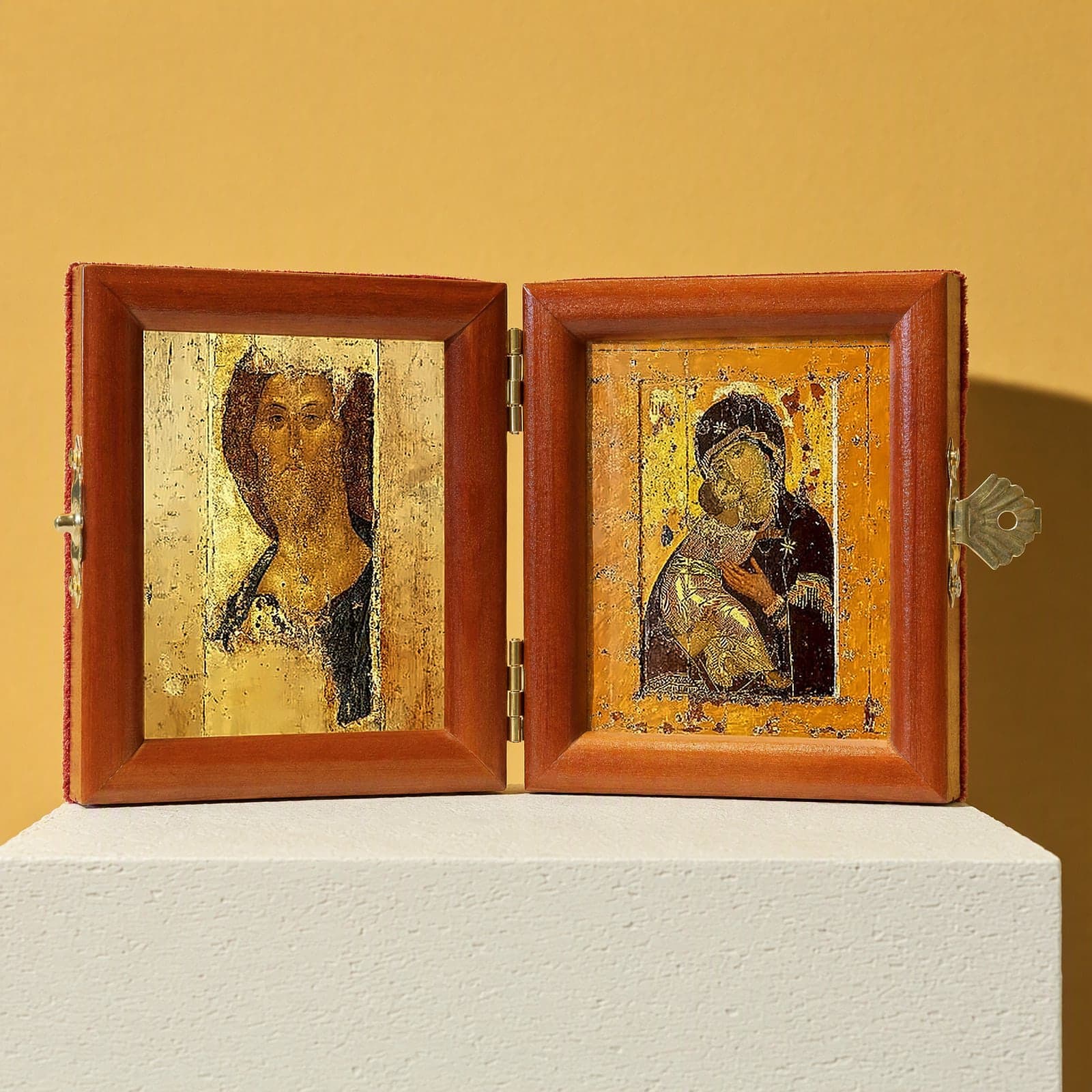 Folding diptych
Christ (Zvenigorod Saviour) & Vladimir Mother of God
$99$69 Folding diptych
Holy Trinity (Rublev) & Christ (Zvenigorod Saviour)
$99$69 Gift set
Name-Day Gift Set
$213$149 Gift set
St Nicholas Gift
$142$99 Gift set
Travel Set
$142$99 Gift set
Patron Saint & Cross
$142$99
Have it consecrated by our priest before it reaches you: Consecration, $49.
The saints in this guide
Questions
Is it all right to give someone an icon, or should icons only be received?
It is all right. Asked whether icons may be given, Archpriest Andrei Efanov answered in Foma that there is no ban on giving icons or on receiving them as a gift. The idea that only a parent or godparent may give one is a family custom, not the Church’s rule.
Which icon should I give if I don’t know the person’s patron saint?
Look up their first name with our patron saint finder; it suggests a saint for nearly every name. If you are still unsure, an icon of Christ and the Mother of God suits every Orthodox home, and St Nicholas is loved by almost everyone.
Can I give an Orthodox icon to a Catholic or Protestant friend?
Yes. The Catholic Church accepts the Seventh Ecumenical Council and teaches that the honor given to an image passes to its prototype. For a Protestant friend, an icon of Christ is the most natural choice. Give it as a gift for prayer, not as decoration.
Does the icon need to be consecrated before I give it?
It is a good thing to give it consecrated, so it comes ready for prayer. With our Consecration ($49), our priest consecrates the icon and the recipient receives a signed certificate and a vial of holy water with it. Consecrated items are final sale.
When should I order an icon for Christmas?
Order by 15 December for Christmas on 25 December, or by 10 December for a cross, icon or medallion with Consecration. For Christmas on 7 January, order by 24 December.
Read next
- What Is Consecration? Why the Church Consecrates Icons and Crosses
What it means for a priest to consecrate an icon or a cross: the teaching of the Seventh Ecumenical Council, the rite in the Book of Needs, how to treat a consecrated item, and how Lampada’s Consecration works.
- How to Care for an Orthodox Icon: Cleaning, Light and the Lampada
How to clean each kind of Orthodox icon, where to keep it, how to tend a vigil lamp safely, and what the Church does with an old or damaged icon.
- Name Days Explained: What They Are, How Families Keep Them, and Gifts
A name day is the feast of the saint whose name you carry. Here is how to find yours on either calendar, how Greek and Russian families keep it, and what to give.
- Orthodox Patron Saint: How to Find Yours (by Name, Day or Choice)
Your Orthodox patron saint is the saint whose name you were given at baptism. Here is how to find yours by name, by the day of your birth or baptism, or by choice, and how to keep the name day.
- Orthodox Wedding Gifts: The Wedding Icons, Crosses and More
What to give an Orthodox couple: the pair of wedding icons of Christ and the Mother of God, crosses, and the start of their icon corner, with the crowning, the common cup and the stefana explained.
- Orthodox Baptism Gifts: The Cross, the Icon and the Customs
What Orthodox families give at a baptism, who usually gives it, and what each gift means: the cross, the patron saint and Guardian Angel icon, the candle and the white garment.
Sources
- Second Council of Nicaea (787), Decree (NPNF, New Advent)
- Catechism of the Catholic Church, 2129–2132: You shall not make for yourself a graven image
- Foma: Можно ли подарить икону? (Archpriest Andrei Efanov)
- Pravoslavie.ru: Priest Afanasy Gumerov on the parents' wedding icons
- Foma: Какие иконы пишут на венчание?
- Foma: Какую икону подарить на свадьбу?
- Azbyka.ru: Что подарить крестнику
- Azbyka.ru: Ангел-Хранитель
- OCA: St Nicholas the Wonderworker, Archbishop of Myra in Lycia
- OCA: Martyr John the Soldier at Constantinople
- OCA: Synaxis of the Archangel Michael and the Other Bodiless Powers
- OCA: Greatmartyr, Victory-bearer and Wonderworker George
- OCA: Greatmartyr and Healer Panteleimon