Psalm 41, which the Church numbers 40
Psalm 41 is Psalm 40 in the Septuagint. The Hebrew numbering, which the King James Bible follows, calls this psalm 41; the Septuagint, the Greek Old Testament that the Orthodox Church reads, calls it 40. The psalm is the same under both numbers. The King James text has 13 verses and Brenton’s Septuagint text has 14; the two count the verses differently. The King James text opens with a title line.
The text. This page does not print the verses of this psalm. They are in the King James Bible under Psalm 41 and in a Septuagint under Psalm 40.
What the psalm says. This page does not print the verses, but the psalm can be told from them. It opens with a blessing on the one who considers the poor, and says that the Lord will deliver him in the time of trouble, preserve him, keep him alive and not give him up to the will of his enemies. The middle verses are a prayer of mercy by one who has sinned against the Lord, and an account of enemies who speak evil of him and ask when he shall die and his name perish. Some come to see him and speak vanity; they whisper together against him. The saddest verse is about a familiar friend in whom he trusted, who ate his bread and has lifted up his heel against him. The one who prays asks the Lord to raise him up, knows that he is favoured because his enemy does not triumph over him, and says that the Lord upholds him in his integrity and sets him before his face for ever. The last verse is a blessing: blessed be the Lord God of Israel from everlasting and to everlasting, Amen and Amen. A reader who wants the words will find them in any Bible at Psalm forty-one, or in a Septuagint under the number the page gives.
The psalm can be read in four parts. The first is a blessing on the one who considers the poor, with the account of what the Lord will do for him. The second is the prayer, which begins with the words, I said, Lord, be merciful to me, and goes on to ask for mercy for his soul. The third is the account of the enemies, who ask when he will die and whose visitors speak falsehood while their hearts gather mischief and they tell it abroad when they go out. The fourth is the answer: the Lord has upheld him in his integrity, and his enemy has not triumphed over him. Between the third and the fourth stands the verse about the friend who ate his bread and lifted up his heel, which is the point where the psalm is at its most personal.
The psalm is also a psalm of reversals. The one who is called blessed in the first verse for considering the poor is, by the end, the one who is himself upheld in his integrity and set before the face of the Lord. The enemies who ask when he will die and his name perish are told, in the same breath, that they do not triumph; and the friend who lifted his heel is answered by a Lord who sets him in his presence for ever.
The reading it belongs to. Orthodox Christians speak of the Psalter in twenty kathismata, and Psalm 41 is in the sixth of them, kathisma 6.
No service named. In Isabel F. Hapgood’s Service Book of the Holy Orthodox-Catholic Apostolic Church we did not find this psalm printed under a Psalm heading, and so the page says nothing about where it is sung.
One Psalter, two numberings
The Church’s Psalter follows the Septuagint, and its numbering is not always the Hebrew numbering of English Bibles. That is why this page gives two numbers, and the kathisma, 6, the reading that holds the psalm.
Prayer from the Psalter, for an Orthodox Christian, is prayer in the Church’s order: twenty kathismata, taken in turn, with the psalms also sung in the services.
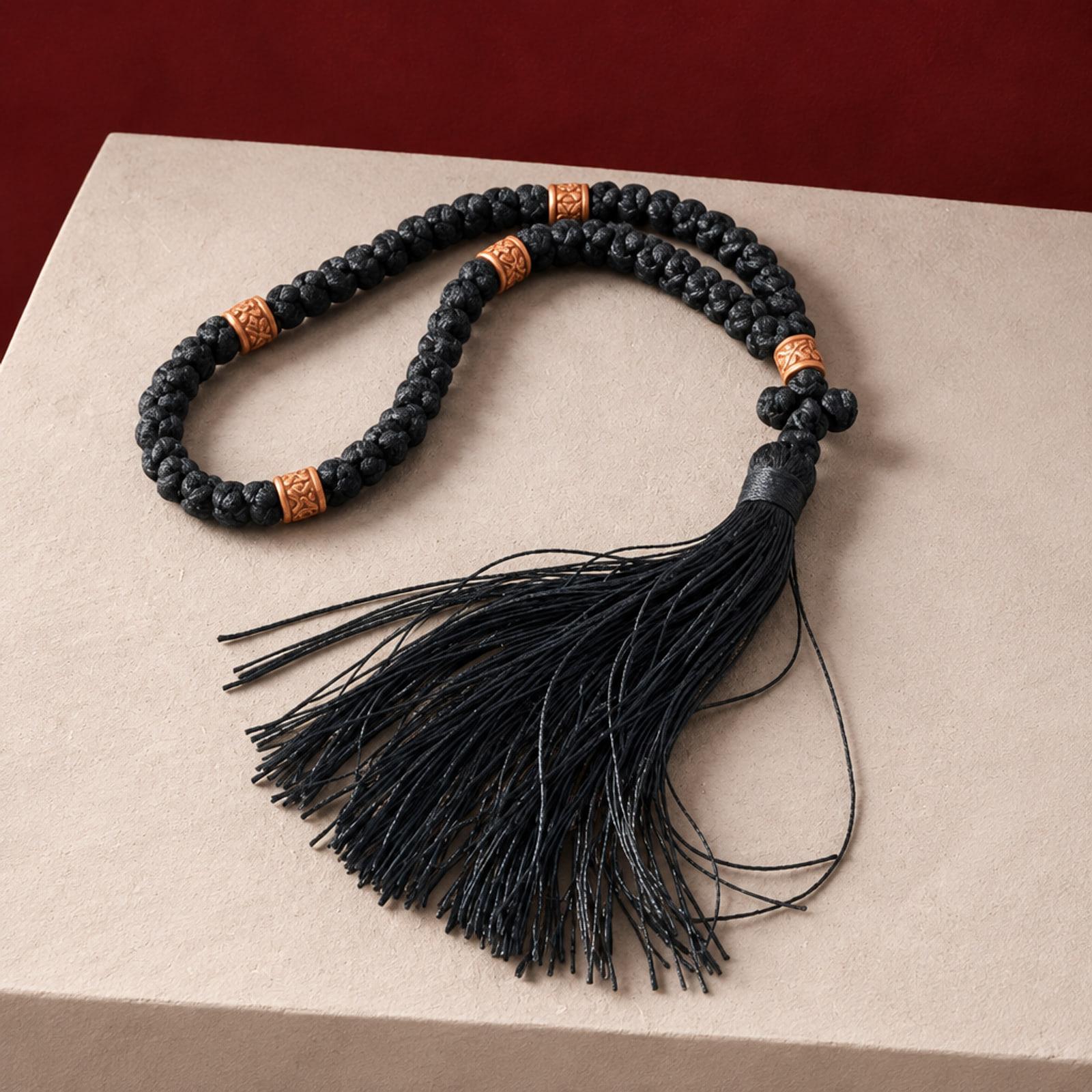
A prayer rope for the psalms
For prayer at home or on the road: a black wool prayer rope with dividing beads and a tassel, $34. Choose the Blessing on its page and an Orthodox priest blesses it before it ships. With the Blessing, $83 (normally $98).
- Blessing, $49. Blessed by an Orthodox priest before it ships.
- Gift packaging, $20
Questions
What is Psalm 41 in the Septuagint?
It is Psalm 40. The King James Bible numbers it 41; the Septuagint, which the Orthodox Church reads, numbers it 40. The psalm is the same.
How many verses does Psalm 41 have?
The King James text has 13 and Brenton’s Septuagint text has 14, because the two count the verses differently.
Which kathisma is Psalm 41 in?
It is in the sixth, kathisma 6. The Church divides the Psalter into twenty kathismata and reads them in order.
Is Psalm 41 printed in the service book?
We did not find it under a Psalm heading in Isabel F. Hapgood’s service book, so this page names no service for it.
Can the prayer rope be blessed before it ships?
Yes. Choose the Blessing on its page and an Orthodox priest blesses it before it ships. With the Blessing, $83 (normally $98).