
What Is Blessing? Why the Church Blesses Icons and Crosses
Updated 15 October 2026
Blessing is the Church’s prayer over a new icon or cross. A priest reads the prayers appointed in the Book of Needs, in the name of the Father, and of the Son, and of the Holy Spirit. A blessed cross or icon looks the same as before, but from that moment it is set apart for prayer and treated as a holy thing. Below you’ll find why the Church does this, what the rite says, how the Greek and Slavic customs differ, and how Blessing works when you order from us.
Why the Church honors icons and crosses at all
An icon is not a decoration. In 787 the Seventh Ecumenical Council, meeting at Nicaea, defended the holy images against the iconoclasts. Its decree says icons should receive “due salutation and honourable reverence,” with “incense and lights” offered “according to ancient pious custom,” but not the worship that belongs to God alone. The reason it gives comes from St Basil the Great: “the honour which is paid to the image passes on to that which the image represents.”
So when you kiss an icon of St Nicholas, the honor goes to St Nicholas himself, and through him to God. The decree treats the figure of the precious cross the same way.
St John of Damascus, who defended the icons decades before the Council, explained why matter can carry grace at all: “I do not worship matter, I worship the God of matter, who became matter for my sake.” Because God took flesh, wood and paint, gold and silver can serve our salvation.

What happens in the rite
The prayers are in the Book of Needs (the Trebnik or Euchologion), the priest’s service book. The Slavonic edition has separate rites for an icon of the Holy Trinity, of Christ, of the Mother of God, of a saint, and for several icons brought together.
In the rite for several icons, the priest begins with the usual opening prayers and a psalm. After a litany he reads a prayer asking God to sanctify the icons and to give them grace to drive away evil and heal sickness. Then he sprinkles them with holy water three times, saying: “These icons are sanctified by the grace of the Most Holy Spirit, by the sprinkling of this holy water, in the name of the Father, and of the Son, and of the Holy Spirit. Amen.” He censes them, and the faithful venerate them.
The blessed cross: how a priest prays over it
A cross is blessed with a shorter rite of its own. The priest lays the cross on the Holy Table and reads two prayers. The first recalls Christ’s voluntary crucifixion and asks that whoever wears the cross, in memory of His Passion, receive help for soul and body. The second, read quietly, asks God to fill the cross with power to drive away the snares of the devil and to protect the wearer “from all evil.” Then he sprinkles it with holy water three times and returns it to its owner.
That is why the faithful have long sought it. A neck cross is worn every day, close to the heart. Those prayers ask that it guard the one who wears it, and many Orthodox families would not let a new cross be put on until a priest had read them. For how to wear it, see how to wear an Orthodox cross.
Does an icon “work” without blessing?
Here the traditions differ, and it’s fair to say so.
Archpriest Andrei Krivonis, writing on the site Azbuka Very, notes that the early Church had no special rite for icons or crosses. When the iconoclasts objected at Nicaea that no prayer had been read over the icons, the Council answered that they are holy by the name of the one they show. The Council also said the figure of the cross is honored though no special prayer is appointed for it. The rite now in the Slavonic Trebnik entered it through Metropolitan Peter Mogila’s book of 1646.
Greek churches today largely do without the rite. A new icon is usually left in church for forty days and then taken home. Slavic practice, by contrast, firmly expects a priest to bless a new icon or cross.
Neither side treats the rite as magic. Azbuka Very quotes the iconographer Leonid Uspensky: the rite “is not a magic formula,” and it cannot make an icon out of something that is not one. What it does is ask God’s grace on the object and on everyone who prays before it. So you may pray before an icon that has not yet been blessed. If your family keeps the Slavic custom, or you simply want the Church’s prayer said over it, ask a priest.
Can you do it yourself?
Not the rite itself: it is a priest’s prayer. The Church’s ordinary way is simple. Bring the icon or cross to your parish priest after a service and ask him to bless it. At home you can keep holy water, sprinkle your icon corner with it and pray there daily; see holy water at home.
How to treat a blessed item
A blessed icon or cross is a holy thing for the rest of its life:
- Give the icon a place of honor, in the icon corner if you have one, with a lampada if you can.
- Kiss it when you pray, as the faithful kiss icons in church: this is the “due salutation” the Council of Nicaea spoke of.
- Don’t use it as ornament or leave it in a drawer with odds and ends.
- Never throw it away. Abbot Tryphon, in a reflection republished by a Greek Orthodox cathedral, says no icon should simply be thrown away, even one that was never blessed. A worn-out icon is taken to church and burned in a place kept for holy things, or burned at home and the ashes buried where they will not be disturbed.
For cleaning and light, see caring for an icon.
How our Blessing works
Blessing is from $39. A priest blesses your item with the prayers of the Church. It comes with a certificate. There are two routes.
Folding diptychs. A priest blesses them one by one before they leave the workshop and films each with its number on a card. That number is on its box and its certificate. A blessed diptych ships as soon as its numbered one is confirmed, within 5 to 8 business days, and Blessing can be added to any diptych we sell. Examples: the St Nicholas and Guardian Angel diptych ($89), or the Icon Corner Set, Complete ($349), which comes with blessed diptychs.
Crosses, icons and medallions. A priest blesses them before they reach our shelf, and a blessed one ships in the normal time. Examples: the plain three-bar crucifix ($64) or the St Michael medallion ($54).
A share of every Blessing goes to the priest’s parish. Blessed items are final sale; blessed items and returns explains why and what is covered.
From our shop
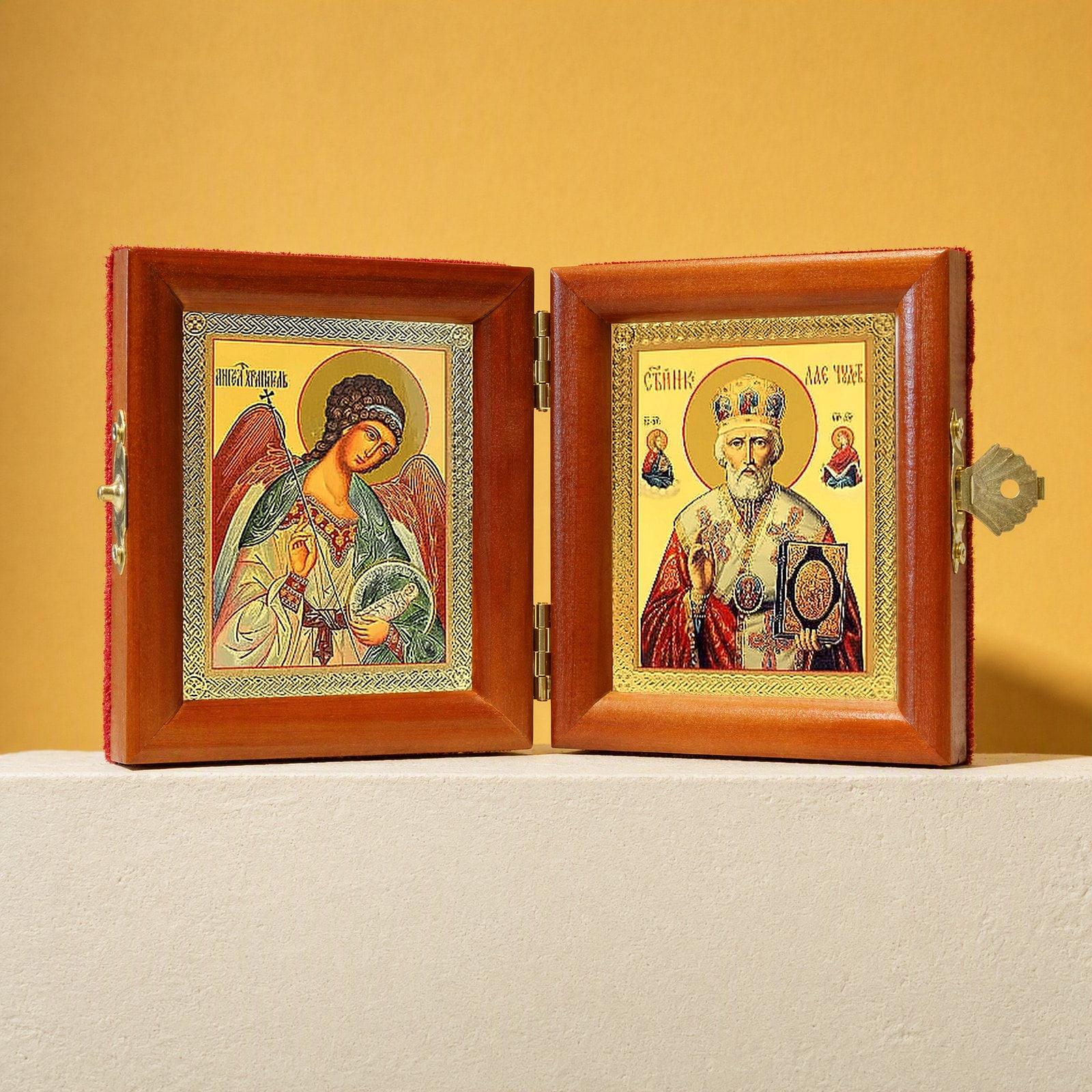 Folding diptych
St Nicholas the Wonderworker & Guardian Angel
$128$89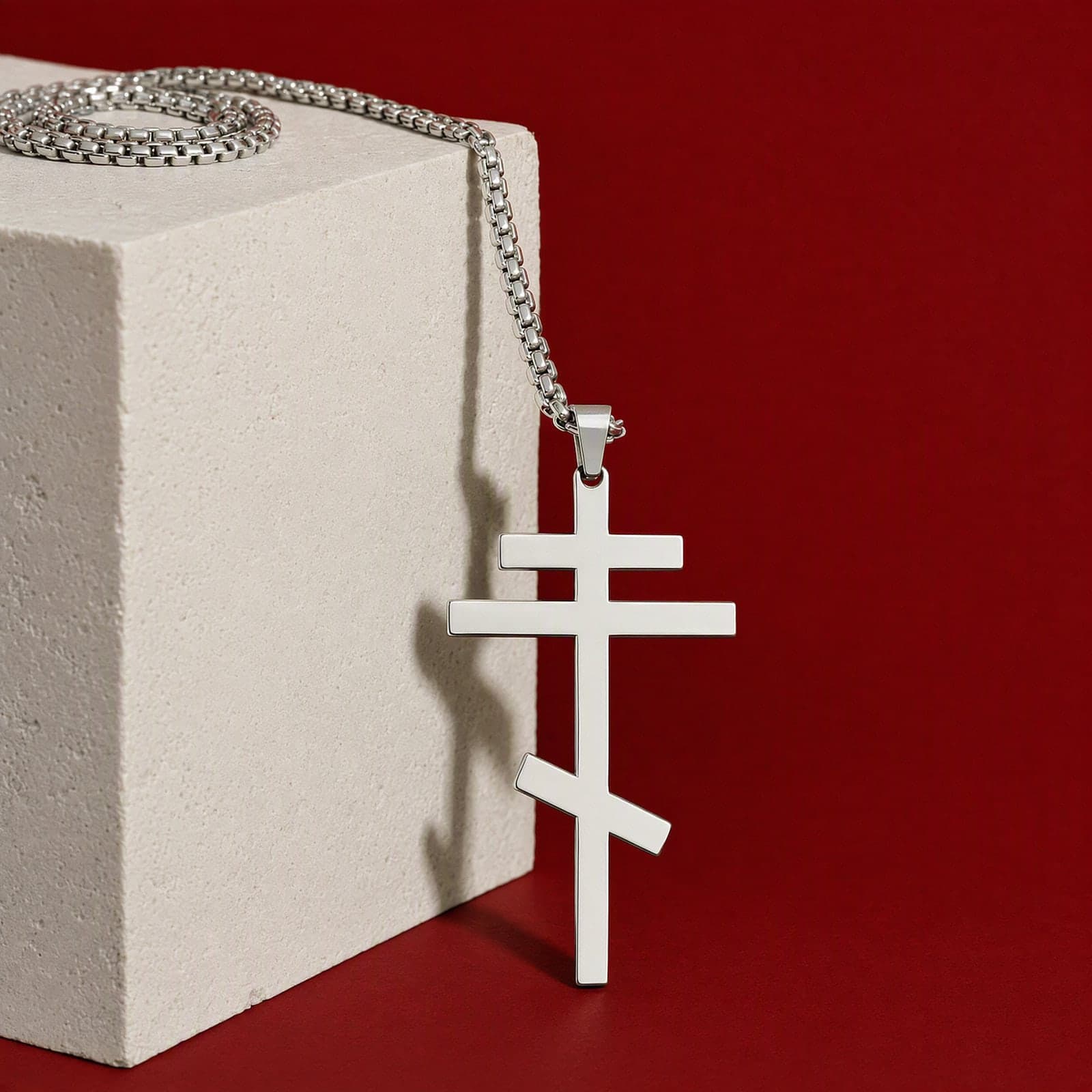 Cross
Three-Bar Bright
Stainless steel, silver finish, 24 in chain$92$64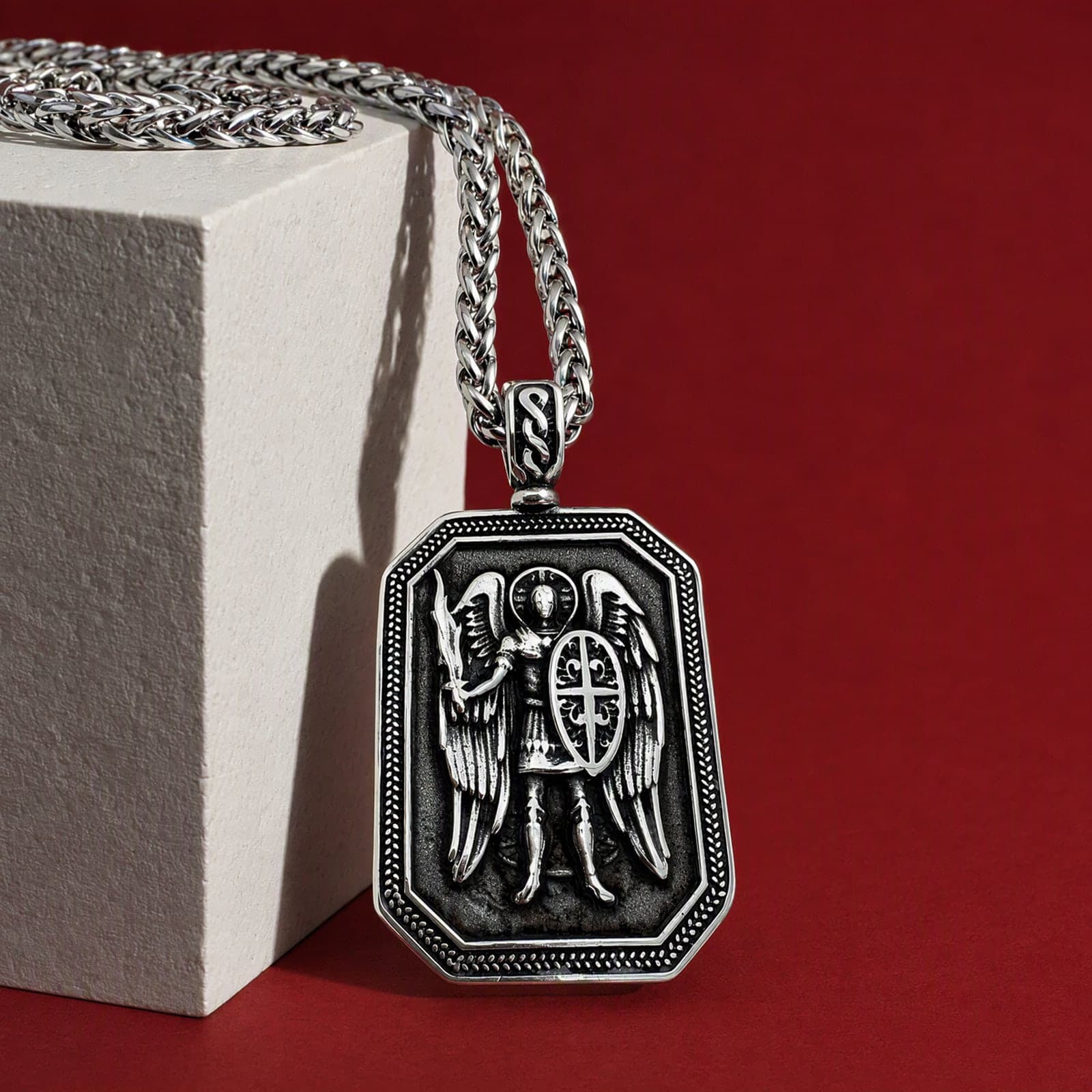 Medallion
Archangel Shield
Stainless steel, silver finish$78$54
Have it blessed by a priest before it reaches you: Blessing, from $39.
The saints in this guide
Questions
What does blessed mean for a cross or an icon?
It means a priest has read the Church’s prayers over it, setting it apart for prayer. Physically nothing changes. In the Church’s understanding the object now belongs to the life of prayer and is treated as a holy thing.
Can I pray before an icon that has not been blessed?
Yes. The Seventh Ecumenical Council honored icons without any special rite, and Greek practice today largely does without one. Slavic practice asks for the rite, and many Orthodox families will not hang a new icon until a priest has prayed over it. Ask your own priest which custom your parish keeps.
Can I bless a cross myself?
No. Blessing is a priest’s prayer. You can sprinkle your home and your icons with holy water and pray before them, but the rite itself is read by a priest. The ordinary way is to bring the cross or icon to your parish priest.
How much is Blessing at Lampada?
Blessing is from $39. A priest blesses the item with the prayers of the Church, and it comes with a certificate. Blessed items are final sale.
What should I do with a damaged blessed icon?
Never throw it away. Take it to your church, where holy things are burned in a place set aside for them. If that is not possible, burn it reverently and bury the ashes where they will not be disturbed.
Read next
- Blessed Items and Returns: Why They’re Final Sale
Why a blessed cross, icon or diptych can’t be returned, how to decide before you order, and what we still replace or refund.
- How to Care for an Orthodox Icon: Cleaning, Light and the Lampada
How to clean each kind of Orthodox icon, where to keep it, how to tend a vigil lamp safely, and what the Church does with an old or damaged icon.
- Orthodox Holy Water at Home: How to Keep and Use It
Where Orthodox holy water comes from, how families keep it near the icons, how to drink it and sprinkle the home, and how to pour out old water with reverence.
- How to Set Up an Orthodox Icon Corner (Prayer Corner) at Home
A step-by-step guide to the Orthodox icon corner, the ‘beautiful corner’ of the home: where it goes, which icons come first, what belongs beside them and how a family prays there.
- How to Wear an Orthodox Cross (and Who May Wear One)
Anyone may wear an Orthodox cross, close to the body, day and night. Here is how to wear it, on what, and what to do when it breaks or comes off.
Sources
- Second Council of Nicaea (787), Decree (New Advent)
- St John of Damascus, Exposition of the Orthodox Faith, Book IV, ch. 16: Concerning Images (New Advent)
- St John of Damascus, Apologia against those who decry holy images (Fordham Medieval Sourcebook)
- Book of Needs (Trebnik): rite for the consecration of various icons offered together, Church Slavonic (Azbuka Very)
- Book of Needs (Trebnik): rite over a cross to be worn on the body (Azbuka Very)
- Archpriest Andrei Krivonis, Should icons and the Holy Cross be consecrated? (Azbuka Very)
- Consecration of an icon (Azbuka Very encyclopedia)
- Abbot Tryphon, Sacred Things (Saint Sophia Greek Orthodox Cathedral, Washington DC)