
How to Wear an Orthodox Cross (and Who May Wear One)
Updated 15 October 2026
You wear an Orthodox cross the way you received it at baptism: on your body, for life, day and night. The priest puts it on you in the baptismal service, and from then on it stays on, under your clothes and close to your heart, a quiet sign that you belong to Christ. An Orthodox cross necklace is not a piece of jewelry to match an outfit. It is the cross of your baptism, and you live in it.
Where the cross comes from: baptism
In the Orthodox Church the cross is part of the sacrament itself. “When a person is baptized, the priest puts the cross on him with his own hand,” as Hieromonk Job Gumerov writes in a well-known Russian priest’s answer. Russian Orthodox writers say the same: the priest places the little cross on the newly baptized child during the service.
Who brings the cross depends on the family’s tradition. In Greek parishes the sponsor usually provides it; one Greek Orthodox parish lists a “Gold Cross for child” among the things the sponsor should bring. Customs vary from family to family, so ask the parents and the priest. If you are a godparent getting ready, our guides to baptism gifts and gifts from godparents walk through each custom, and the Godparent Set ($149) includes a gold-tone crucifix on a 60 cm chain for the godchild’s later years.
How to wear an Orthodox cross necklace day to day
Under your clothing, next to the body
Russian Orthodox teaching is plain on this point: laypeople wear the cross on the body, under their clothes. The word for it, natelny krest, literally means “the cross on the body.” The cross is worn hidden as a reminder to yourself of your baptismal vows, while jewelry is worn to be seen.
Not every Orthodox culture keeps it out of sight as strictly, and in some parishes you will see crosses worn openly. Traditions differ; your priest is the right guide. What every Orthodox tradition shares is the spirit of it. Fr Steven Kostoff of the OCA notes that most Orthodox Christians wear a cross, and that it “is not meant to be one more piece of ‘matching jewelry’ or displayed in an ostentatious fashion.” His point: we are called to be not just “cross-wearers” but “cross-bearers.”
Day and night, without taking it off
The custom is not to take your cross off, not to sleep, not to shower, not to swim. Azbyka, the large Russian Orthodox library, says it should stay on even while washing and during sports.
Sometimes it really must come off, such as for surgery, an MRI or a contact sport where the rules forbid it. Fr Job Gumerov allows a consecrated wooden cross in the bath or during an operation. A light wooden cross like our Orthodox Crucifix, Wooden Cross ($29) or the black wooden cross ($29) is the one many Orthodox wear for exactly these times. When you have to take your cross off, put it somewhere clean and put it back on as soon as you can.
Cord or chain?
The old Russian custom is the gaitan, a simple cord. A chain is just as good. Azbyka says there is no essential difference between a chain and a cord; what matters is that it holds the cross securely, so you don’t lose it.
Length matters more than material. The cross should rest on your chest under your shirt, not hang out of the collar. Our chains are 60 cm (23.6 in), which falls to about the breastbone on most adults.
Which metal?
Gold, silver, stainless steel and wood are all used. If you have a metal allergy, wood is the usual answer, or a metal you already know you tolerate. Most of our crosses are stainless steel, which stands up well to everyday wear, and our wooden crosses are light and warm against the skin.
“Save and protect” on the back
Turn over a Russian cross and you will often find the words Спаси и сохрани, “Save and protect.” This short prayer is the traditional inscription on the back of the eight-pointed cross; some crosses carry the opening of the prayer to the Cross instead, and a plain back is fine too. The front usually shows the three-bar cross with its title board and slanted footrest, explained in our guide to the three-bar cross.
Can you wear an Orthodox cross if you are not Orthodox?
When an Azbyka reader asked whether her unbaptized but believing husband could wear a cross, one priest answered: “Nobody forbids wearing a cross, but is there any point?” The others agreed with him: the cross is put on at baptism, and wearing it is not enough on its own.
So, if you are Catholic, Protestant or still looking, you may wear one, and many do. Just know what it means to the Orthodox: the sign of baptism and of belonging to the Church, never a charm and never a fashion accessory. Azbyka calls wearing a cross for fashion, outside the Church, a sin. Wear it with reverence, and let it lead you to prayer. If you are coming to an Orthodox church, the OCA suggests you make the sign of the Cross when it is “an expression of that which you accept and believe,” not to blend in.
Consecrating a new cross
The custom is that a priest consecrates a cross before it is first worn. Russian Orthodox writers note that crosses sold in church shops are consecrated with a special rite, and that a cross is consecrated only once. A cross bought elsewhere should be taken to a priest. You can ask your parish priest, or add Consecration ($49) to any cross from us: our priest consecrates it with holy water and the Church’s rite for the consecration of a cross before it ships, and it arrives with a signed certificate and a vial of holy water. Orders with Consecration ship in 3–8 business days, and consecrated items are final sale. Read more in What is Consecration.
Kissing your cross and making the sign
Your cross is part of your prayer. You can kiss it at the end of your morning and evening prayers, or before you set out on a journey, as a small act of love for Christ. When you cross yourself, the Orthodox way is to put the thumb and first two fingers together for the Holy Trinity and touch forehead, breast, right shoulder and left shoulder.
A child’s cross
A child receives the cross at baptism, and Russian Orthodox guidance is to keep it on. For the very young, safety comes first: use a short, soft cord and watch it closely, or keep the cross beside the bed until the child is older. Many families buy a whole set at once; the Family Cross Set ($69) gives you three stainless steel crucifixes in the finishes you choose.
When a cross breaks, is lost or is found
- Broken: Have it repaired if you can. Azbyka says it needs to be consecrated again only in exceptional cases, such as when it was badly damaged and rebuilt. If it cannot be repaired, bring it to your priest rather than throwing it away, and wear a new consecrated cross.
- Found on the street: The fear of picking up a found cross is a superstition. You may keep it at home, give it to a church, or give it to someone who needs one. If you want to wear it, have it consecrated first.
- A relative’s cross: Orthodox Christians are usually buried with their baptismal cross. If a relative’s cross does come to you, keep it with reverence by your icons, or ask your priest about wearing it.
Feast of the Cross
On 14 September (27 September on the Old Calendar) the Church keeps the Elevation of the Cross, remembering how St Helen found the Cross in Jerusalem. It is a day of fasting and prayer.
Choosing a cross
- Plain Three-Bar Crucifix, Silver Color, 60 cm Chain ($49): a simple everyday cross, ready to wear.
- Jesus Prayer Crucifix, Silver Color, 60 cm Chain ($49): carries the Jesus Prayer.
- Orthodox Crucifix, Silver Color ($39): for your own cord or chain.
- Orthodox Crucifix, Wooden Cross ($29): light enough for sleep, the bath and the hospital.
See every cross in our cross collection.
From our shop
 Cross
CrossOrthodox Crucifix (Plain Three-Bar)
Silver Color · 60cm Chain · Stainless Steel Cross$70$49 Cross
CrossOrthodox Crucifix (Jesus Prayer, Bright)
Silver Color · 60cm Chain · Stainless Steel Cross$70$49 Cross
CrossOrthodox Crucifix
Silver Color · Cross$56$39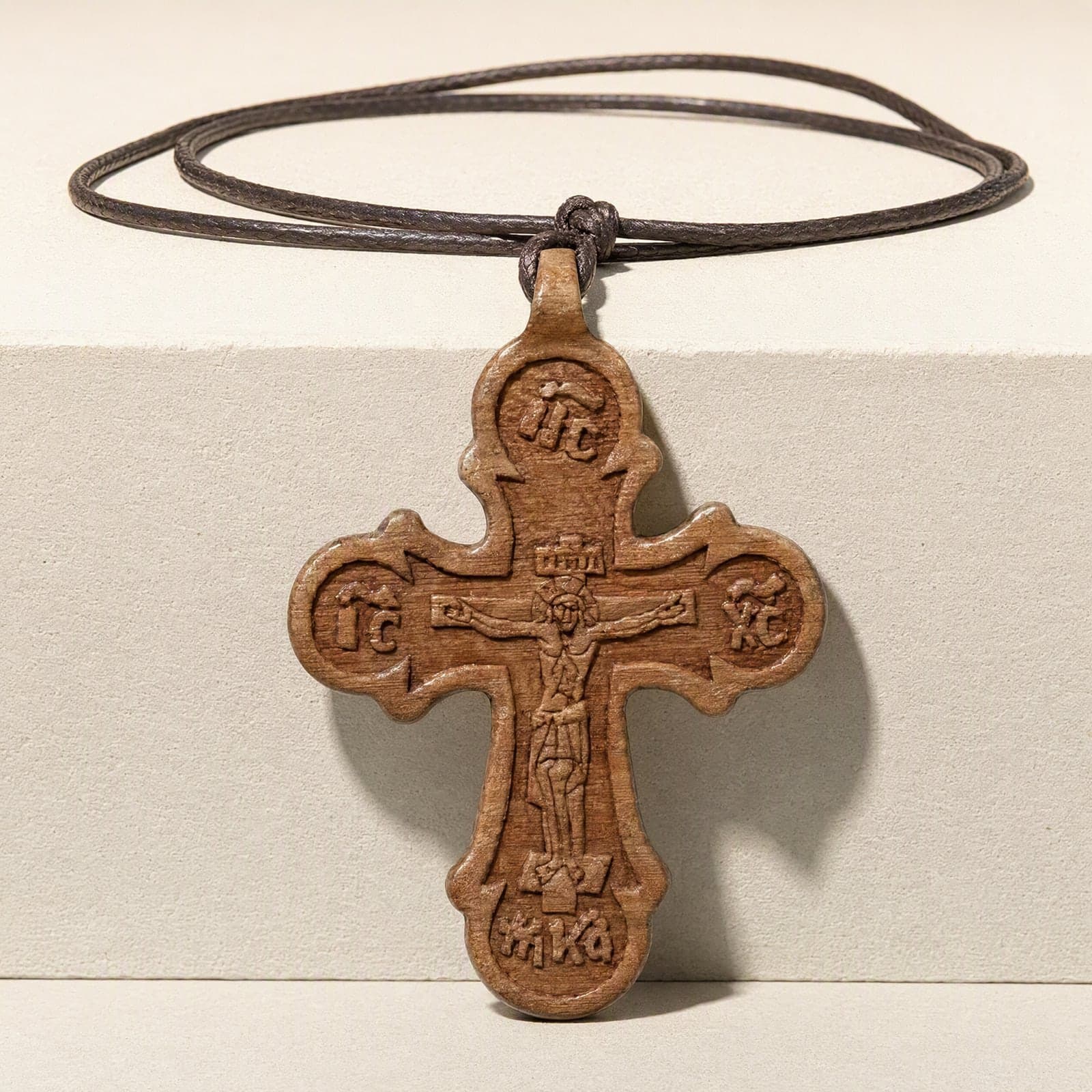 Cross
CrossOrthodox Crucifix
Wooden Cross$41$29 Cross
CrossOrthodox Crucifix
Black Color · Wooden Cross$41$29 Gift set
Family Cross Set
$99$69 Gift set
Godparent Set
$213$149
Have it consecrated by our priest before it reaches you: Consecration, $49.
The saints in this guide
Questions
Should an Orthodox cross be worn under or over clothing?
In the Russian and Slavic tradition it is worn under the clothing, next to the body, as a private reminder of your baptism rather than an ornament. Customs differ between Orthodox peoples, so if your parish does it differently, follow your priest. Either way it is never meant as jewelry for show.
Can a Catholic or a non-Orthodox Christian wear an Orthodox cross?
Orthodox priests answer that nobody forbids it, but that the cross is not a charm and finds its full meaning in baptism and the life of the Church. If you wear one, wear it with reverence and not as fashion.
Do you ever take an Orthodox cross off?
The custom is not to take it off, even to wash, swim or play sports. When you truly must, as for surgery or an MRI, many Orthodox switch to a light consecrated wooden cross, or put the cross back on as soon as they can.
Does a new cross need to be consecrated?
Yes, the custom is for a priest to consecrate a cross before it is worn. A cross is consecrated once. You can ask your own parish priest, or add Consecration ($49) to a cross from us and our priest will consecrate it before it ships.
How long should the chain for an Orthodox cross be?
Long enough that the cross rests on the chest under your shirt, out of sight. Our chains are 60 cm (23.6 in), which sits at about the breastbone on most adults.
Read next
- The Orthodox Three-Bar Cross Explained: Bars, Footrest, Letters
What each part of the Orthodox three-bar (eight-pointed) cross means: the title board, the slanted footrest, the letters IC XC NIKA and the Golgotha signs, with the cross feasts and how our crosses follow the tradition.
- What Is Consecration? Why the Church Consecrates Icons and Crosses
What it means for a priest to consecrate an icon or a cross: the teaching of the Seventh Ecumenical Council, the rite in the Book of Needs, how to treat a consecrated item, and how Lampada’s Consecration works.
- Orthodox Baptism Gifts: The Cross, the Icon and the Customs
What Orthodox families give at a baptism, who usually gives it, and what each gift means: the cross, the patron saint and Guardian Angel icon, the candle and the white garment.
- Godparent Gifts: Orthodox Gifts For and From Godparents
What an Orthodox godparent traditionally gives at the baptism and through the years, and how parents can thank the godparents: a patron saint icon, a prayer rope, a cross.
Sources
- Azbyka.ru: Крест нательный (The pectoral cross)
- Azbyka.ru Q&A: May an unbaptized believer wear a pectoral cross?
- St Nicholas Russian Orthodox Church, Stratford: On the Wearing of the Cross (Hieromonk Job Gumerov)
- OCA, Fr Steven Kostoff: The Place of the Cross in the Church, and in our Lives
- OCA, The Orthodox Faith: Sign of the Cross
- OCA Q&A: Attending Services
- OCA, The Orthodox Faith: Elevation of the Cross
- Greek Orthodox Church of the Assumption (GOARCH): Holy Baptism