Russian cross: what the Russian Orthodox cross means, and how to choose one
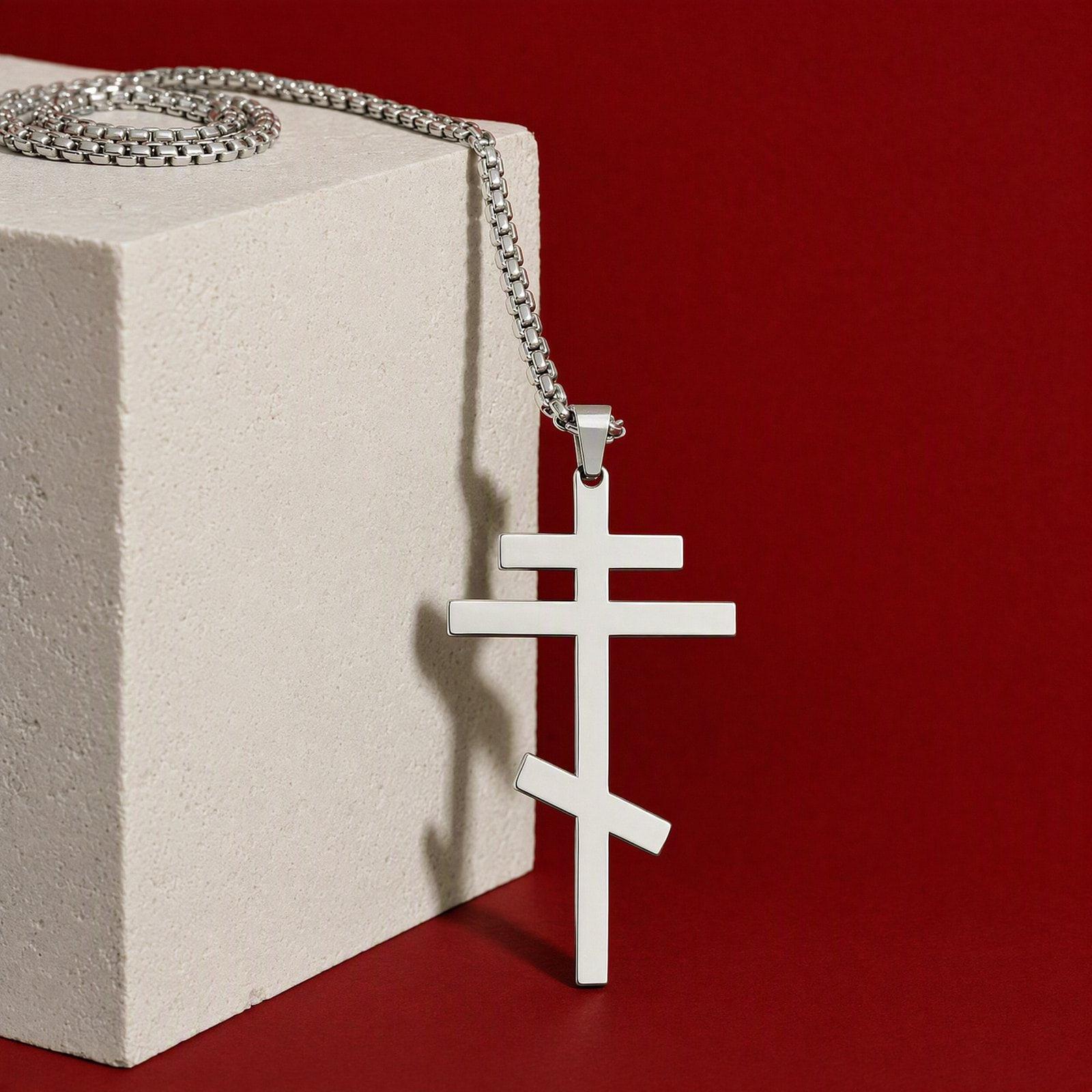
The Russian cross is the name many people use for the eight-pointed Orthodox cross: a long upright, a short top bar, a long middle bar and a slanted bar near the foot. It is the cross on the domes of Slavic Orthodox churches and the one most Slavic Orthodox Christians receive at baptism.
It is not the invention of one country. It shows the cross of Christ as the Gospels describe it, with the title board over His head and the footrest under His feet. Below: where it comes from, what each part means, its forms, and the crosses we carry.
What the Russian cross is, and where it comes from
Christianity came to the lands of Rus from Constantinople in 988, when Prince Vladimir of Kyiv was baptized and his people with him. With the faith came the Byzantine cross, the services and the icons. Over the following centuries the eight-pointed cross, with its slanted footrest, became the cross of the Slavic churches, and it is still the form Ukrainian, Belarusian, Carpatho-Rusyn and other Slavic Orthodox Christians wear.
On Slavic church domes the same cross rises over the bell towers, sometimes standing on a crescent that is read as the anchor of hope. On the neck, it is the baptismal cross, given by the godparent and worn for life.
How it differs from other crosses
| Cross | Shape | Where you see it |
|---|---|---|
| Russian cross (eight-pointed) | Top bar, long bar, slanted footrest | Slavic Orthodox churches and baptismal crosses |
| Greek Orthodox cross | Four equal or near-equal arms | Greek, Antiochian and other Orthodox churches |
| Latin cross | One crossbar, a longer foot | Catholic and Protestant churches |
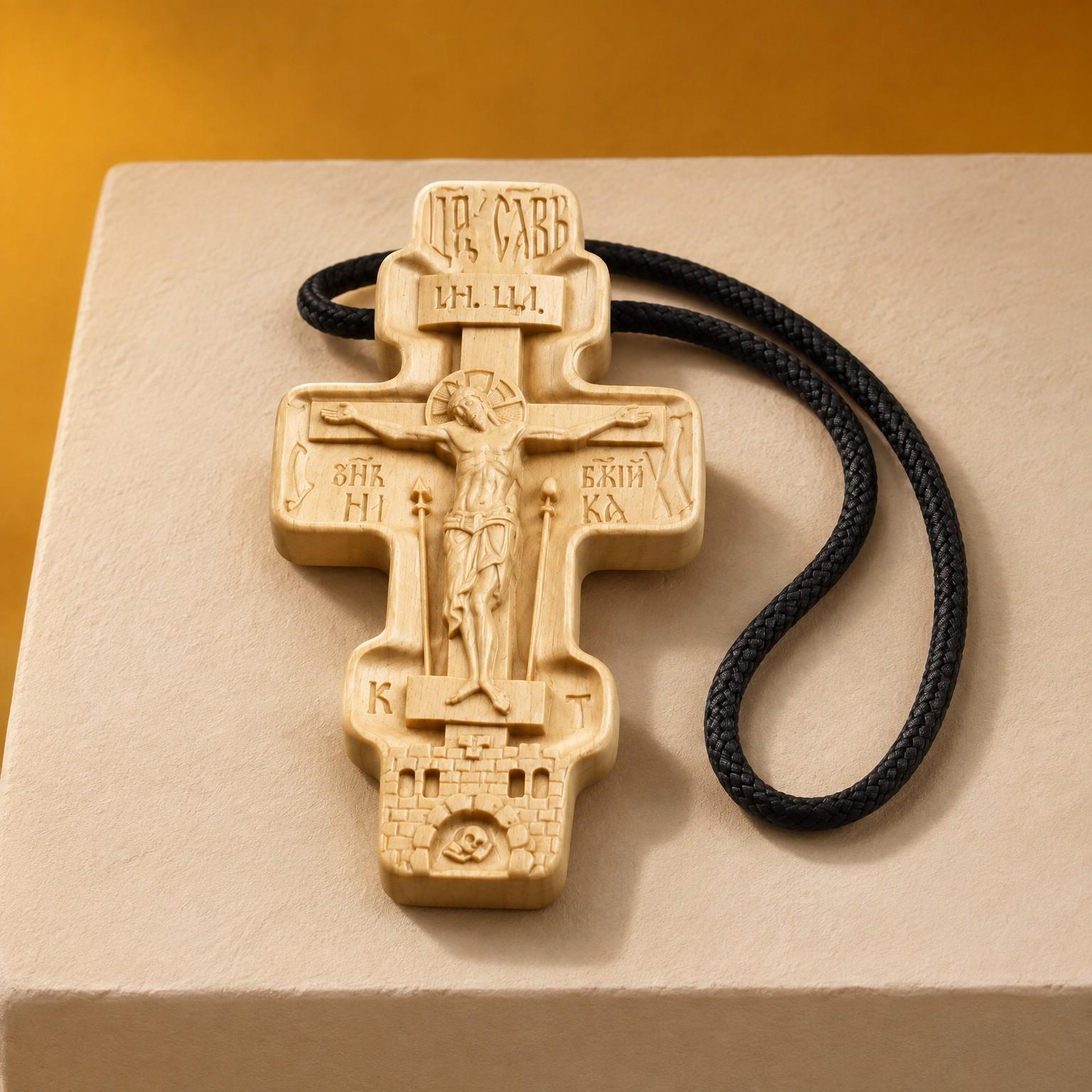
| Calvary cross | Eight-pointed cross on stepped Golgotha | Monastic habits, some neck crosses |
The Russian cross and the Orthodox three-bar cross are the same cross under two names. What sets one cross apart from another within the family is the ends (plain, budded, or with roundels), the inscriptions, and whether Christ is shown on it.
The meaning of its parts
- The top bar is the title board over Christ’s head. It may read IC XC (Jesus Christ) or the words King of Glory; see the King of Glory inscription.
- The long bar is where Christ’s arms were stretched out, embracing the whole world.
- The slanted footrest points up toward the repentant thief, who went with Christ to paradise, and down toward the thief who did not repent.
- The letters IC XC NIKA, Greek for “Jesus Christ conquers,” often sit at the ends of the bars; see IC XC NIKA.
- On the back, Russian crosses worn on the neck are often engraved with the short prayer “Save and protect.”
Forms of the Russian cross
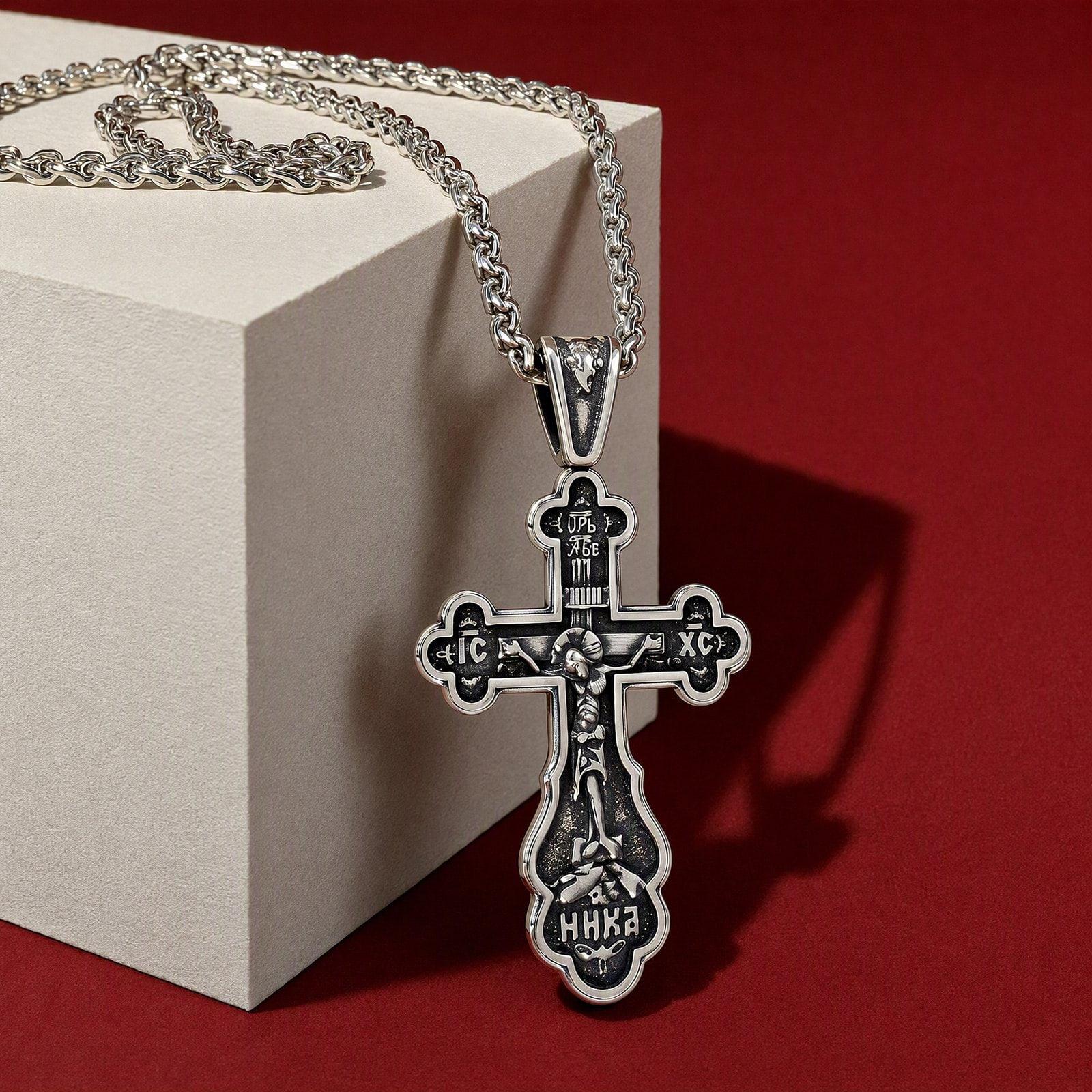
The plain form has straight ends. The budded cross ends each arm in three rounded buds, for the Holy Trinity. The crucifix form shows Christ, flat or in low relief, in the manner of an icon. The Calvary cross stands on steps over the skull of Adam, a reminder that, in tradition, Christ was crucified over Adam’s grave. Old Believers, who kept the older rites after the church reforms of the 17th century, hold the eight-pointed form especially dear.
Who wears it
Orthodox Christians of Slavic families wear it as their baptismal cross; many converts in American Orthodox parishes do too. It is also a common gift for a godchild, a name day, or a family member starting a new chapter, and people who are not Orthodox often wear it because they love its shape and meaning. Most wear it under clothing, on a chain of 20 to 24 in (50 to 60 cm).
What we carry
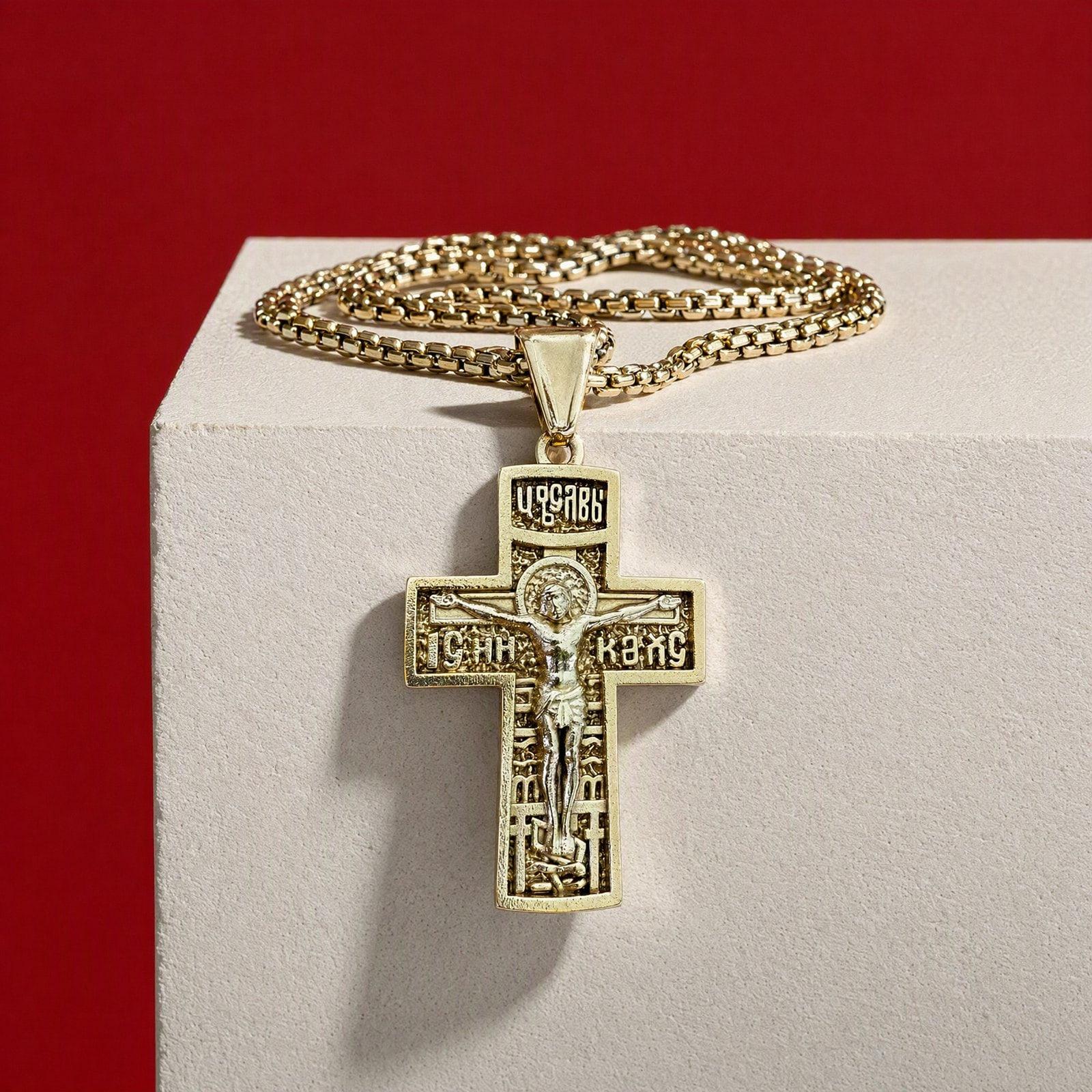
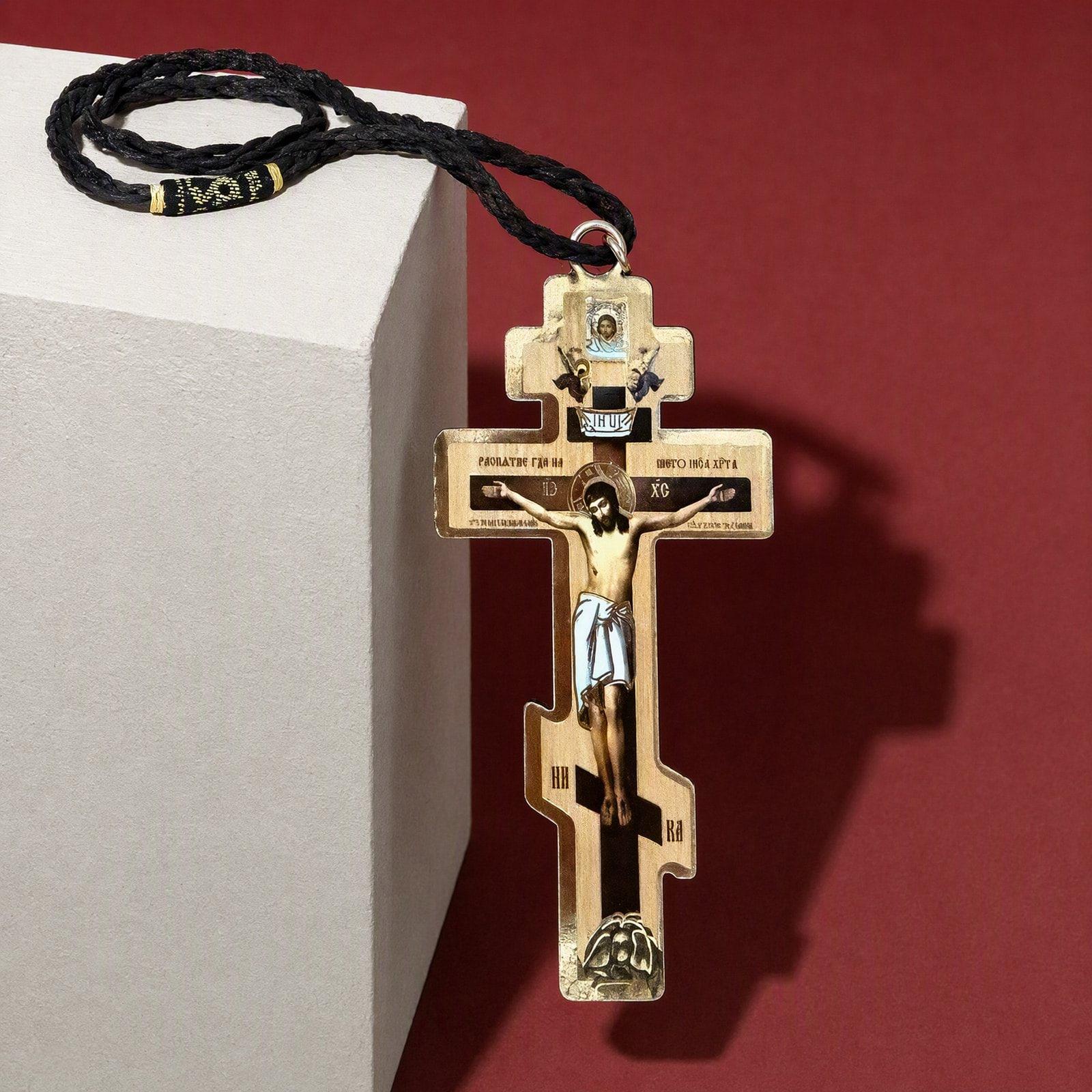
Our eight-pointed crosses come in stainless steel and wood. The plain three-bar crucifix in silver tone on a 60 cm chain ($64) is the classic Russian cross. The King of Glory crucifix in gold tone ($54) is named for the title many Russian crosses carry, and the budded crucifix in dark silver tone ($54) has the trefoil ends. In wood, the eight-pointed wooden crucifix, 10 cm ($44), and the eight-pointed cross in white hornbeam ($129). See every piece in our Orthodox cross necklaces. Orders arrive in 5–8 business days: US-based, ships from Florida.
Our eight-pointed Orthodox crosses
Five of our crosses in the eight-pointed form, in stainless steel and in wood. Each card shows its live price.
US-BASED. SHIPS FROM FLORIDA
Delivery in 5–8 business days.
Questions
What is the Russian Orthodox cross called?
It is the eight-pointed or three-bar Orthodox cross. People in the West often call it the Russian cross or the Slavic cross because it is so common in the Slavic Orthodox churches, but Orthodox Christians simply call it the Orthodox cross.
Why is the bottom bar of the Russian cross slanted?
The slanted bar is the footrest of the cross. Tradition reads its slant as a balance: it points up toward the thief at Christ’s right hand who repented, and down toward the thief who mocked Him. It reminds the believer of the choice each person makes.
What does the top bar on the Russian cross mean?
The short top bar is the title board Pilate had nailed over Christ, which read “Jesus of Nazareth, King of the Jews.” On Orthodox crosses it often carries the letters IC XC, for Jesus Christ, or the words King of Glory.
Is the Russian cross different from the Greek Orthodox cross?
The faith is the same. Greek Orthodox Christians often wear an equal-armed or four-pointed cross, while Slavic Orthodox Christians use the eight-pointed form. Both are Orthodox, and both are worn and blessed in the same way.
Can I wear a Russian cross if I am not Slavic?
Yes. The eight-pointed cross belongs to the whole Orthodox Church, and many American Orthodox Christians of every background wear it. Anyone may wear it with respect, as a sign of faith in Christ.
What is a Russian Orthodox Calvary cross?
It is the eight-pointed cross standing on steps that stand for Golgotha, with the skull of Adam beneath, and the spear and the reed with the sponge on either side. It is embroidered on the habits of monks of the great schema and appears on some neck crosses.