Orthodox Calvary cross, the hill, the skull and the icon
An Orthodox Calvary cross is a cross rising from the hill of Calvary, with the slopes of the hill drawn as steps. Wikipedia describes it as a monastic form, with the Holy Lance on one side, a pole with the sponge on the other, and the skull and bones of Adam beneath the hill. Lampada does not sell the stepped cross; the nearest we carry show Christ with John and the Mother of God.
Calvary and Golgotha are two names for one place, the site just outside the walls of Jerusalem where the four Gospels set the Crucifixion. Both words mean the place of the skull, and English Calvary comes from the Latin that Jerome used. Tradition puts the site in a chapel of the Holy Sepulchre church, and Wikipedia links its identification to Empress Helena, mother of Constantine.
The skull in the picture is Adam’s. OrthodoxWiki says tradition buries Adam’s skull at Golgotha, with a shrine on the spot, and Wikipedia adds that Origen already tied the name to such legends. That is why some crucifixes carry a skull and crossbones under the figure, and why Wikipedia lists the same sign on the vestment of the highest monastic degree.
In an Orthodox church a Golgotha is also a large icon of the crucified Christ with John and the Mother of God at his sides, kept at the front of the nave for memorial services. Three of our crucifixes show that company: the black and gold-tone one at $64, the two-tone silver-tone at $64 and the darkened silver-tone at $64, each on a chain.
A monastic image, and the crucifix with Mary and John
Wikipedia sets the Calvary cross among monastic signs, usually embroidered on the robe of a schema-monk, and our sources say nothing about who else may wear it. We therefore do not claim that it belongs on a layperson’s neck, and we do not sell it. What a lay Christian can wear is a crucifix that adds the Mother of God and John, and OrthodoxWiki describes exactly that company in the Golgotha icon. Wikipedia adds that in Eastern Orthodoxy the figure of Jesus on a cross is usually painted or kept in low relief. The Blessing has an Orthodox priest bless the cross ahead of dispatch, and with it the three come to $103.
The Golgotha company on a chain
The crucifix that comes closest to the Golgotha icon is the black and gold-tone one at $64, with Christ crucified, John and the Mother of God on the front.
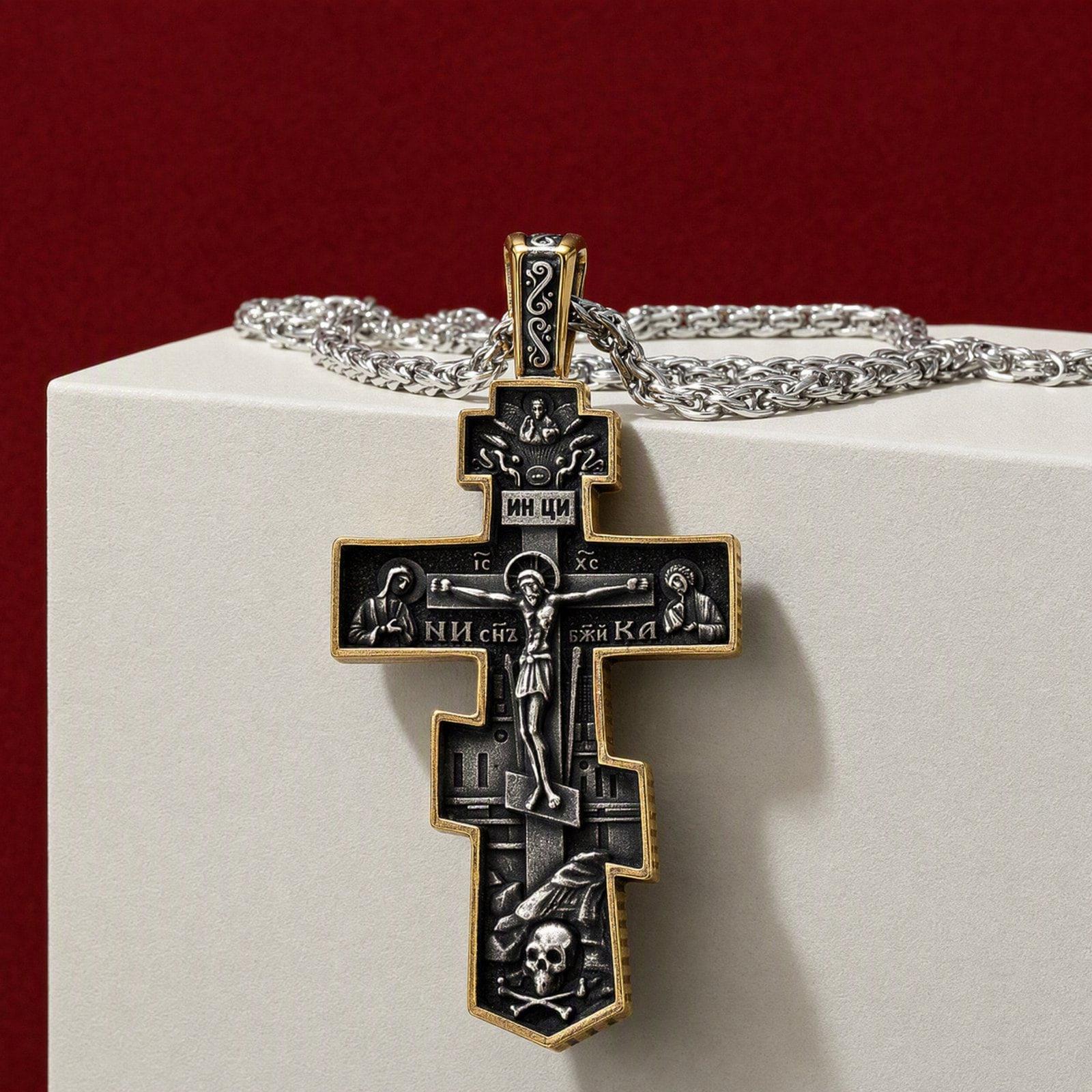 Cross
Golgotha Vespers
Stainless steel, black & gold finish, 24 in chain$92$64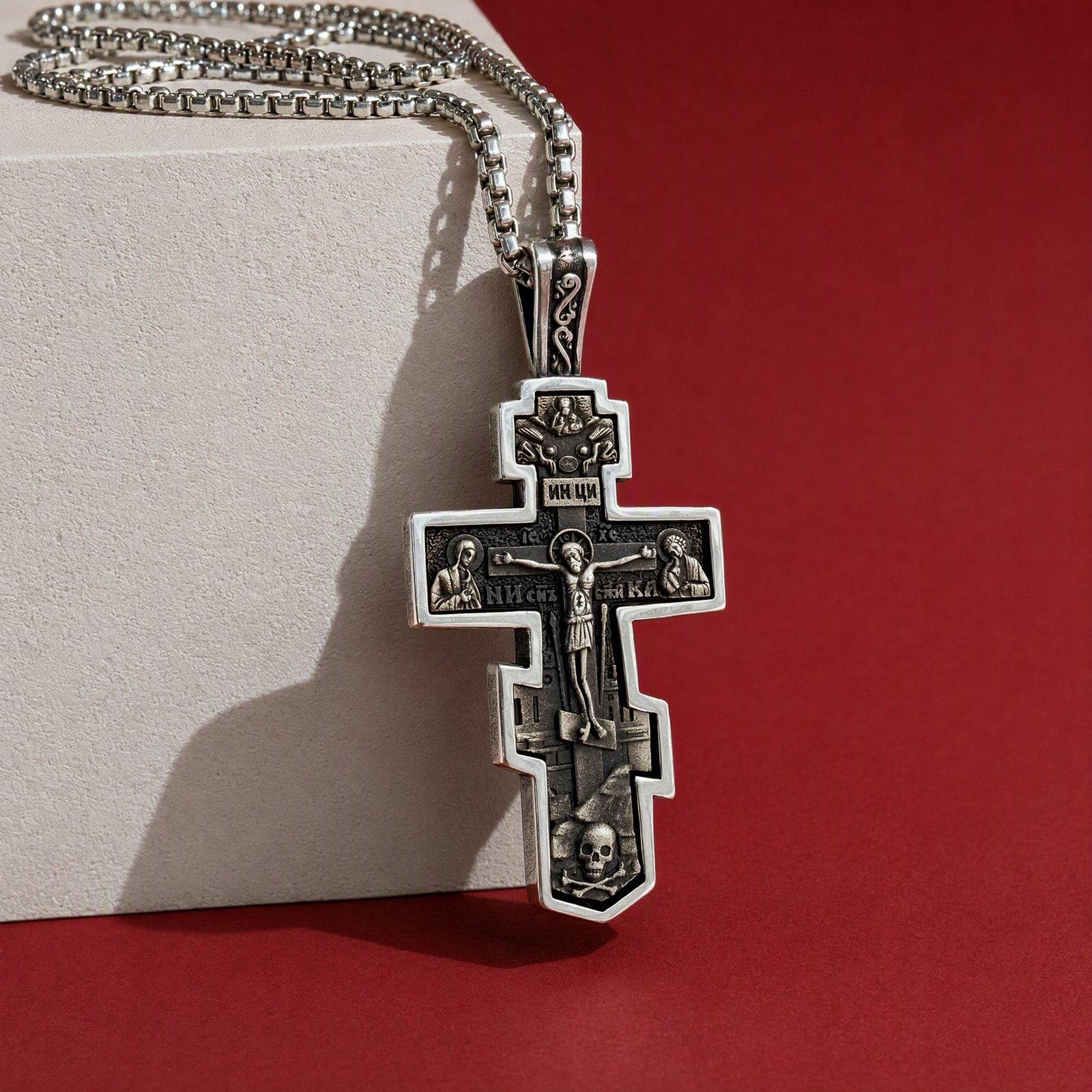 Cross
Golgotha Dawn
Stainless steel, silver finish, 24 in chain$92$64 Cross
Golgotha Ash
Stainless steel, silver finish, 24 in chain$92$64
- Blessing, $39. Blessed by an Orthodox priest before it ships.
- Gift packaging, $20
Questions
What is an Orthodox Calvary cross?
Wikipedia describes a monastic cross that rises from the hill of Calvary, with steps for the slopes, the lance on one side, the sponge on a pole on the other, and Adam’s skull and bones beneath.
What do the steps on a Calvary cross mean?
They stand for the slopes of the hill of Calvary, the place of the skull outside Jerusalem where the Gospels set the Crucifixion.
Why is there a skull under the cross?
Tradition places the skull of Adam at Golgotha. OrthodoxWiki records it, and Wikipedia says some crucifixes show a skull and crossbones beneath the figure as a reference to Golgotha.
What is a Golgotha in an Orthodox church?
OrthodoxWiki calls it a large icon of the crucified Jesus, usually flanked by the Mother of God and John, kept at the front of the nave for memorial services and moved during Holy Week.
Does Lampada sell an Orthodox Calvary cross?
No, and none of our crosses shows the stepped hill. The closest are crucifixes that add John and the Mother of God, at $64, $64 and $64.