Celtic cross meaning, as far as our source goes
Not in our store todayWe do not carry a Celtic cross today. Below: what the Celtic cross is, what its ring may mean, what to look for in one, and our closest items, plain Orthodox crosses and a St Patrick of Ireland icon.
As Wikidata describes it, a Celtic cross is a Christian cross with a ring set where its arms meet, and the whole is called a religious icon. The ring at the crossing is the one feature our source names.
Wikidata also sets the Celtic cross as a subclass of the Christian cross, so it is one kind of Christian cross among others. It keeps the item apart from the high cross, which it records as a different thing.
What our source answers
- What it is: a Christian cross with a ring on its intersection.
- What family it belongs to: the Christian cross.
- What it is not: Wikidata says it is different from the high cross.
What our source does not answer
- What the ring stands for.
- Where the shape first appeared, or in what century.
- How any church, Orthodox or otherwise, regards it.
The sections below give what the wider public record says on the first two, and say where it is unsure; on the third, our sources are silent, so we do not guess. Our catalogue has no Celtic cross, either.
The Celtic cross: what it is and where it comes from
A Celtic cross is a Christian cross with a ring around the place where the arms meet. The arms usually reach past the ring, and the lower arm is often longer, so the cross keeps the Latin shape. Many are covered in knotwork, the interlaced bands of early Irish and British art.
The shape is carved on stone monuments in Ireland and Britain from the early Middle Ages. The best known are the free-standing high crosses of Ireland, raised from about the 8th to the 12th century near churches and monasteries; Muiredach’s High Cross at Monasterboice, from the 10th century, shows Bible scenes on every face. Wikidata keeps the high cross as its own item, the monument, apart from the Celtic cross as a symbol.
In the 19th century the Celtic Revival brought the ringed cross back, first on gravestones and memorials, then on jewelry. That is where most Celtic cross necklaces and Celtic cross chains sold today come from: a modern piece in an old shape.
What the ring may mean
No early source explains the ring, so every meaning is a later reading. The common ones:
- A halo or crown of glory around the cross, as on icons of Christ.
- The sun or the world, with the cross set over it. A popular story credits St Patrick with joining the cross to a circle; the story is not found in early sources.
- Eternity, because a circle has no end.
- A support. On a stone cross the ring braces the long arms, and some historians think it began that way.
Wear it with whichever reading you hold; none of them changes that it is a cross.
A ringed cross and a plain Orthodox one
Side by side, the one difference our source supports is the ring. A Celtic cross has it at the crossing. The Orthodox cross we sell has three bars instead and, in its plainest form, nothing depicted upon it. Whether Orthodox churches welcome the Celtic cross is not something our sources say, and we will not guess. For a friend who loves the Celtic cross, the plain Orthodox cross is a quiet way to meet the Orthodox form of the sign.
| Celtic cross | Orthodox three-bar cross | |
|---|---|---|
| Bars | One crossbar, with a ring at the crossing | Three: a title bar, the arms, a slanted footrest |
| Decoration | Often knotwork, sometimes Bible scenes | Often IC XC, sometimes a flat figure of Christ |
| Where it grew | Ireland and Britain | The Greek and Slavic churches |
Read more on the Orthodox three-bar cross and on the Latin cross, the plain shape inside most Celtic crosses.
Who wears a Celtic cross, and what to look for
Many people of Irish, Scottish or Welsh descent wear a Celtic cross as a sign of faith and family at once. It is a common gift for a confirmation, a St Patrick’s Day, a wedding or a memorial.
If you are buying a Celtic cross necklace elsewhere, check four things. The metal: sterling silver and karat gold cost more and need more care than stainless steel. The size: a small Celtic cross pendant of about an inch suits a woman’s fine chain, while a men’s Celtic cross pendant of 1.5 in or more reads well on a heavier chain. The ring: open or solid, plain or knotted. The chain: 18 to 20 in for most women, 22 to 24 in for most men.
Saints of the early Irish church
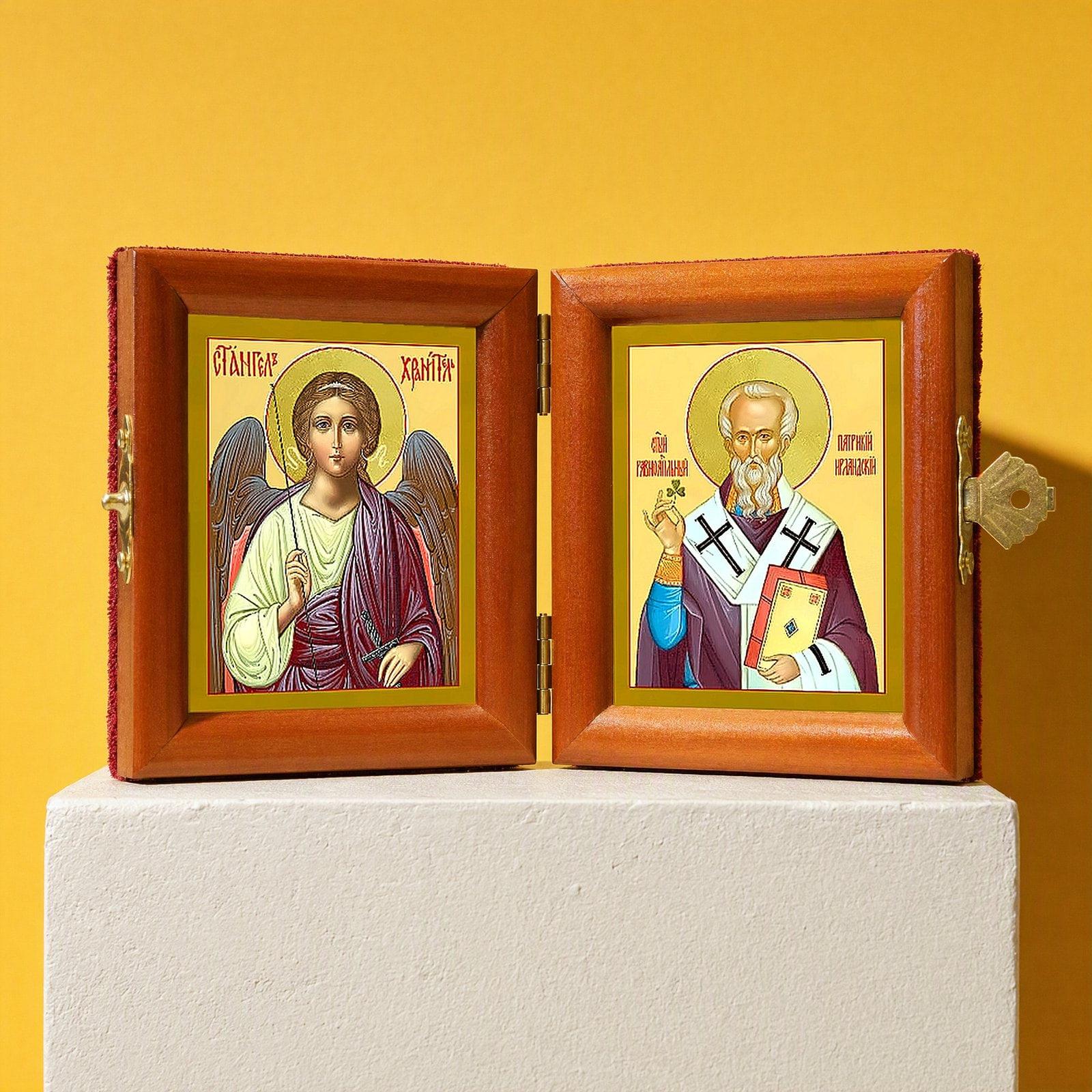
The Celtic cross grew up in the church of St Patrick, St Brigid of Kildare and St Columba, centuries before East and West split in 1054. The Orthodox Church honors these saints too: St Patrick on March 17, St Brigid on February 1, St Columba on June 9. If the Celtic cross speaks to you because of Ireland, an icon of St Patrick of Ireland is a way to keep that link at home.
What we carry instead
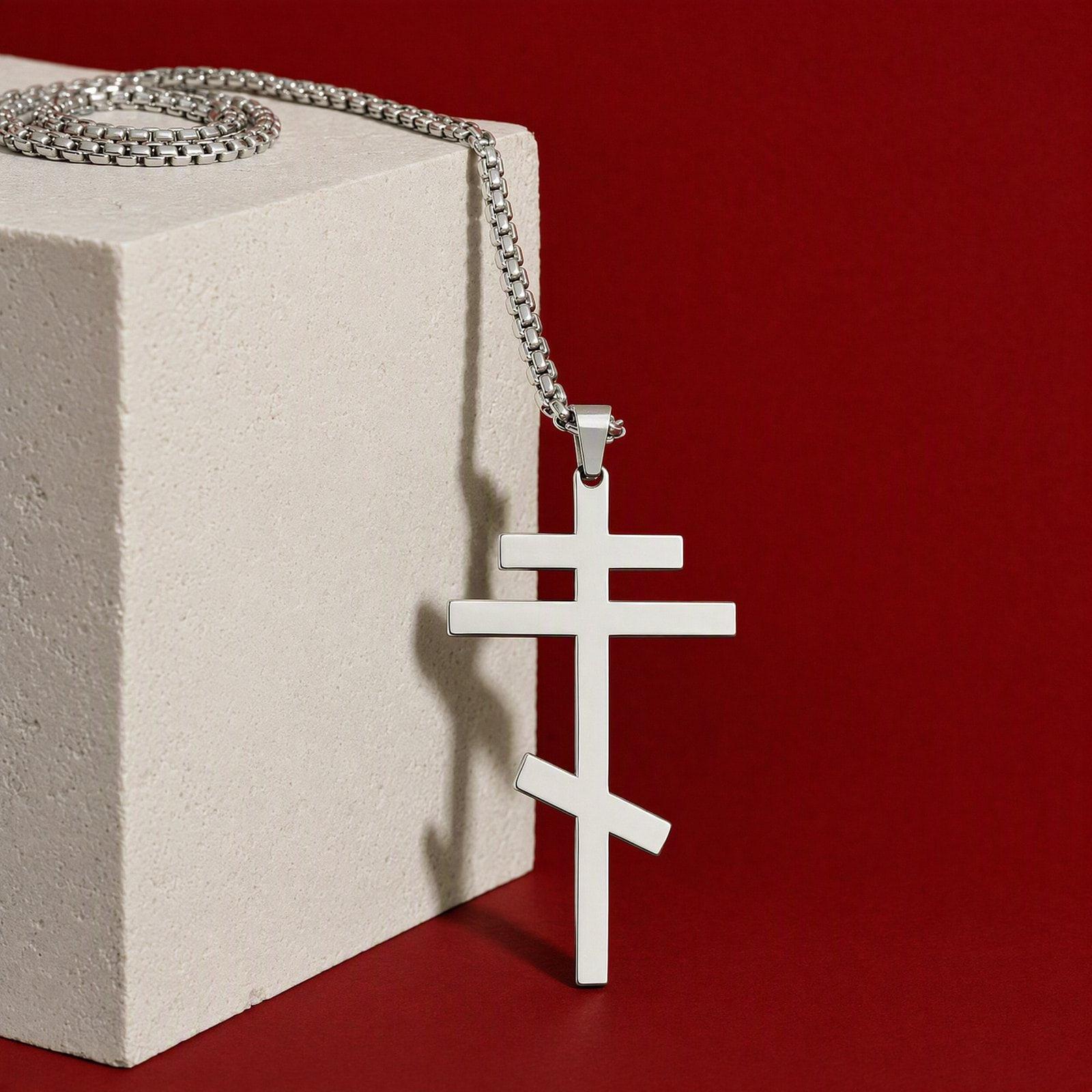
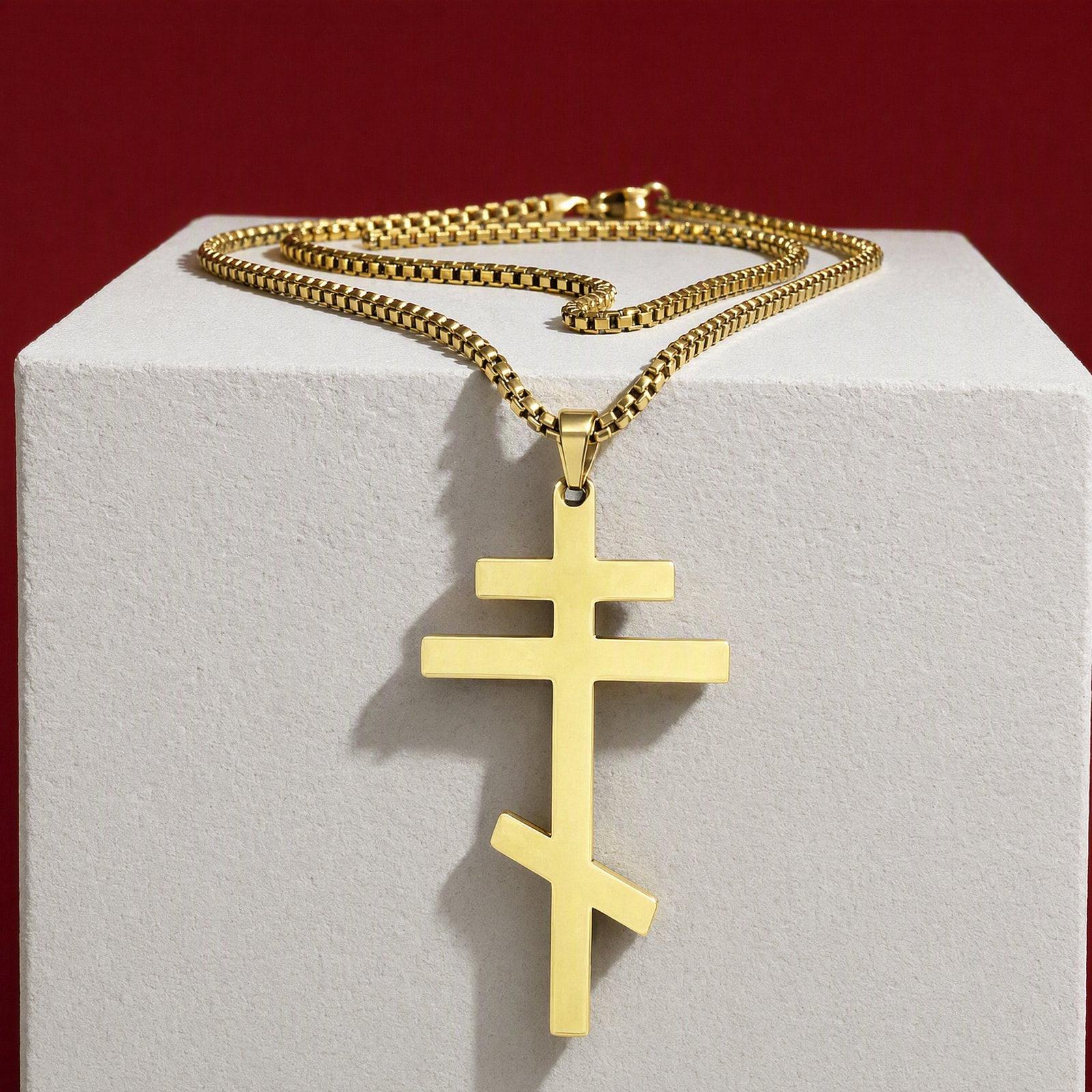
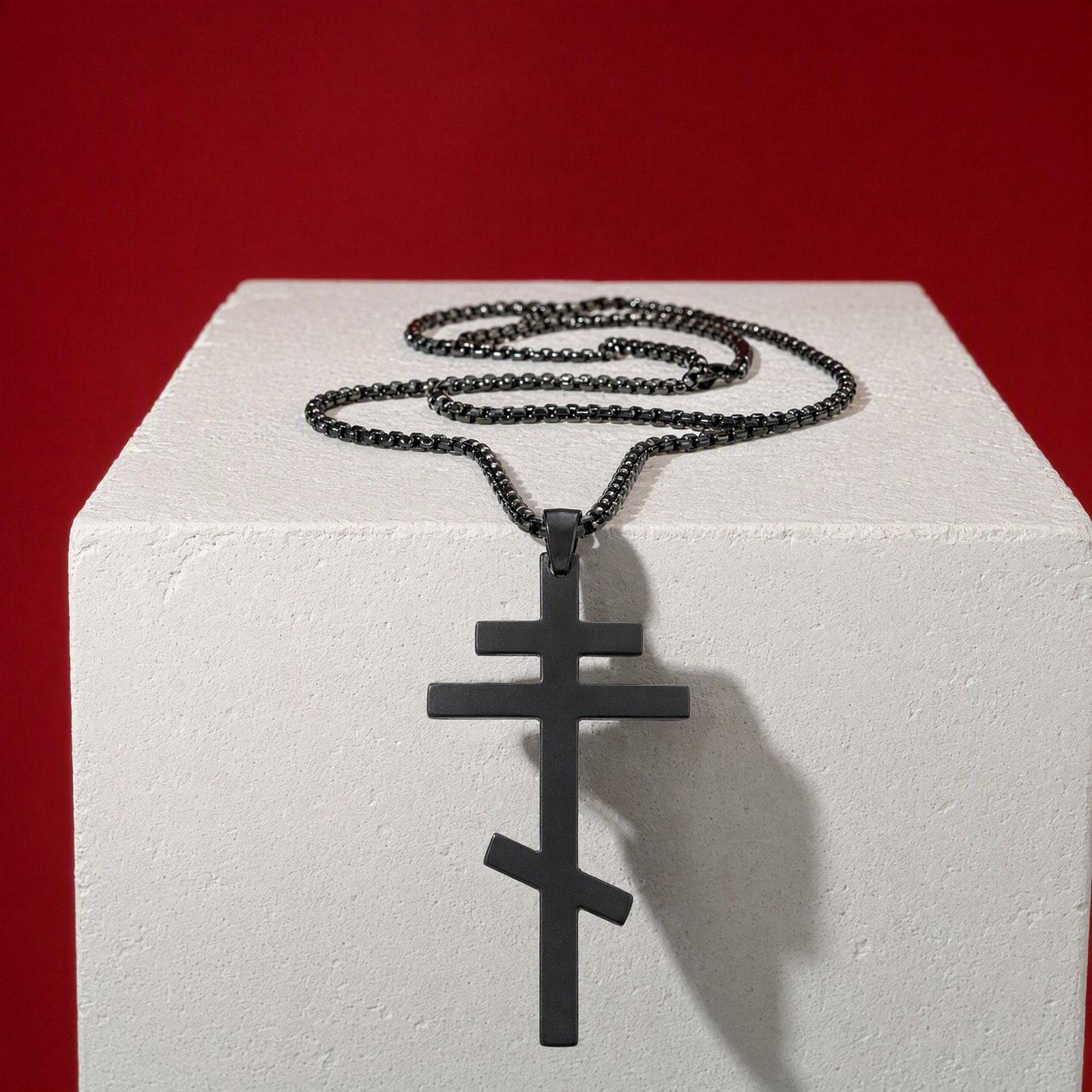
Our closest items are the plain Orthodox three-bar cross with no figure, in silver-tone ($64), gold-tone ($64) and black ($64) stainless steel, each on a 60 cm chain, and the St Patrick of Ireland and Guardian Angel folding icon ($104). With the Blessing, an Orthodox priest blesses the piece before it is posted. See every cross in all our Orthodox cross necklaces. Orders arrive in 5–8 business days: US-based, ships from Florida.
A plain Orthodox cross for someone who loves crosses
Three finishes of the same plain cross are shown, starting with silver-tone, and an Orthodox priest can bless any of them. Beside them, St Patrick of Ireland, the best-known saint of the early Irish church, on a folding icon.
US-BASED. SHIPS FROM FLORIDA
Delivery in 5–8 business days.
Want us to stock it?
We don't carry a Celtic cross today. Leave your email and we will write once if we stock it.
Questions
What does the Celtic cross mean?
Our source describes a Christian cross with a ring at the crossing, and gives no meaning for the ring. Later writers read the ring as a halo, the sun or eternity; no early source settles it, so we do not pick one.
Is a Celtic cross the same as a high cross?
Wikidata says no. It records the Celtic cross as different from the high cross.
Does Lampada sell a Celtic cross necklace or pendant?
Not at present. Our crosses are Orthodox crosses, so the closest we can offer is the plain three-bar one, in silver-tone, gold-tone or black.
Are your crosses blessed?
They can be. The Blessing is a separate extra, and an Orthodox priest gives it before the cross is posted.
How old is the Celtic cross?
Ringed crosses are carved on stone monuments in Ireland and Britain from the early Middle Ages, and the great high crosses of Ireland date from about the 8th to the 12th century. The shape came back in the 19th century, when the Celtic Revival used it for gravestones and jewelry.
Is a Celtic cross Catholic, Protestant or Orthodox?
It belongs to the early Christianity of Ireland and Britain, centuries before the split of East and West in the 11th century and long before the Reformation. Today Catholics, Protestants and others all use it; it is not the mark of one church.
What should I look for in a Celtic cross necklace?
Look at the metal (sterling silver and karat gold cost more than stainless steel), the size of the pendant, whether the ring is open or solid, any knotwork, and the chain length. For a man, a longer chain that sits mid-chest; for a woman, a shorter one just below the collarbone.
What is the closest cross Lampada carries?
A plain Orthodox three-bar cross with no figure, in silver-tone, gold-tone or black stainless steel on a chain, and a folding icon of St Patrick of Ireland, a saint honored in the Orthodox Church as well.