Ankh cross meaning, from our source: the ankh, life and the looped cross
Not in our store todayWe do not carry an ankh cross today. The crosses below are our closest: plain Orthodox three-bar crosses to wear every day.
The ankh is an ancient Egyptian hieroglyphic symbol. That is Wikidata’s own description, and any honest answer to ankh cross meaning has to begin there.
Wikidata files the ankh under several headings at once. It is a hieroglyph, it is a cross, and it is counted among the crosses in heraldry. It is also listed as part of the regalia of the Pharaohs, and the Metropolitan Museum of Art’s tagging vocabulary describes it. A free image of it is held on Wikimedia Commons.
| Wikidata property | What it says |
|---|---|
| Description | ancient Egyptian hieroglyphic symbol |
| Instance of | crosses in heraldry; hieroglyph |
| Subclass of | cross |
| Part of | regalia of the Pharaohs |
| Described by | Metropolitan Museum of Art Tagging Vocabulary |
Beyond this table our record offers no meaning, so the guide below gives the meaning Egyptologists and historians record, and no guesswork. Lampada does not sell the ankh; the crosses we import are Orthodox crosses.
The ankh cross: what it is and where it comes from
The ankh is an ancient Egyptian sign: a T-shaped cross topped by an oval loop. It is a hieroglyph that spells the Egyptian word for life, and it appears from the earliest dynasties, about five thousand years ago. In tomb paintings and temple carvings the gods carry it and hold it out to the pharaoh, giving him life; it was part of the regalia of the Pharaohs, as our source says.
Nobody is sure what the sign first showed. Egyptologists have suggested a sandal strap, a knot of cloth and other objects; none is proven. What is certain is that for thousands of years it meant life itself, and that it is the best-known symbol of ancient Egypt today.
Ankh, Coptic and Orthodox crosses compared
| Cross | Shape | Where it comes from |
|---|---|---|
| Ankh | A T with a loop on top | Ancient Egypt, a sign of life |
| Crux ansata | The ankh used as a cross | Early Christians in Egypt |
| Coptic cross | Equal arms, three points at each end | The Coptic Orthodox Church |
| Orthodox three-bar cross | Short top bar, long bar, footrest | Orthodox baptismal crosses |
| Tau cross | A T without the loop | Franciscans |
The ankh has no title board, no footrest and no figure of Christ. Its loop takes the place of the cross’s upper arm.
What the ankh means
- Life. The sign stands for the word itself, and for the breath of life the gods give.
- The loop is read by some as eternity or the rising sun, by others as a knot; Egyptologists do not agree.
- In the hands of the gods the ankh shows that life is their gift, often beside the scepter and the djed pillar.
The ankh in Christian Egypt
When the old temples closed, Christians in Egypt saw in the sign of life a sign of the Cross, through which Christ gives eternal life. They called it the crux ansata and carved it on gravestones, in churches and in manuscripts. The church historian Socrates Scholasticus tells how, when the great temple of Serapis in Alexandria was pulled down, Christians found the looped sign carved there and read it as the Cross. In time the Copts came to prefer their own Coptic cross, but the ankh remains a part of Christian Egypt’s story.
How the ankh differs from the Orthodox three-bar cross
A plain Orthodox cross in our catalogue is a three-bar cross with no figure on it, and the catalogue calls it a simple cross to wear every day. The ankh, in our source, is a hieroglyph that belonged to the regalia of the Pharaohs. Nothing we have read links it to Eastern Orthodox use, and we will not suggest a link. If you came looking for a cross to wear, the plain Orthodox cross below is the nearest thing we carry. We chose it because it has no figure on it, which is an editorial choice and not a claim that the two look alike.
What we carry instead
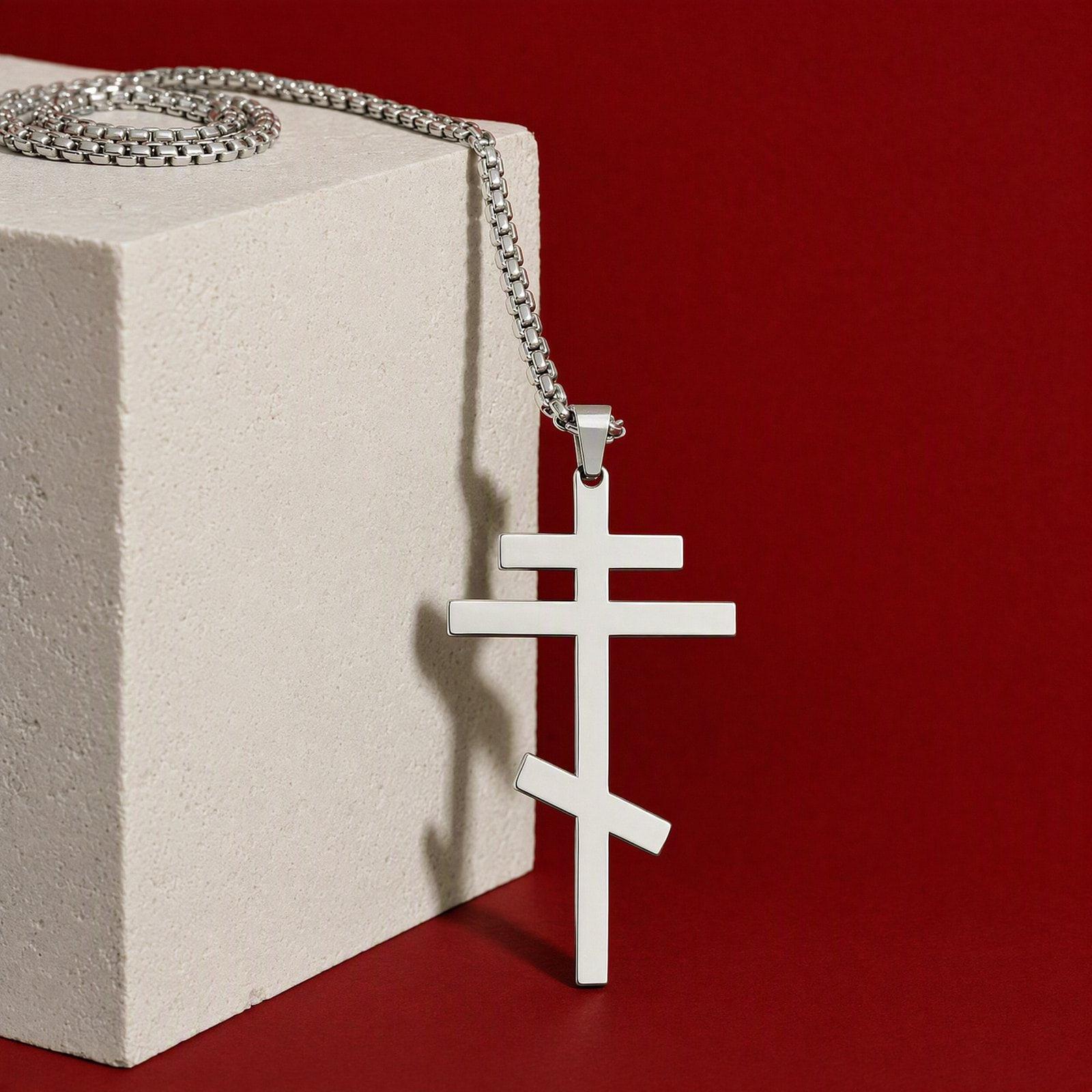
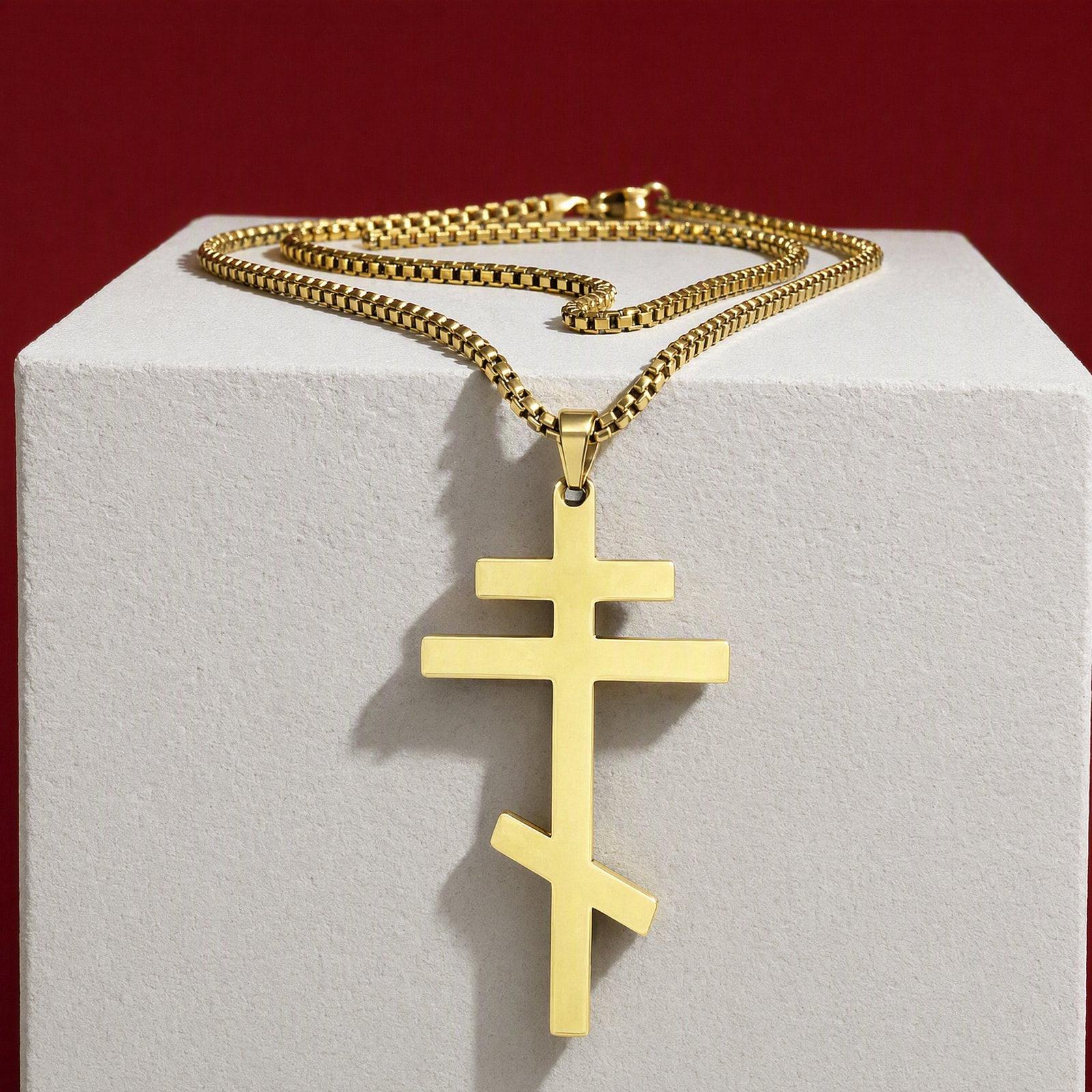
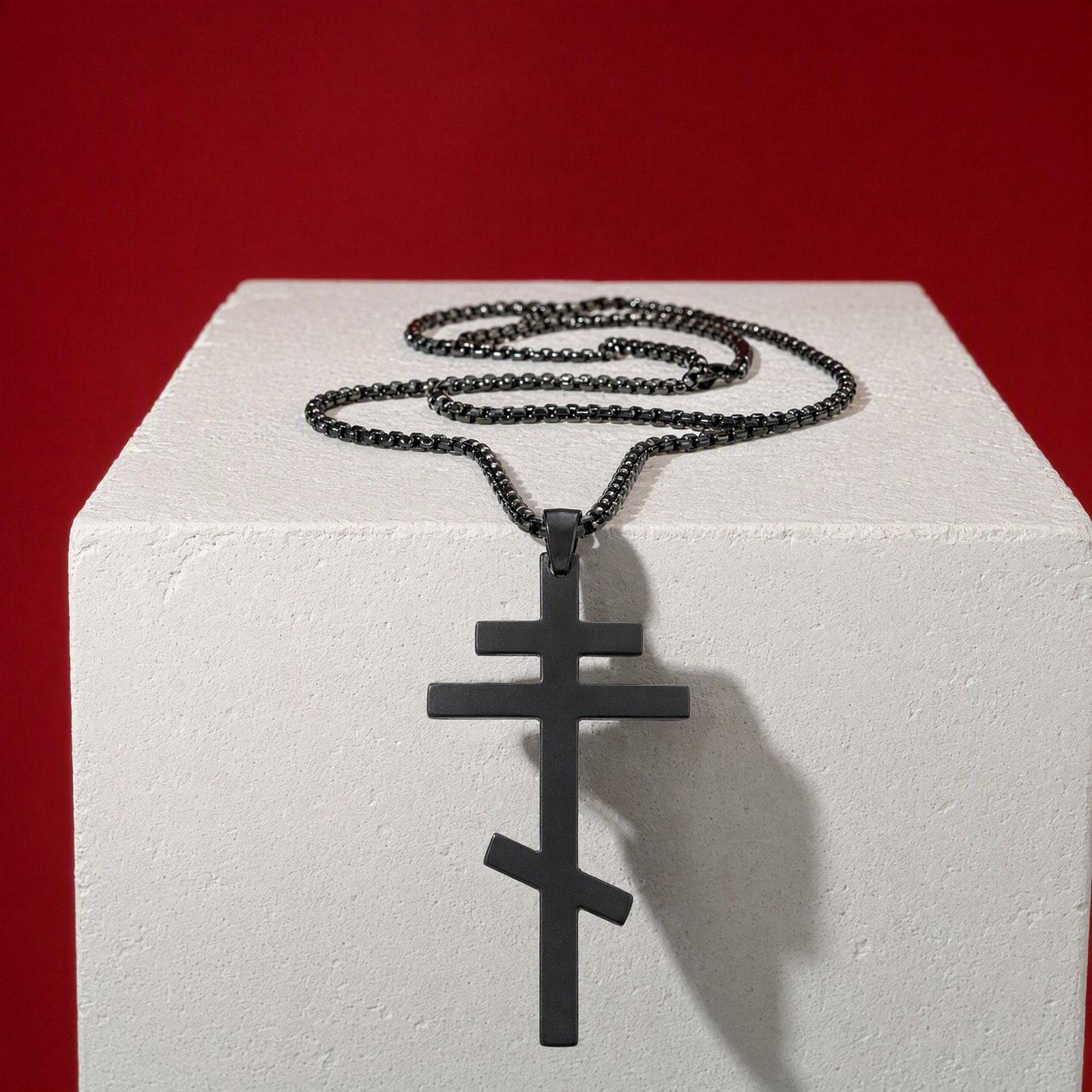
We do not stock ankh cross jewelry. Our closest are the plain three-bar Orthodox crosses with no figure, about 2¼ in, each on a 60 cm chain: silver-tone stainless steel ($64), gold-tone stainless steel ($64) and black stainless steel ($64). An Orthodox priest can bless each one before it ships. Every piece we offer is in our Orthodox cross necklaces. Orders arrive in 5–8 business days: US-based, ships from Florida.
A plain cross for the neck, in three finishes
The silver-tone cross, the gold-tone and the black each come on their own chain, and an Orthodox priest can bless the one you choose.
МЫ В США. ОТПРАВКА ИЗ ФЛОРИДЫ
Delivery in 5–8 business days.
Want us to stock it?
We don't carry an ankh cross today. Leave your email and we will write once if we stock it.
Questions
What does the ankh cross mean?
Wikidata calls it an ancient Egyptian hieroglyphic symbol, and lists it as a hieroglyph, a cross and part of the regalia of the Pharaohs. It gives no meaning beyond that. Egyptologists read it as the sign for life, since the hieroglyph spells the Egyptian word for life, and in temple scenes the gods hold it to the lips of kings.
Is the ankh a Christian cross?
Not at first. It is an Egyptian sign far older than Christianity. Wikidata places it in the family of crosses, and early Christians in Egypt took it up as the crux ansata, the looped cross, so it has a place in Coptic history. It is not a cross of the Orthodox baptismal tradition.
Does Lampada sell an ankh cross pendant?
No. We carry Orthodox crosses, imported, and the ankh is not one of them. The nearest we have by shape is a plain three-bar cross with no figure.
Can the plain cross be blessed before it ships?
Yes. An Orthodox priest can bless it before it leaves us.
What is the crux ansata?
Crux ansata, Latin for a cross with a handle, is the name Christians gave the ankh when they used it as a cross. Christians in Egypt carved it on stones and painted it in books in the first centuries after the old temples closed, reading the sign of life as the Cross of Christ, who gives eternal life.
Why do people wear an ankh cross necklace?
Some wear it for ancient Egypt, some for African heritage, some as a sign of life, and some as a Christian looped cross. A gold ankh cross or an ankh cross pendant in silver is popular jewelry. If you want a cross of the Christian faith in particular, a plain cross or crucifix says it more clearly.