Armenian cross meaning: a guide to Armenian crosses
Not in our store todayWe do not carry Armenian crosses today. The crosses below are our closest: plain Orthodox three-bar crosses to wear every day.
Armenian crosses are the crosses of the Armenian Apostolic Church, with arms that open into paired buds or loops, often carved on stone cross-stones called khachkars. Lampada keeps only a short record of the Armenian cross, and we would rather show it whole than pad it. Wikidata calls it a religious symbol, files it as a kind of cross, and names a single country for it: Armenia.
That record stops there. It does not describe the shape, date it or say what its parts stand for, so the guide below answers from public sources on the Armenian Church and its cross-stones.
Questions the guide answers
- What does an Armenian cross look like in detail?
- How old is it, and where is it used besides Armenia?
- What do its parts stand for?
- How does the Orthodox Church regard it?
Each of those is a fair question, and each has its section below. The one thing we can state plainly is what we do not carry. There is no Armenian cross in the Lampada catalogue, so a search for an Armenian cross pendant or necklace ends here without a product.
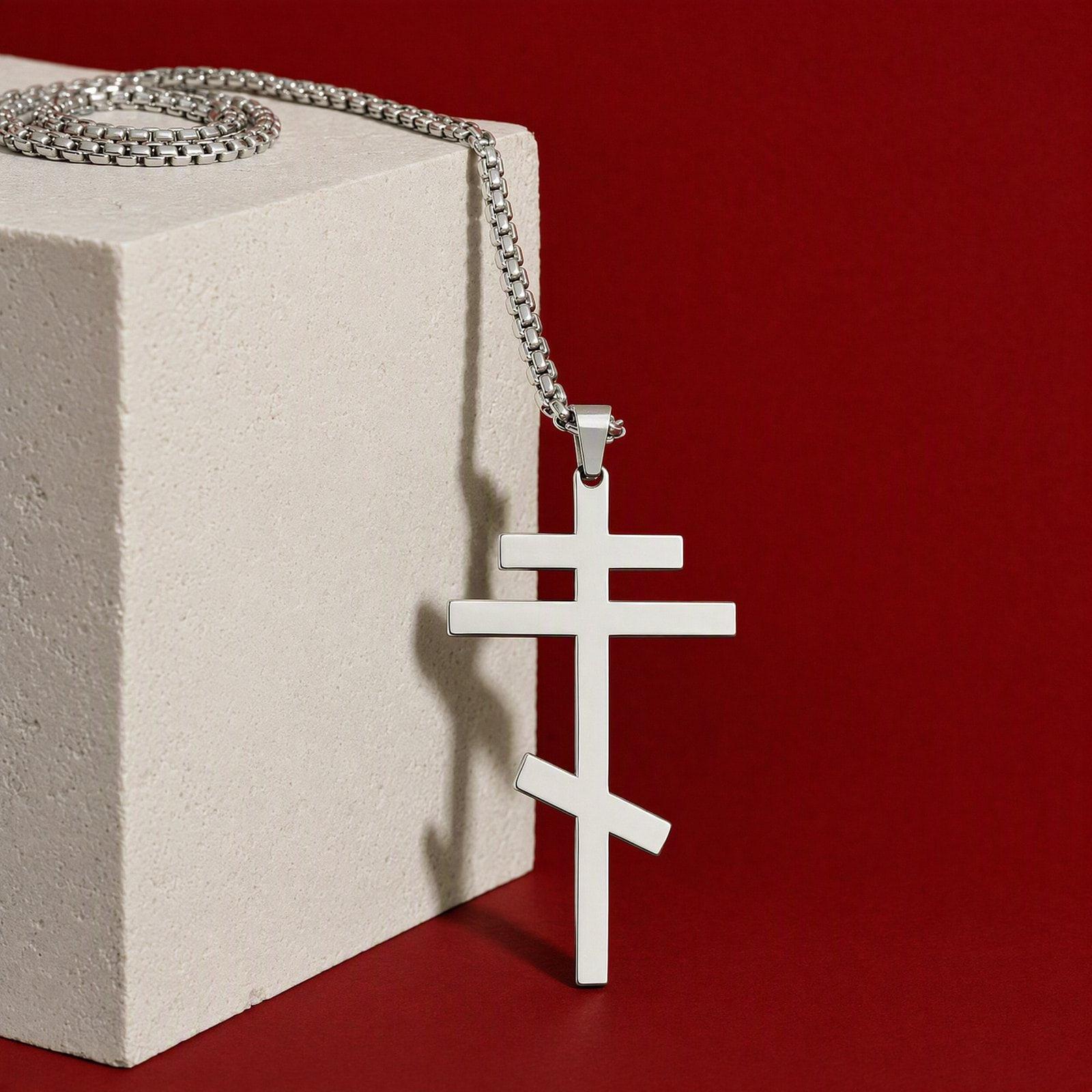
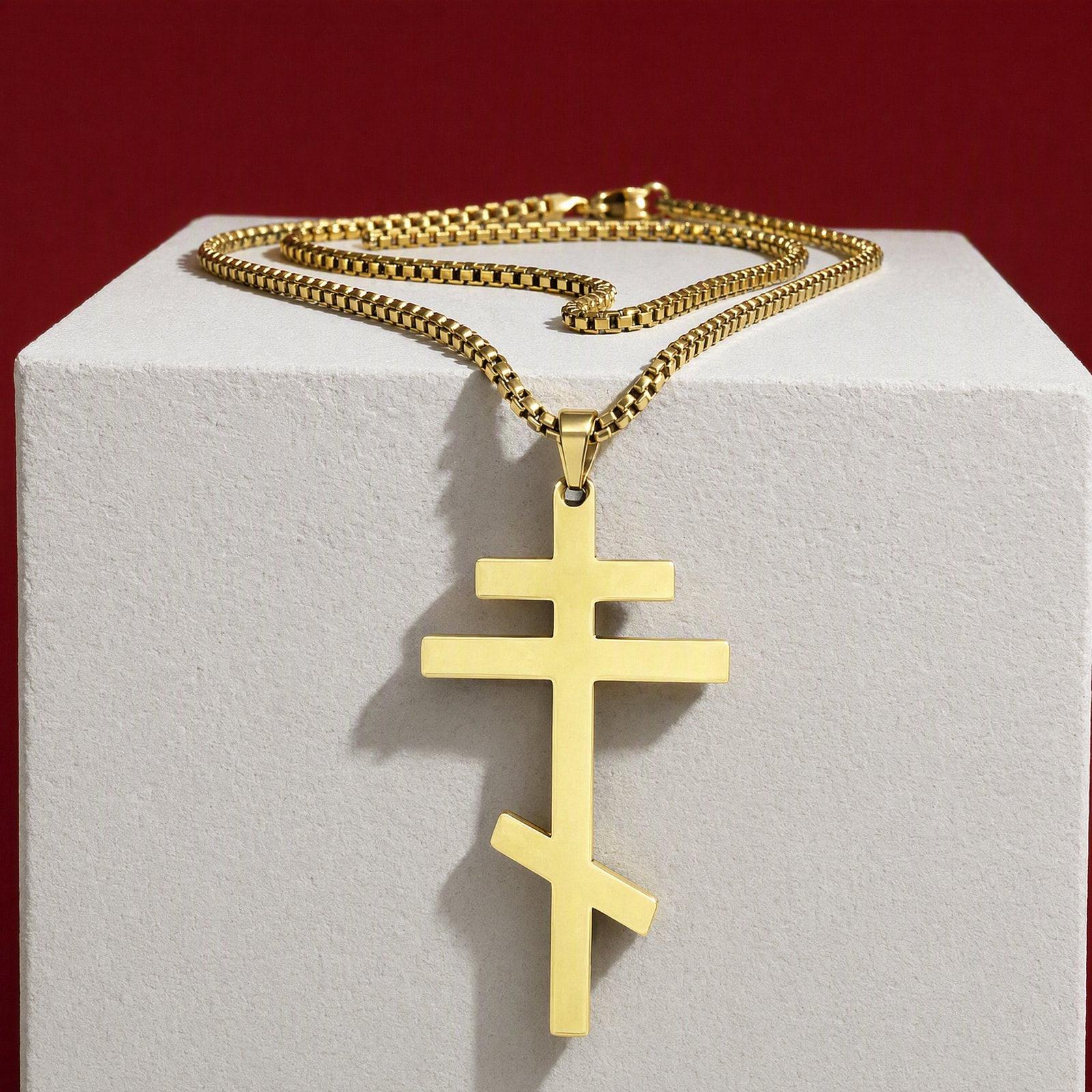
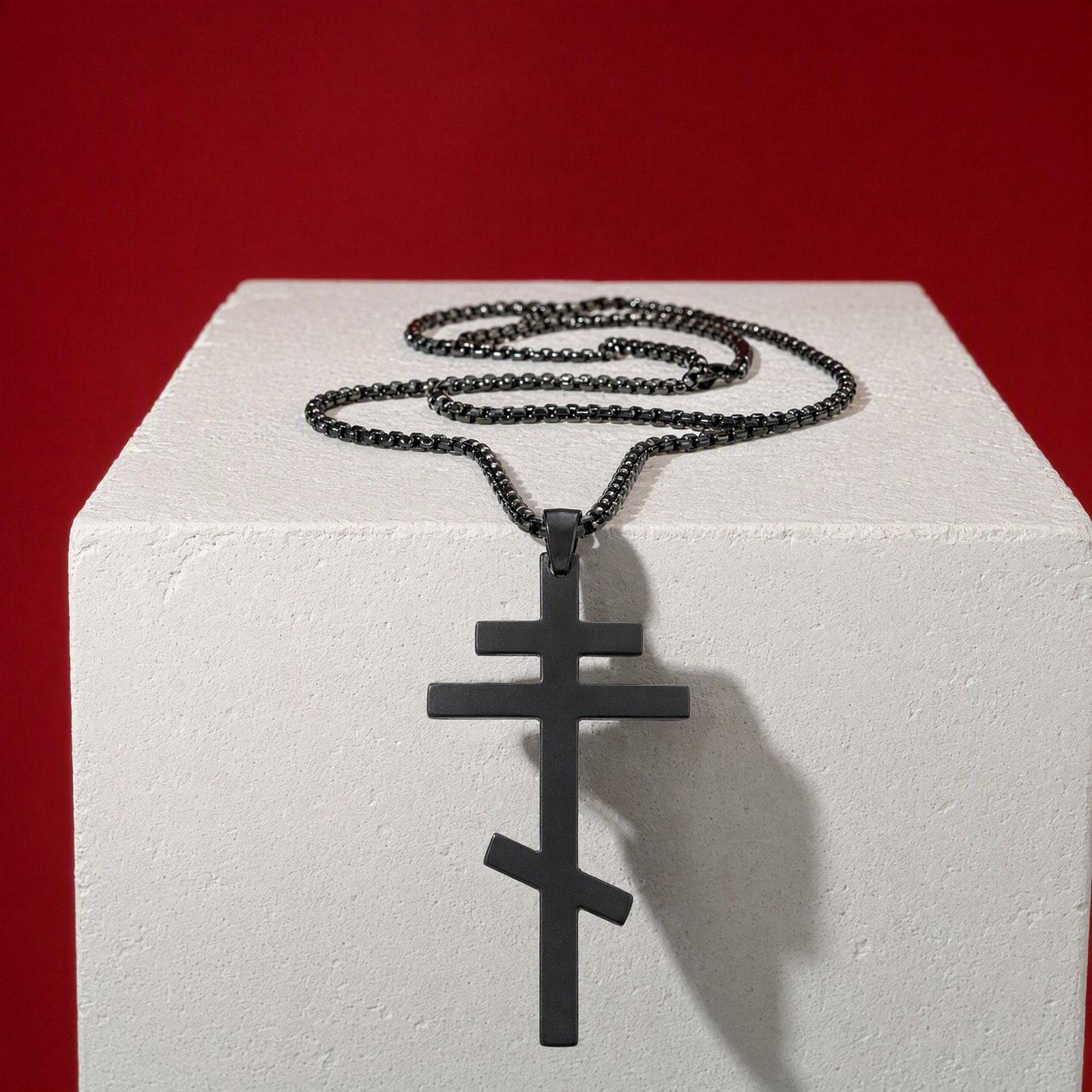
For a reader who still wants a cross, here are the plain Orthodox crosses we do sell, each with no figure on it:
- silver-tone stainless steel
- gold-tone stainless steel
- black stainless steel
Armenian crosses: what they are and where they come from
Armenia is counted as the first nation to take Christianity as its state faith, by tradition in 301, when King Tiridates III was baptized by St Gregory the Illuminator. Its church, the Armenian Apostolic Church, traces its line to the apostles Thaddeus and Bartholomew. In the early 400s St Mesrop Mashtots made the Armenian alphabet so the Scriptures could be read in the people’s own tongue.
From the ninth century Armenians carved the cross into standing stones, the khachkars, raised at churches, roadsides and graves. Thousands survive, and no two are alike. The same cross, with its flowering ends, is what Armenian families wear today as an Armenian cross necklace, give at baptism, and hang in the home.
How it differs from the Orthodox three-bar cross
| Cross | Shape | Figure of Christ |
|---|---|---|
| Armenian cross | Four near-equal arms, each ending in two loops or buds | Usually none |
| Orthodox three-bar cross | Short top bar, long bar, footrest | Often, in low relief |
| Budded cross | Each arm ends in three round buds | Either |
| Coptic cross | Equal arms with three points at each end | Usually none |
The Armenian and the Orthodox three-bar cross are both crosses of the Christian East, but they belong to two families of churches. An Armenian crucifix exists, yet most Armenian cross pendants show the bare cross, seen as the sign of the Resurrection as much as of the Passion.
The meaning of its parts
- The flowering ends. The loops and buds make the cross look as if it is coming into leaf: the wood of death turned into the tree of life.
- The rosette or wheel below. On khachkars the cross often stands on a round rosette, commonly read as a sign of eternity.
- Vines, leaves and pomegranates. They speak of life, fruit and the Eucharist, and frame the cross on stone and in jewelry.
- The knotwork border. Endless interlace around the cross is a mark of Armenian carving, not a code with one fixed meaning.
Placing the Armenian cross beside the crosses we sell
Our catalogue describes its own crosses as three-bar Orthodox crosses with no figure, made for daily wear. The Armenian cross is a religious symbol tied to a country and to its own church, with the shape described above. Our sources do not say how every Orthodox Christian regards it, so we leave that point to your priest. If you were given an Armenian cross and came here to learn about it, the sections above are the short story; a priest of the Armenian Church can tell you the rest.
Who wears Armenian cross jewelry
Armenian Christians receive a cross at baptism, often from the godfather, and many wear it for life. A gold Armenian cross pendant is a common family gift for a baptism, a birthday or a wedding, and Armenian wooden crosses hang in many homes. Friends of Armenian families, and people who love the shape, wear it too. Worn with respect, it is a sign of faith, not a charm.
What we carry instead
We do not stock an Armenian cross. Our closest are the plain three-bar Orthodox crosses with no figure, about 2¼ in, each on a 60 cm chain: silver-tone stainless steel ($64), gold-tone stainless steel ($64) and black stainless steel ($64). An Orthodox priest blesses each cross before it ships. For a cross with buds at its ends, see the budded cross; for the other Oriental Orthodox crosses, see the Ethiopian cross. All our pieces are in our Orthodox cross necklaces. Orders arrive in 5–8 business days: US-based, ships from Florida.
Plain Orthodox crosses to wear every day
Each of the three is imported and comes on its own chain, and the Blessing by an Orthodox priest is given before the cross ships.
МЫ В США. ОТПРАВКА ИЗ ФЛОРИДЫ
Delivery in 5–8 business days.
Want us to stock it?
We don't carry an Armenian cross today. Leave your email and we will write once if we stock it.
Questions
What does the Armenian cross mean?
Wikidata gives three facts: it is a religious symbol, it is a cross, and its country is Armenia. Armenian tradition reads its flowering ends as the Cross become the tree of life, a sign of Christ’s victory over death, and the cross-stones carry it as a prayer and a memorial.
Is there an Armenian cross necklace on this site?
No. We have no Armenian cross in the catalogue, whether as a pendant, a necklace or any other form.
Which of your crosses is closest?
The plain three-bar cross with no figure. We point to it as an editorial choice, since it is the simplest cross in our catalogue, and not because it looks like the Armenian cross.
Can a cross be blessed before delivery?
It can. The priest who gives the Blessing is an Orthodox priest, and the price each cross’s page opens at already includes it, so there is nothing to add up at checkout.
What do Armenian crosses look like?
Most have four arms of near-equal length, and each arm ends in two rounded loops or buds, sometimes with a small point between them. Many rise from a rosette, a wheel or spreading leaves, and most show no figure of Christ. Carved in stone, the same cross fills the face of a khachkar.
Is the Armenian Church Orthodox?
The Armenian Apostolic Church is one of the Oriental Orthodox churches, with the Coptic, Ethiopian, Syriac and Indian Malankara churches. They parted from the Eastern Orthodox churches after the Council of Chalcedon in 451, though they share much of the same early faith, worship and love of the cross.
What is a khachkar?
A khachkar is an Armenian cross-stone, a standing slab carved with a cross over a rosette and surrounded by vines and knotwork. Thousands survive in Armenia and its old lands, and UNESCO listed the art of the khachkar as Intangible Cultural Heritage in 2010.