Ethiopian cross design: the Ethiopian cross, its forms and meaning
Not in our store todayWe do not carry an Ethiopian cross today. The crosses below are our closest: plain Orthodox three-bar crosses to wear every day.
Ethiopian crosses are a family of designs that stand for Christianity in Ethiopia and in Eritrea, and for Ethiopian and Eritrean communities abroad. Abyssinian cross and Ethiopian-Eritrean cross are two more names for them, and Wikidata gives the name Eritrea cross as another.
The design. Most are open latticework. The article takes the interlacing of the lattice to mean life without end, and no two crosses are alike, since each maker can pick a shape and a pattern.
Two forms. A processional cross has a socket at its foot, for fixing it to a staff. Priests hold hand crosses while they give benedictions. Adam’s arms is the name of a motif, arms drawn at the foot, on which processional crosses of this style often stand; the arms are covered with brightly coloured cloth on festive days.
An example. The best-known example is the Lalibela Cross, a big processional cross of this family with rich decoration, believed to come from the 12th century and kept at Lalibela, in the rock-cut church named Bet Medhane Alem.
Lampada does not sell an Ethiopian cross.
The Ethiopian cross: what it is and where it comes from
Ethiopia is one of the oldest Christian lands. In the 4th century King Ezana of Aksum took the faith, taught by St Frumentius, whom St Athanasius of Alexandria made bishop. The Ethiopian Orthodox Tewahedo Church grew from there; tewahedo means “made one”, for the union of God and man in Christ. It belongs to the Oriental Orthodox churches with the Coptic, Armenian, Eritrean and Syriac churches, and for centuries its head bishop came from Alexandria, until it received its own patriarch in the 20th century.
Over those centuries Ethiopian makers turned the cross into an art of its own. Ethiopian crosses are cast, forged or carved in brass, silver, iron and wood, and you see them at every service, at the great feasts and on the necks of the faithful in Ethiopia, Eritrea and their communities in the US.
How it differs from the Orthodox three-bar cross
| Cross | Shape | Figure of Christ |
|---|---|---|
| Ethiopian cross | Pierced lattice, loops and many small arms around a cross | Usually none |
| Orthodox three-bar cross | Short top bar, long bar, footrest | Often, in low relief |
| Coptic cross | Equal arms, three points at each end | Usually none |
| Processional cross | Any form, on a staff | Either |
The Orthodox three-bar cross keeps the outline of the cross of the Gospels. The Ethiopian cross keeps a cross at its heart but surrounds it with interlace, so that the shape of the whole may be round, square or a flame of points.
Neck, hand and processional crosses
- Neck crosses are small and flat, often silver, brass or wood, and worn on a cord from baptism. This is the Ethiopian cross necklace most people mean.
- Hand crosses are held by priests, who bless the faithful with them; the people kiss the cross.
- Processional crosses stand on a staff and lead the procession at the feasts, often with colored cloth hung from the arms.
Collectors name many styles after places, such as the Ethiopian Axum cross, the Lalibela cross and the Gondar cross. Ethiopian cross jewelry sold abroad copies these forms, in silver, gold tone and wood.
The meaning of the lattice
In the lattice the lines never stop, wound around the cross that gives life. Many crosses add small crosses at the tips of the arms, or stand on a square base. Because each maker picks a pattern, no single reading fits every cross.
Crosses carried in the church, and a plain one for the neck
Our source places the processional cross in the church’s ceremonies and the hand cross in a priest’s hand when he gives a benediction. It adds that the Lalibela Cross may be rubbed on believers by a priest, to bless them. Those are crosses of ceremony. The plain Orthodox cross we offer is made for a different purpose, which the catalogue states in a phrase: a simple cross to wear every day, hung on a 60 cm chain and carrying no figure. Neither stands in for the other.
What we carry instead
We do not stock an Ethiopian Orthodox cross. Our closest are the plain three-bar Orthodox crosses with no figure, about 2¼ in, each on a 60 cm chain: silver-tone stainless steel ($64), gold-tone stainless steel ($64) and black stainless steel ($64). An Orthodox priest can bless each one before it ships. For the other crosses of this family see the Coptic cross and the Armenian cross; every piece we offer is in our Orthodox cross necklaces. Orders arrive in 5–8 business days: US-based, ships from Florida.
A plain Orthodox cross for everyday wear
Silver-tone, gold-tone and black, each with its chain, and blessed by an Orthodox priest before it ships.
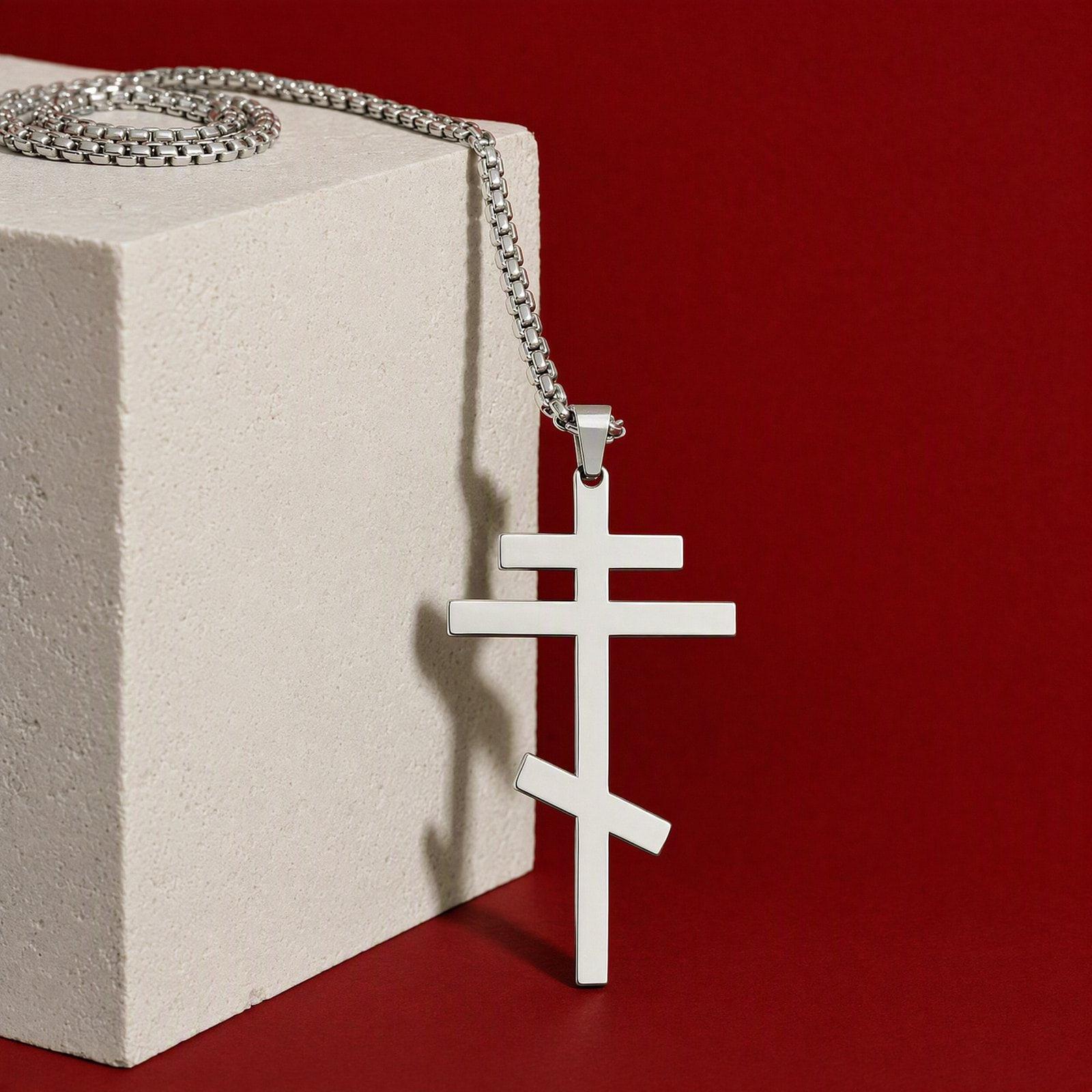
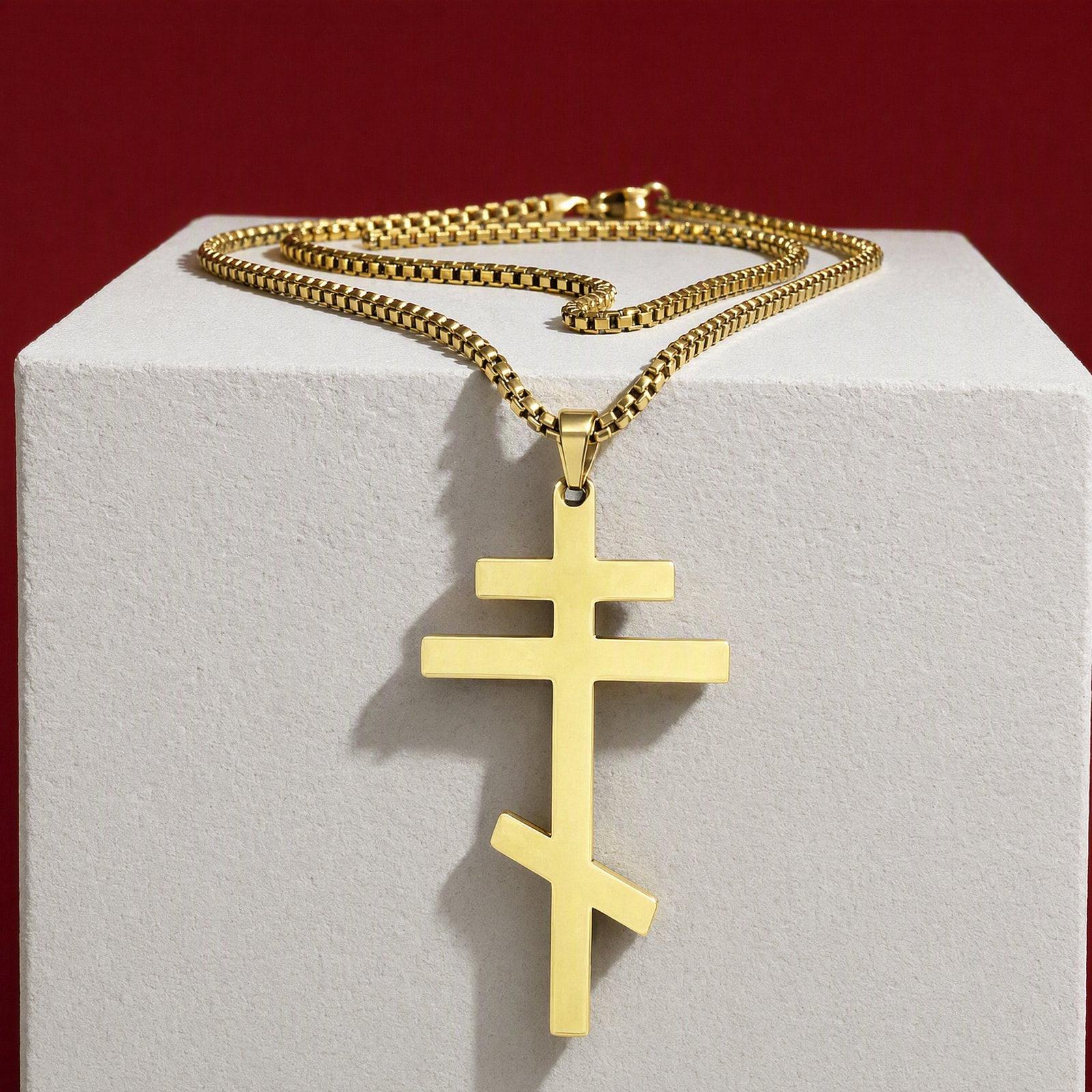
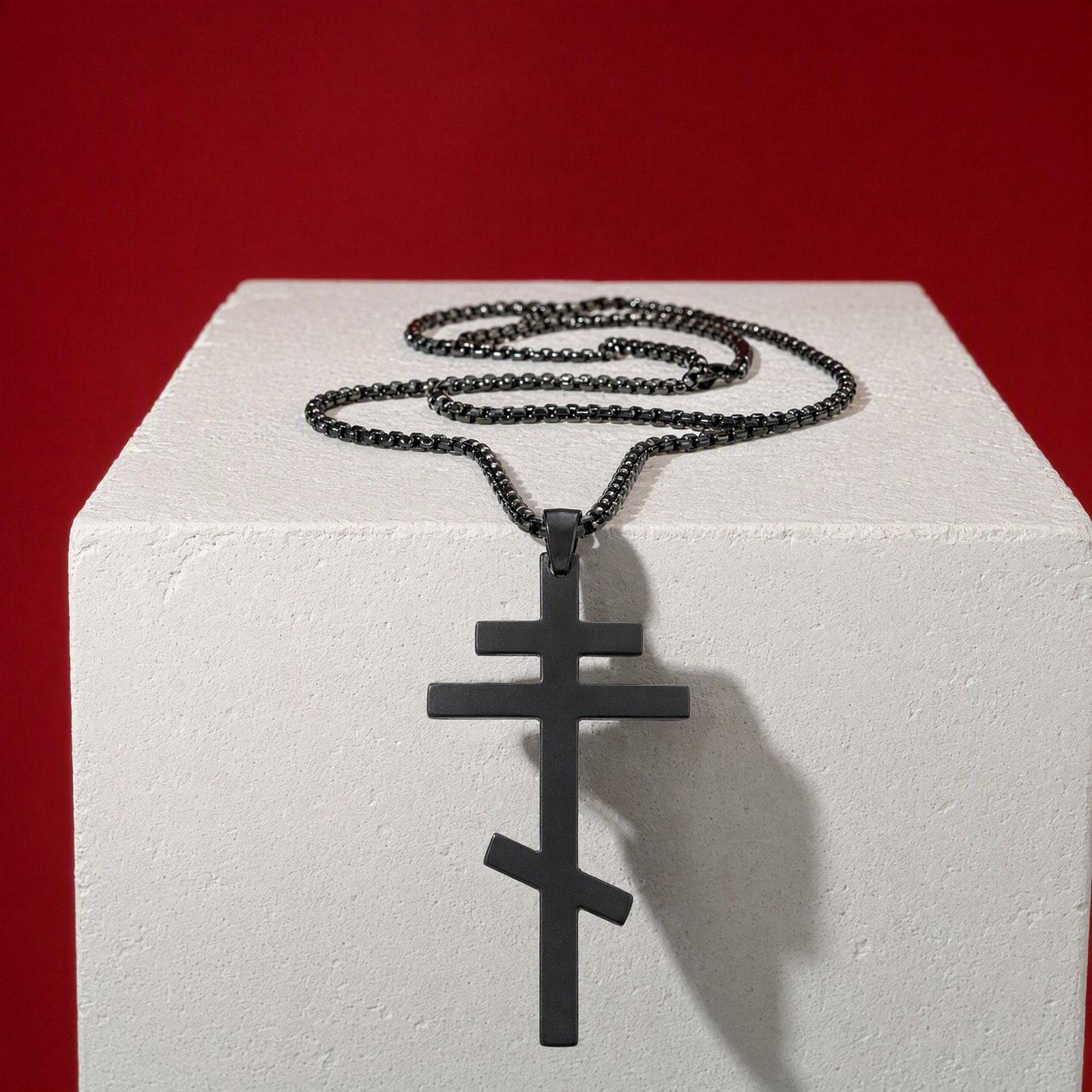
МЫ В США. ОТПРАВКА ИЗ ФЛОРИДЫ
Delivery in 5–8 business days.
Want us to stock it?
We don't carry an Ethiopian cross today. Leave your email and we will write once if we stock it.
Questions
What is an Ethiopian cross?
It is one of a family of designs that stand for Christianity in Ethiopia and Eritrea. Most are open latticework, and no two are alike.
What does the lattice on an Ethiopian cross mean?
The source takes the interlacing of the lattice to mean life without end.
What is the Lalibela Cross?
A big, ornate processional cross of this family, believed to come from the 12th century, kept at Lalibela, in the rock-cut church named Bet Medhane Alem.
Do you sell an Ethiopian cross necklace?
No. There is no Ethiopian cross in the Lampada catalogue. The plain three-bar Orthodox cross is the nearest we have to offer.
Is the Ethiopian cross the same as the Coptic cross?
They are close relatives. For centuries the Ethiopian Church received its head bishop from the Coptic Church of Alexandria, and both belong to the Oriental Orthodox family. The Coptic cross is a compact cross with three points on each arm; the Ethiopian cross is usually larger, pierced and far more varied.
What is an Ethiopian Orthodox cross necklace worn on?
Many Ethiopian Orthodox Christians wear the neck cross on a simple cord, often dark blue, received at baptism and worn for life. Metal chains are common too. The neck cross itself is often small and flat, in silver, brass or wood, and as open in design as the great church crosses.
What is Meskel?
Meskel is the Ethiopian feast of the Finding of the True Cross by St Helen, kept on September 27, or 28 in a leap year. Bonfires topped with a cross of daisies are lit in towns and villages, and UNESCO lists the celebration as Intangible Cultural Heritage.