Psalm 30, which the Church numbers 29
Psalm 30 (Septuagint 29). Two numberings are in use. English Bibles that follow the Hebrew, the King James among them, give this psalm the number 30; the Greek Psalter of the Orthodox Church gives it 29. The King James text has 12 verses and Brenton’s Septuagint text has 13; the two count the verses differently. The King James text opens with a title line.
The text. This page does not print the verses of this psalm. They are in the King James Bible under Psalm 30 and in a Septuagint under Psalm 29.
What the psalm says. This page does not print the verses, but the psalm can be told from them. It opens with praise, I will extol you, O Lord, for you have lifted me up and have not let my foes rejoice over me. The one who prays says that he cried to the Lord and that the Lord brought up his soul from the grave and kept him alive, and he calls the saints to sing to the Lord and to give thanks at the remembrance of his holiness. Then comes the line the psalm is best known for: the anger of the Lord is for a moment, his favour is for a life, and weeping may endure for a night, but joy comes in the morning. The second half looks back at a time of ease when he said he would never be moved, and at the hiding of the Lord’s face that troubled him, and at a question to the Lord whether the dust can praise him. The last verses are a turning of mourning into dancing, sackcloth put off and gladness put on, so that his glory may sing to the Lord and not be silent, and he will give thanks for ever. A reader who wants the words will find them in any Bible at Psalm thirty, or in a Septuagint under the number the page gives.
The psalm is built as a story with a before and an after. Before: the one who prays had thought he would never be moved, and said so, and then the Lord hid his face and he was troubled. After: he cried to the Lord and made supplication, and the Lord turned his mourning into dancing, took off his sackcloth and clothed him with gladness. In between there is an argument he puts to the Lord, which is that there is no profit in his death, since the dust cannot praise and cannot declare the truth of the Lord. The reason he gives for being brought up is therefore not his own comfort but the praise that only a living voice can give, and the psalm ends where it should, with that voice singing and not being silent, and giving thanks for ever.
Where the psalm names time, it does so in pairs: a moment and a life, a night and a morning. The pairs are its way of saying that the sorrow was real and short beside the favour that followed it.
Place in the Psalter. Kathisma 4 contains this psalm. A kathisma is one of the twenty parts into which the Church divides the Psalter for reading.
In the Service Book. We found no page of Isabel F. Hapgood’s Service Book of the Holy Orthodox-Catholic Apostolic Church that prints this psalm under its own Psalm heading, so this page names no service for it.
The Psalms in the Church’s prayer
The Church prays the Psalms in two ways: in the services, where they are set among the hymns and prayers, and in the Psalter read in kathismata, twenty readings in all. Psalm 30 is in kathisma 4.
The Church speaks of what a psalm says and of where it is read; it does not treat a psalm as a charm. Read Psalm 30 as the Church does, with the words in front of you, in the translation you know best and in the Septuagint’s.
For someone in a hard season
In the Comfort Set you receive a folding icon of their patron saint beside the Guardian Angel, a bronze-tone Holy Face crucifix, a prayer rope, a gold-tone Mother of God icon in an arched frame and a printed prayer with their names, and the story of their saint’s life and feast day, sent to you by email, $209. The Blessing is offered on its page. With the Blessing, $258 (normally $348).
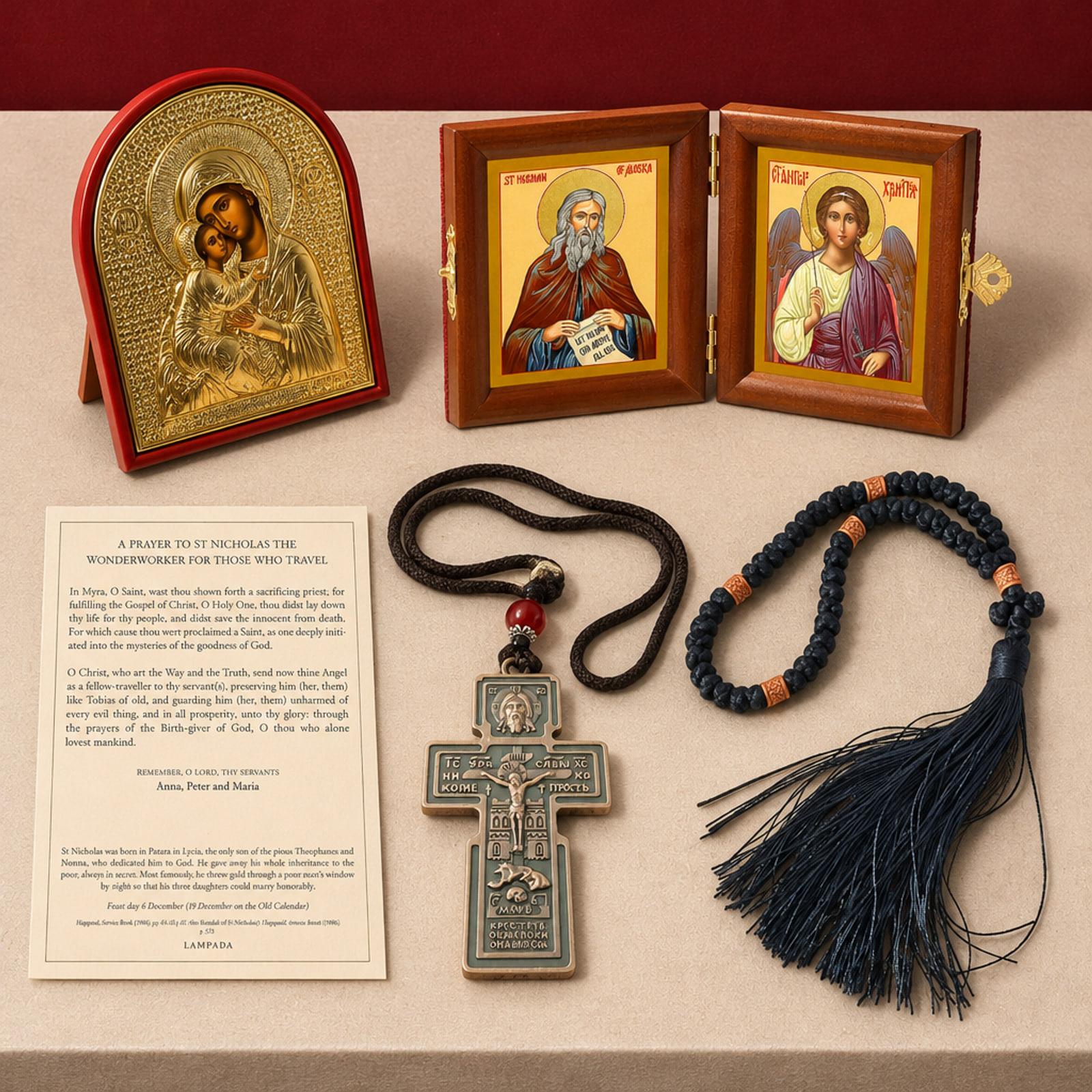
- Blessing, $49. Blessed by an Orthodox priest before it ships.
- Gift packaging, $20
Questions
What is Psalm 30 in the Septuagint?
It is Psalm 29. The King James Bible numbers it 30; the Septuagint, which the Orthodox Church reads, numbers it 29. The psalm is the same.
How many verses does Psalm 30 have?
The King James text has 12 and Brenton’s Septuagint text has 13, because the two count the verses differently.
Which kathisma is Psalm 30 in?
It is in the fourth, kathisma 4. The Church divides the Psalter into twenty kathismata and reads them in order.
Is Psalm 30 printed in the service book?
We did not find it under a Psalm heading in Isabel F. Hapgood’s service book, so this page names no service for it.
Can the Comfort Set be blessed before it ships?
Yes. Choose the Blessing on its page and an Orthodox priest blesses it before it ships. With the Blessing, $258 (normally $348).