A short prayer for the dead: Give rest with the Just, O Saviour
A short prayer for the dead. The service book prints this hymn in the General Panikhida, the Requiem Service. The words below are those of Isabel F. Hapgood’s English Service Book of the Holy Orthodox-Catholic Apostolic Church, printed in Boston in 1906, on page 567:
“Give rest with the Just, O Saviour, unto thy servants, and establish them in thy courts, as it is written: Regarding not, in that thou art good, their sins, whether voluntary or involuntary, and all things, committed either with knowledge or in ignorance, O thou who lovest mankind.”
Where to find it. In Hapgood’s Service Book, page 567: the book prints this hymn in the General Panikhida (Requiem Service).
The hymn asks the Saviour to give rest with the Just to his servants and to establish them in his courts, as it is written. It asks him, in that he is good, not to regard their sins, whether voluntary or involuntary, and all things committed either with knowledge or in ignorance. It ends by naming him as the one who loves mankind.
Reading the hymn. The hymn is a single sentence with two requests and one reason. The requests are for rest and for a place in the courts of the Lord. The reason, given in the middle, is that he is good, and the second request depends on it: regarding not their sins. The sins are listed in the book’s usual way, voluntary or involuntary, with knowledge or in ignorance. The hymn closes with the title the Church uses for the Lord at the Requiem, the one who loves mankind.
A note on the words. The hymn is a request that the Lord not look at sins, and it lists them by kind: voluntary or involuntary, and committed with knowledge or in ignorance. The phrase as it is written refers to Scripture, as the hymn says; it does not name the passage, and neither does this page.
The hymn can be read as a prayer in two halves of nearly equal length. The first asks where the departed are to rest, with the Just and in the courts of the Lord. The second asks what the Lord should not do, which is to regard their sins. The request that he regard them not rests on the single word that comes before it, good.
About the translation. The words are Isabel F. Hapgood’s, from the book printed in Boston in 1906. The text above was read from the page twice, by two different readings, and every difference between them was settled against an image of the printed page. Spaces before marks of punctuation have been tidied; the words are exactly the book’s.
A hymn of the Requiem
The book prints this hymn in the General Panikhida, the Requiem Service, as a troparion. The hymn is short, and it is one of several in that service that have pages on this site. It asks for rest with the Just and for the sins of the departed not to be regarded. It does not describe the state of the departed, and this page does not either.
In memory of someone dear
The Memorial Set, $229, holds a folding icon of the Holy Trinity and Christ, a wooden wall crucifix, a Christ Pantocrator icon in silver and gold, a prayer rope and a printed prayer with the names you give us. You give us the names for the printed prayer. With the Blessing, $278 (normally $377).
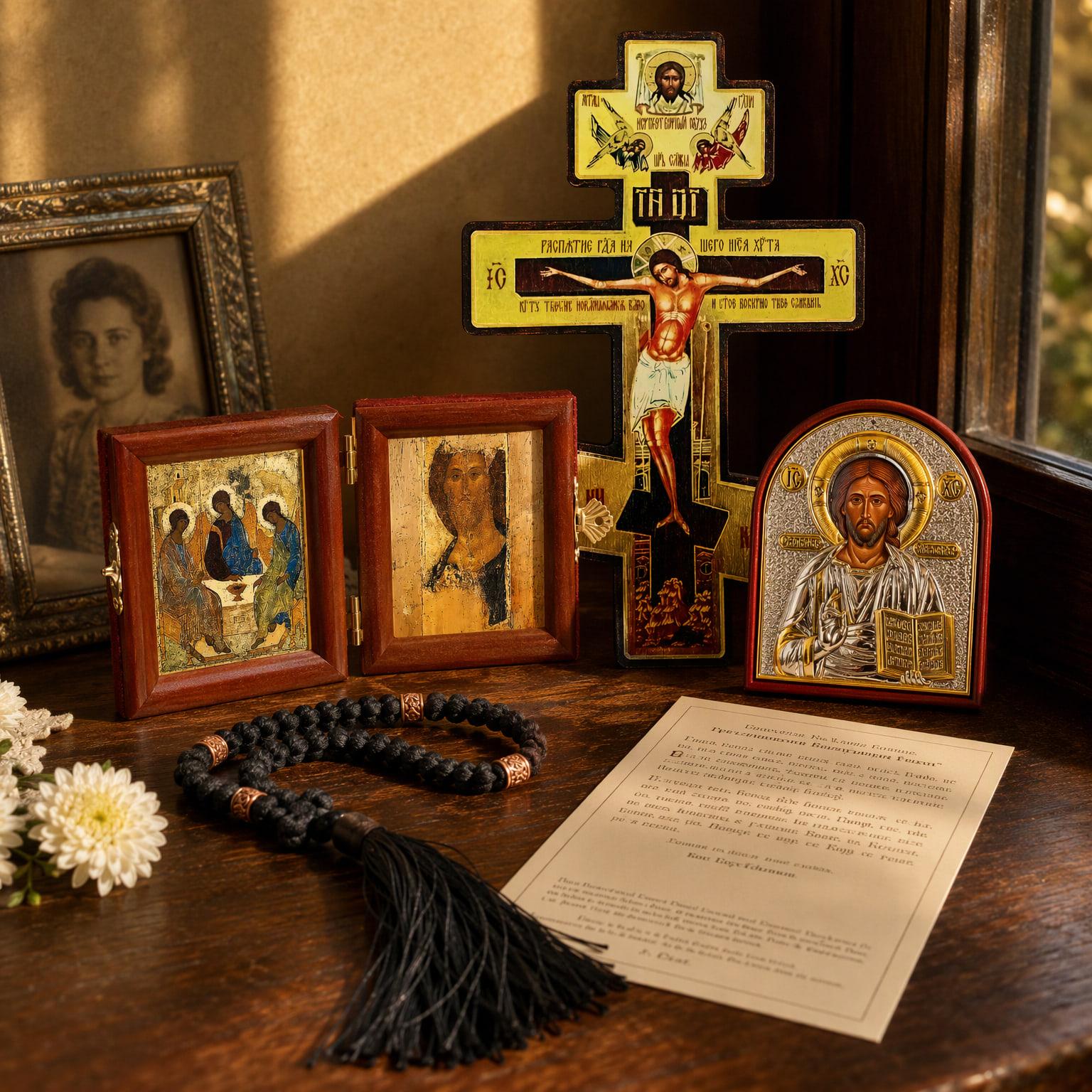
- Blessing, $49. Blessed by an Orthodox priest before it ships.
- Gift packaging, $20
Questions
What is the short prayer for the dead?
A hymn printed in the General Panikhida, on page 567: Give rest with the Just, O Saviour, unto thy servants.
What does it ask the Saviour not to regard?
Their sins, whether voluntary or involuntary, committed with knowledge or in ignorance.
Where do the servants rest?
The hymn asks that they be established in the Lord’s courts, as it is written.
How does this hymn differ from the memorial hymn?
The memorial hymn begins with the Saints give rest, O Christ, and ends with Alleluia. This one begins give rest with the Just, O Saviour, and asks that sins not be regarded. Both are printed in the General Panikhida, on page 567.
Can the Memorial Set be blessed before it ships?
Yes. Choose the Blessing on its page and an Orthodox priest blesses it before it ships. With the Blessing, $278 (normally $377).