14k gold Orthodox cross: coming to Lampada, and what to know first
Not in our store todayWe do not carry 14k or other karat gold crosses today. Below: what 14k means, how to choose and care for a gold cross and chain, and our closest items, Orthodox crosses in gold-tone stainless steel.
A 14k gold cross chain is a cross and chain made of 14 karat gold, which is 58.3 percent gold, and this page explains that mark and what to look for in one. Lampada does not sell 14k gold Orthodox crosses today. They are coming to the catalogue, and this page is for anyone who wants to know what to look for before they arrive. The gold crosses we sell now are gold-tone: stainless steel with a gold-tone finish, and not gold itself. The catalogue records no karat and no hallmark for any of them.
What 14 karat means. Karat counts the parts of gold in 24. Wikipedia gives 14 karat as 58.3 percent gold, marked 585 in parts per thousand, and calls it the most common level for jewellery in the United States. 18 karat is 75 percent, marked 750, and 24 karat is taken as fine gold, nearly all gold. The karat number or the mark tells you the purity. The word gold in a listing does not.
The closest crosses we sell today are gold-tone stainless steel:
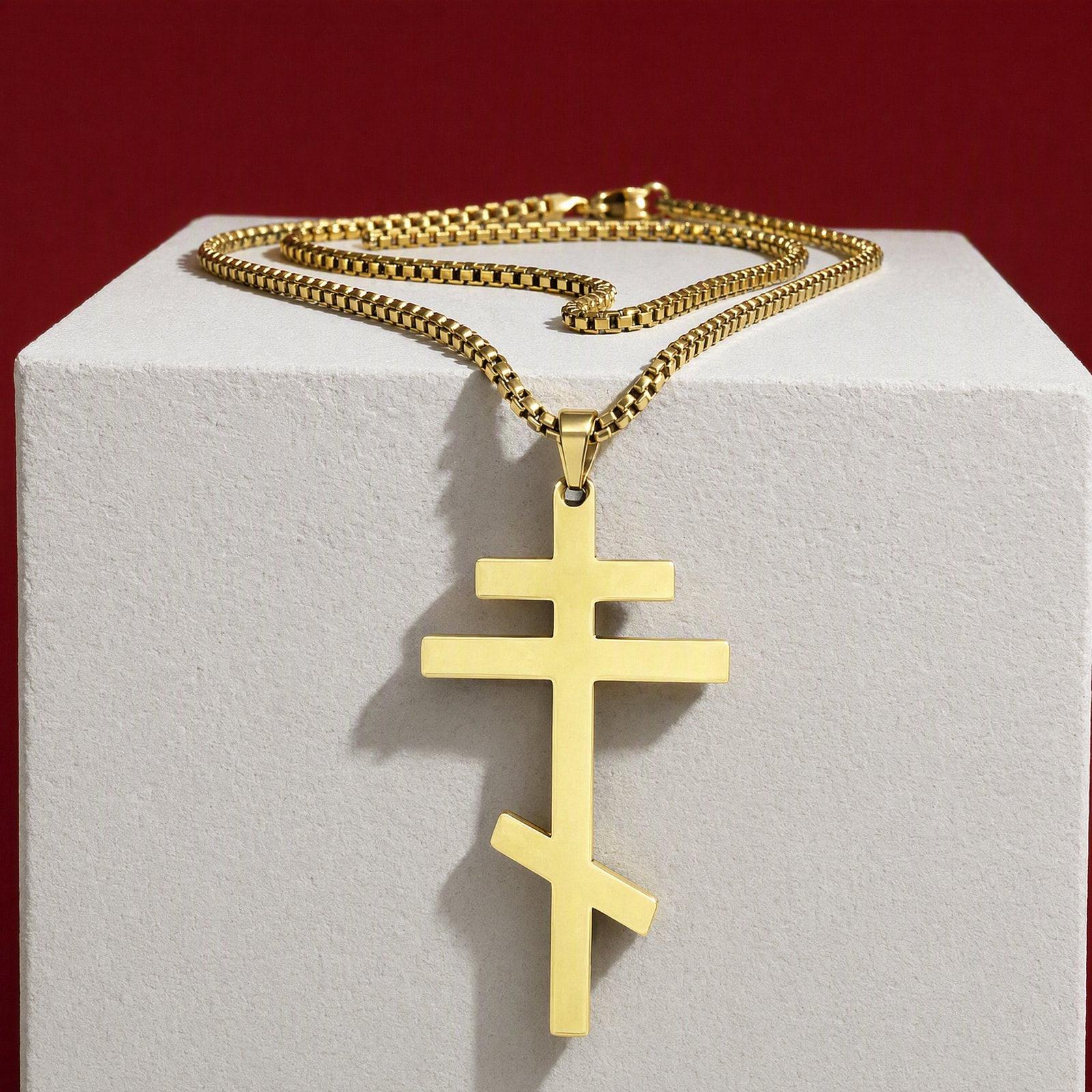
- the plain three-bar cross on a 60 cm chain;
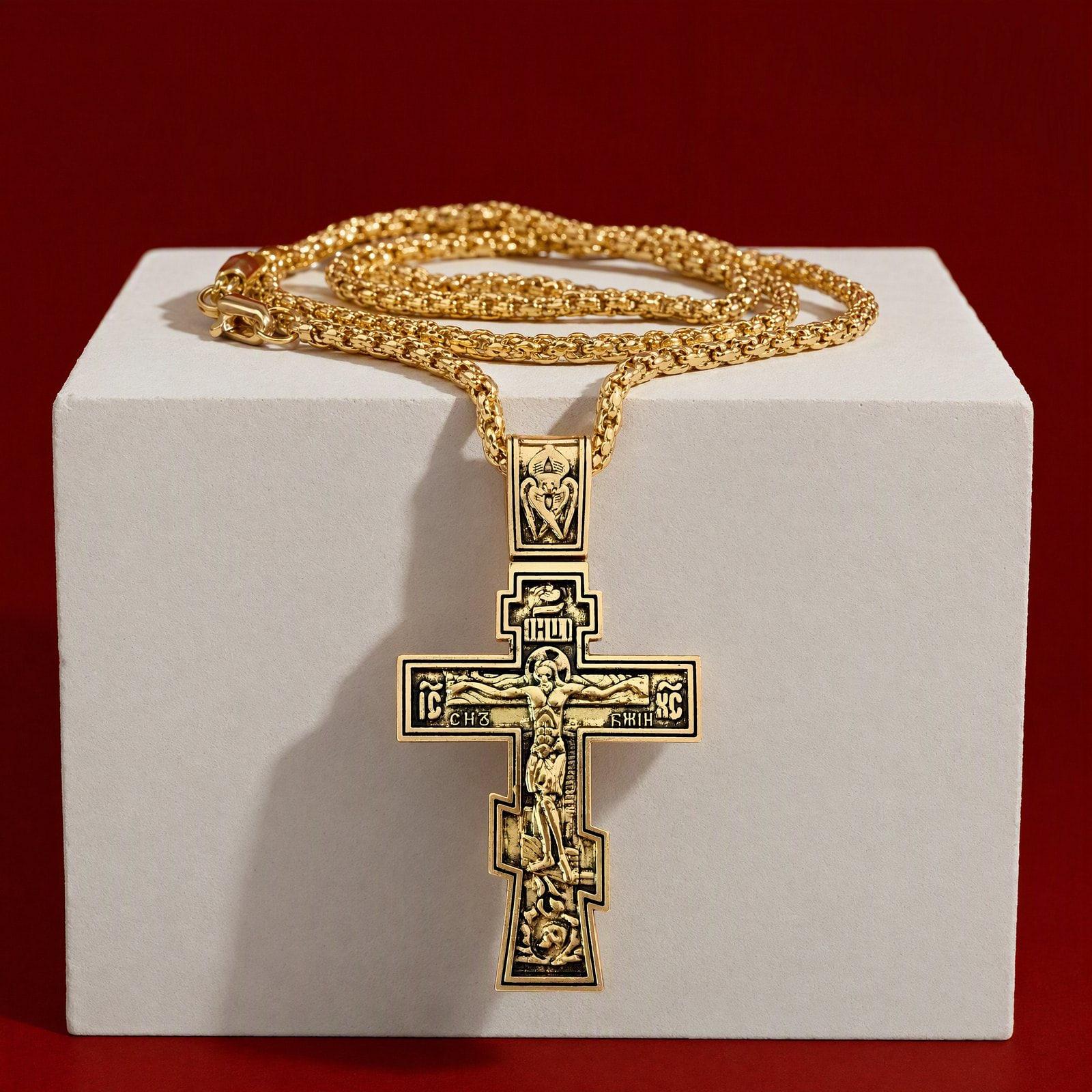
- the crucifix with Let God arise on the back, also on a 60 cm chain;
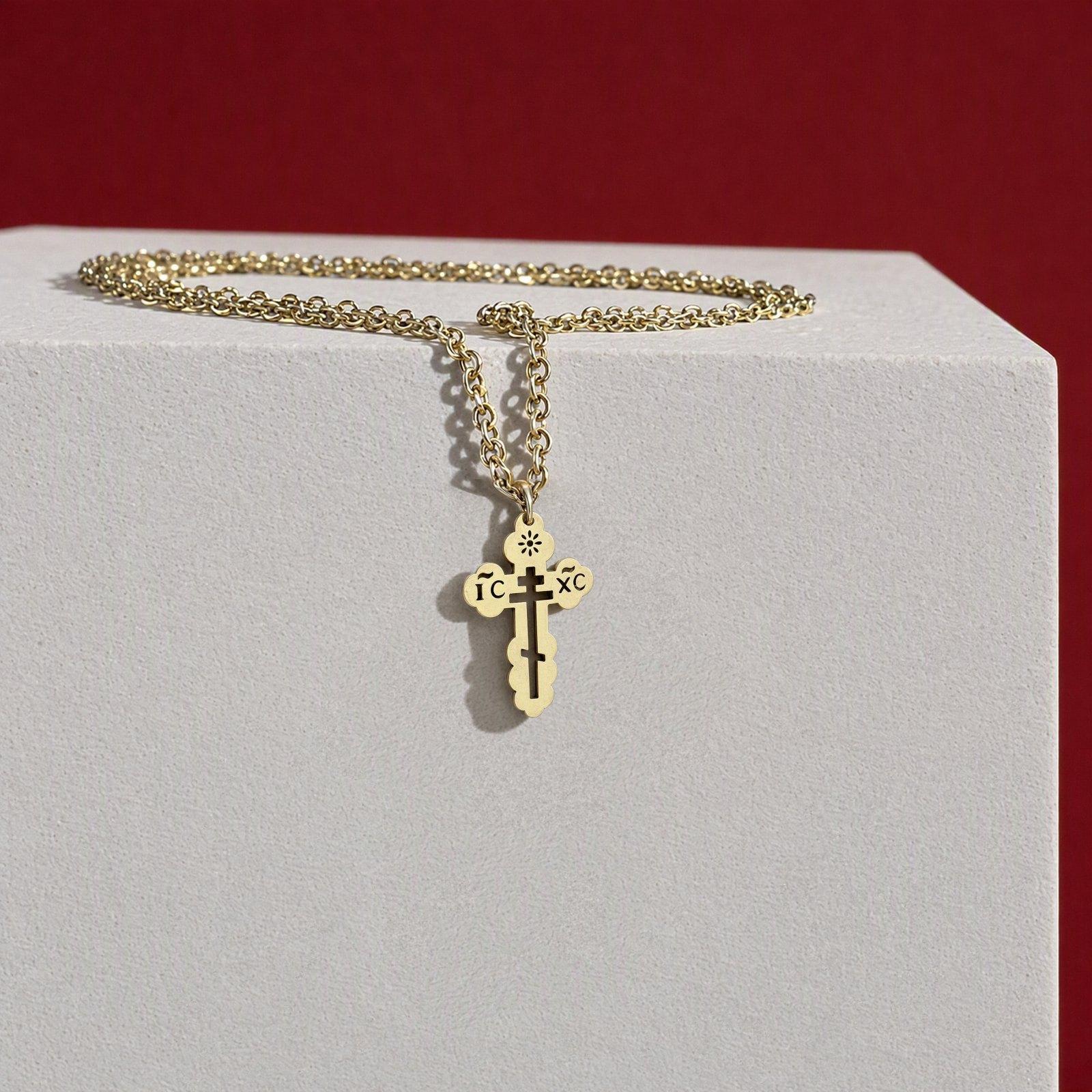
- the small cut-out cross with the letters IC XC, a pendant;
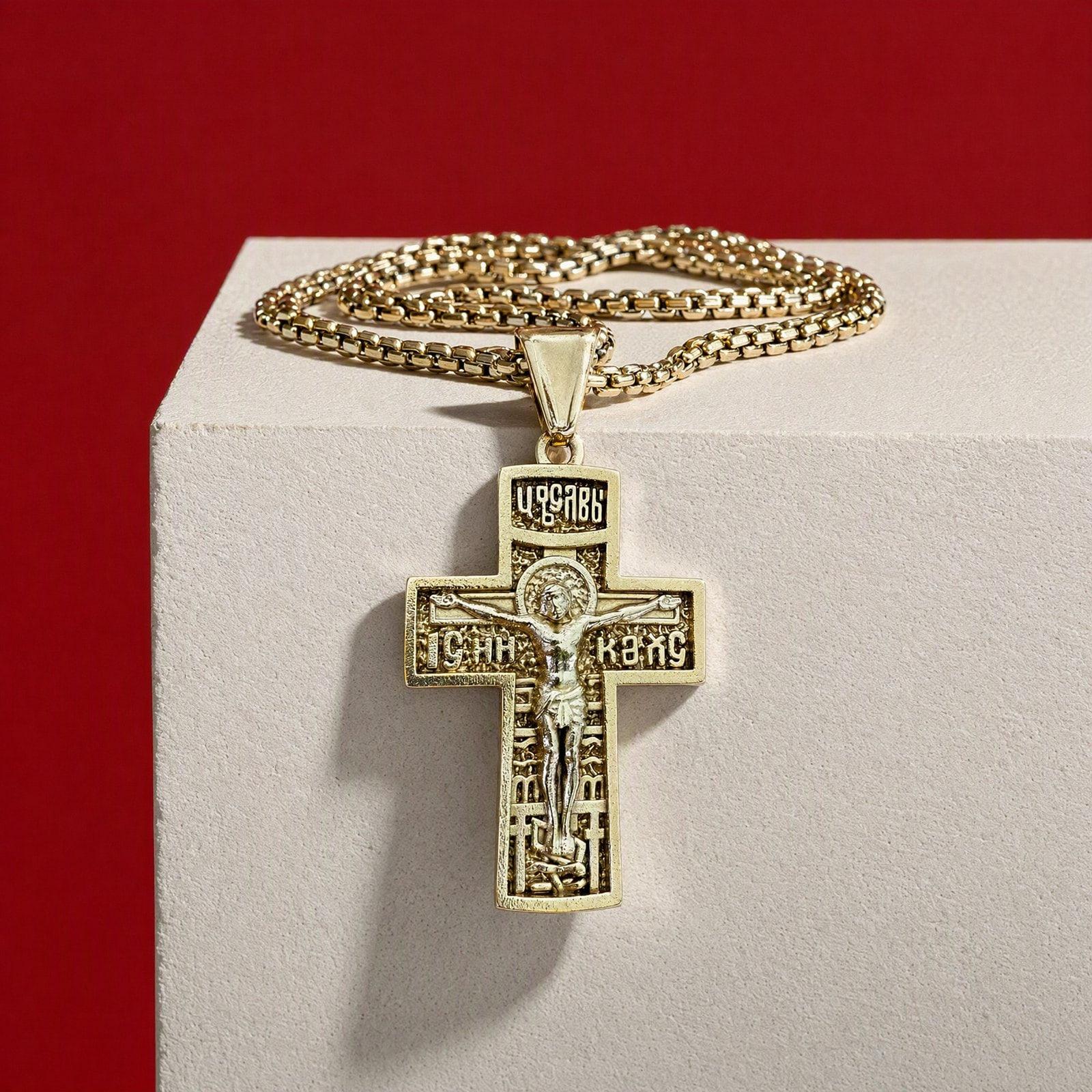
- the crucifix under the title King of Glory, a pendant.
14k gold cross chain: what to look for
A 14k gold cross and chain is a gift meant to last a lifetime, often for a baptism, a first communion, a wedding or a milestone birthday. Before you buy one, check:
- The stamps. Look for 14K, 14KT or 585 on the cross, on the chain and on the clasp. A listing that only says “gold” tells you nothing about the content.
- The weight. Gold is priced by the gram, so two crosses of the same size can differ a lot in price. Ask for the weight.
- Hollow or cast through. A hollow cross is lighter and cheaper but dents more easily.
- The chain. A fine cable or box chain suits a small cross; a rope or curb chain carries a larger one. The chain should be 14k as well, or the weakest part decides how long it lasts.
- The length. For a woman’s 14k gold cross necklace, 16 to 18 in is the most common; for a man, 20 to 24 in.
What karat means
| Karat | Gold content | Mark | Where you see it |
|---|---|---|---|
| 10k | 41.7% | 417 | The lowest karat sold as gold in the United States |
| 14k | 58.3% | 585 | The most common for jewelry in the United States |
| 18k | 75% | 750 | Typical in Europe; used where stones are set |
| 22k | 91.6% | 916 | Common in South Asian and Middle Eastern jewelry |
| 24k | 99.9% | 999 | Very soft; rarely used for a chain worn every day |
The rest of a karat alloy is other metals, usually silver, copper and zinc. They decide the color and make the gold harder.
Yellow, white and rose 14k gold
The same 14 karat can come in three colors. Yellow gold is gold with silver and copper. White gold has a white metal such as palladium or nickel in it and is usually plated with rhodium for a bright finish. Rose gold has more copper. The gold content is the same in each; only the other metals change. Our page on white and rose gold Orthodox crosses covers the other two colors.
What makes a cross Orthodox, whatever the metal
OrthodoxWiki describes a small cross on a chain round the neck as the usual thing for an Orthodox Christian to wear, and the three-bar cross as the form many Orthodox churches use: a short top bar for the notice above Christ, a long middle bar for his arms and a lowest bar for the footrest. Those are what make a cross Orthodox. A karat figure says how much of the metal is gold and nothing about the form or the words on the cross. When gold crosses arrive, the same questions apply as to steel ones: the form, the words, the chain, and whether an Orthodox priest has blessed it. More on the form in the Orthodox three-bar cross.
Gold-filled, plated and gold-tone
| Label | What it is |
|---|---|
| 14k gold | Gold alloy all through |
| Gold-filled | A thick layer of gold bonded to a base metal |
| Gold-plated or vermeil | A thin layer of gold over a base metal or silver |
| Gold-tone | A gold color on another metal, with no gold content |
Every gold cross we sell today is gold-tone stainless steel. It is a cross for everyday wear at a fraction of the price of karat gold; it is not a gold heirloom, and we do not call it one. See gold-tone Orthodox crosses for the full range.
Caring for a 14k gold cross
Clean a gold cross in warm water with a drop of mild soap, using a soft brush for the corners, then rinse and dry it. Take it off for the pool, cleaning with bleach and heavy work, because chlorine can weaken a karat alloy over time and a chain can catch. Store it apart from other jewelry so harder stones do not scratch it, and have a jeweler check the clasp now and then. Read how to wear an Orthodox cross for the customs that come with it.
What we carry instead
Our closest items are Orthodox crosses in gold-tone stainless steel, each at its live price: the plain three-bar cross on a 60 cm chain ($64), the crucifix with Let God arise on the back, on a 60 cm chain ($64), the small cut-out IC XC cross, a pendant ($54), and the King of Glory crucifix, a pendant ($54). The whole range is in all our Orthodox cross necklaces. Orders arrive in 5–8 business days: US-based, ships from Florida.
The closest gold-tone crosses on sale now
Each cross below is gold-tone stainless steel, and the email box under them is the waiting list for the gold pieces.
CU SEDIUL ÎN SUA. EXPEDIERE DIN FLORIDA
Delivery in 5–8 business days.
Want us to stock it?
We don't carry a 14k gold cross chain today. Leave your email and we will write once if we stock it.
Questions
Does Lampada sell 14k gold Orthodox crosses?
Not yet. They are coming to the catalogue. Until then the gold crosses on sale are gold-tone stainless steel, from the small IC XC cross to the crucifixes on a chain.
What does 14k mean on a cross?
It means 14 parts of gold in 24, which is 58.3 percent, with other metals making up the rest. Wikipedia says 14 karat is marked 585 and is the most common level for jewellery in the United States.
Is 14k or 18k better for an Orthodox cross?
We hold no source that ranks one above the other for a cross. Wikipedia says 18 karat, at 75 percent gold, is the highest level used where stones are set, because the gold must be firm enough to hold a stone. A plain cross with no stones has no such need.
Are the gold-tone crosses made of gold?
No. They are stainless steel with a gold-tone finish, and the catalogue states no karat and no hallmark for them. We call them gold-tone for that reason.
How will I hear when gold crosses arrive?
Leave your email in the box on this page. It is the waiting list for the gold pieces.
What should I look for in a 14k gold cross chain?
A 14K or 585 stamp on the cross, on the chain and on the clasp; a weight in grams, since gold is priced by weight; and a chain strong enough for the cross. A hollow cross is lighter and cheaper but dents more easily than one cast through.
Does a 14k gold cross tarnish?
Gold itself does not rust. Because 14 karat is only 58.3 percent gold, the other metals in it can dull a little over the years, and a soft cloth with warm water and mild soap brings back the shine.
What is the difference between 14k gold and gold-filled or plated?
A 14k cross is gold alloy all through. Gold-filled and gold-plated pieces have a layer of gold over a base metal, which can wear with years. Gold-tone, like our crosses, is a gold color on stainless steel, with no gold content.