Orthodox three-bar cross meaning
The three bar cross is the cross most Orthodox Christians wear: a short bar at the top, a long crossbar, and a slanted footrest below, eight ends in all. The outside source for the Orthodox three-bar cross is brief. Wikidata sums it up as three beam slanted cross and places it among the crosses. It does not explain the beams or the slant, and gives no meaning for either.
Lampada now sets out the Church’s traditional reading of the three bars below, bar by bar. What we can give with confidence is what our own catalogue says of the plain version: three bars, no figure, stainless steel, a 60 cm chain, made for daily wear.
Those crosses are on this page. The finish is the choice:
| Finish | Material, as the catalogue words it |
|---|---|
| Silver-tone | silver-tone stainless steel |
| Gold-tone | gold-tone stainless steel |
| Black | black stainless steel |
Our catalogue also lists an eight-pointed wooden crucifix. It is a separate item from these three plain crosses and is not shown here.
What the three bar cross means, bar by bar
The three-bar cross draws the cross of the Crucifixion as the Gospels describe it, with every part in its place.
| Bar | What it stands for |
|---|---|
| Short top bar | The title board Pilate had nailed above Christ’s head, “Jesus of Nazareth, King of the Jews” (what INRI means); Orthodox crosses often write “King of Glory” or IC XC there instead |
| Long crossbar | The beam to which Christ’s hands were nailed |
| Slanted lower bar | The footrest, tilted up toward the thief who repented and down toward the one who did not |
The letters often found on it are IC XC, the first and last letters of “Jesus Christ” in Greek, and NIKA, “conquers”. Some crucifixes add a small skull at the foot: Adam’s skull, for the old tradition that Christ was crucified over Adam’s grave on Golgotha.
Where the three-bar cross comes from
Early Christians drew the cross as a simple four-armed sign. The top bar and the footrest came from the way the cross of Christ is shown in Byzantine icons and frescoes of the Crucifixion, and over the centuries the full three-bar form became the cross of the Slavic Orthodox churches: on church domes, on graves, on the vestments of priests and around the necks of the faithful. Greek-tradition churches use it too, beside the plain four-armed cross. Today it is the cross most people picture when they hear “Orthodox cross”. Our three-bar cross explained goes further into its history.
How it differs from other crosses
| Cross | Bars | Where you see it |
|---|---|---|
| Orthodox three-bar (8 pointed) | Three, the lowest slanted | Orthodox churches, especially the Slavic ones |
| Patriarchal cross | Two, both straight | Archbishops’ crosses, heraldry |
| Latin cross | One, the upright longer below | Most Western churches |
| Greek or Byzantine cross | One, four equal arms | Greek churches, Byzantine art |
The slanted footrest is the quickest way to tell an Orthodox cross apart. For how it compares with a Catholic crucifix, see Orthodox cross vs Catholic cross.
Who wears a three bar cross necklace
In Orthodox families a child receives a cross at baptism and wears it from then on, under the clothes and close to the heart, as a sign of belonging to Christ rather than as jewelry. Converts receive one at their reception into the Church. Many people who are not Orthodox wear the three-bar cross too, drawn to its old shape, and that is welcome. Our guide on how to wear an Orthodox cross covers chains, length and everyday wear.
A cross with no figure, worn plain
These three are the crosses in our catalogue that carry no figure at all. They show the shape and nothing else: no Crucifixion and no saint. The guide above gives the Church’s traditional reading of the three bars, and its comparison with other crosses. Each cross is imported, comes on its chain, and can be blessed by an Orthodox priest if you ask. A reader from another tradition can take the page for what it is, a description of a plain cross and nothing more.
What we carry
- The plain three-bar cross, about 2¼ in, no figure, on a 60 cm chain, in silver-tone ($64), gold-tone ($64) or black stainless steel ($64). See the plain three-bar cross.
- The IC XC three-bar cross, a small cut-out cross with the letters IC XC, 1⅜ in tall, easy to wear under any shirt, in silver-tone ($54) or gold-tone ($54).
- The Family Crosses Set ($239): plain three-bar crosses in gold-tone, silver-tone and black and a black and gold-tone crucifix, each on a 60 cm chain, with an 8 in wooden wall crucifix.
Our crosses are stainless steel in a silver, gold or black finish. Each price is the one the item’s page opens at. Orders arrive in 5–8 business days: US-based, ships from Florida.
Plain three-bar crosses for everyday wear
Each cross arrives on its chain, and the Blessing is there if wanted. Two smaller three-bar crosses with the letters IC XC, and a set of four crosses for a family, sit beside them.
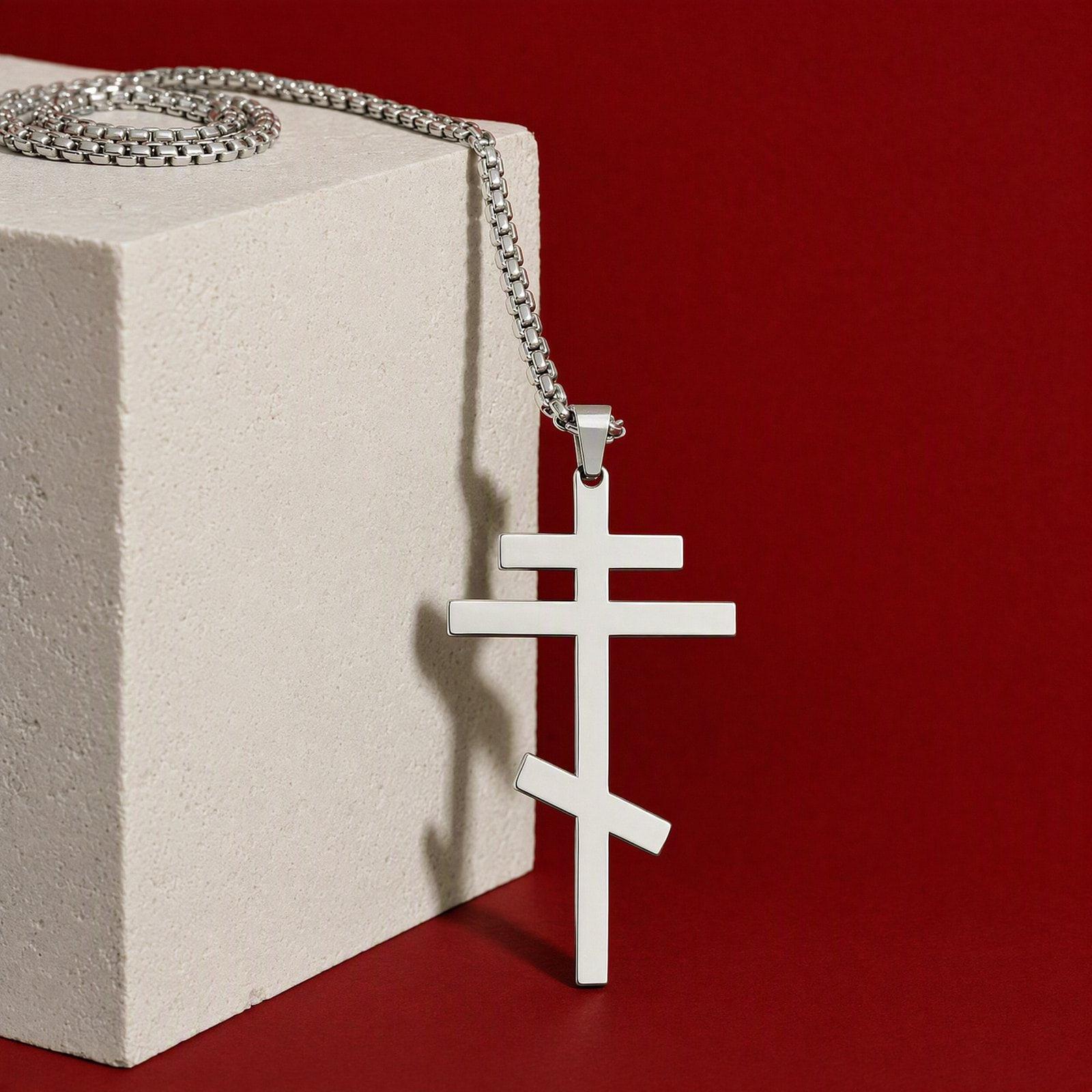 Cruce
Three-Bar Bright
Argintiu · Lănțișor 60cm · Oțel inoxidabil$92$64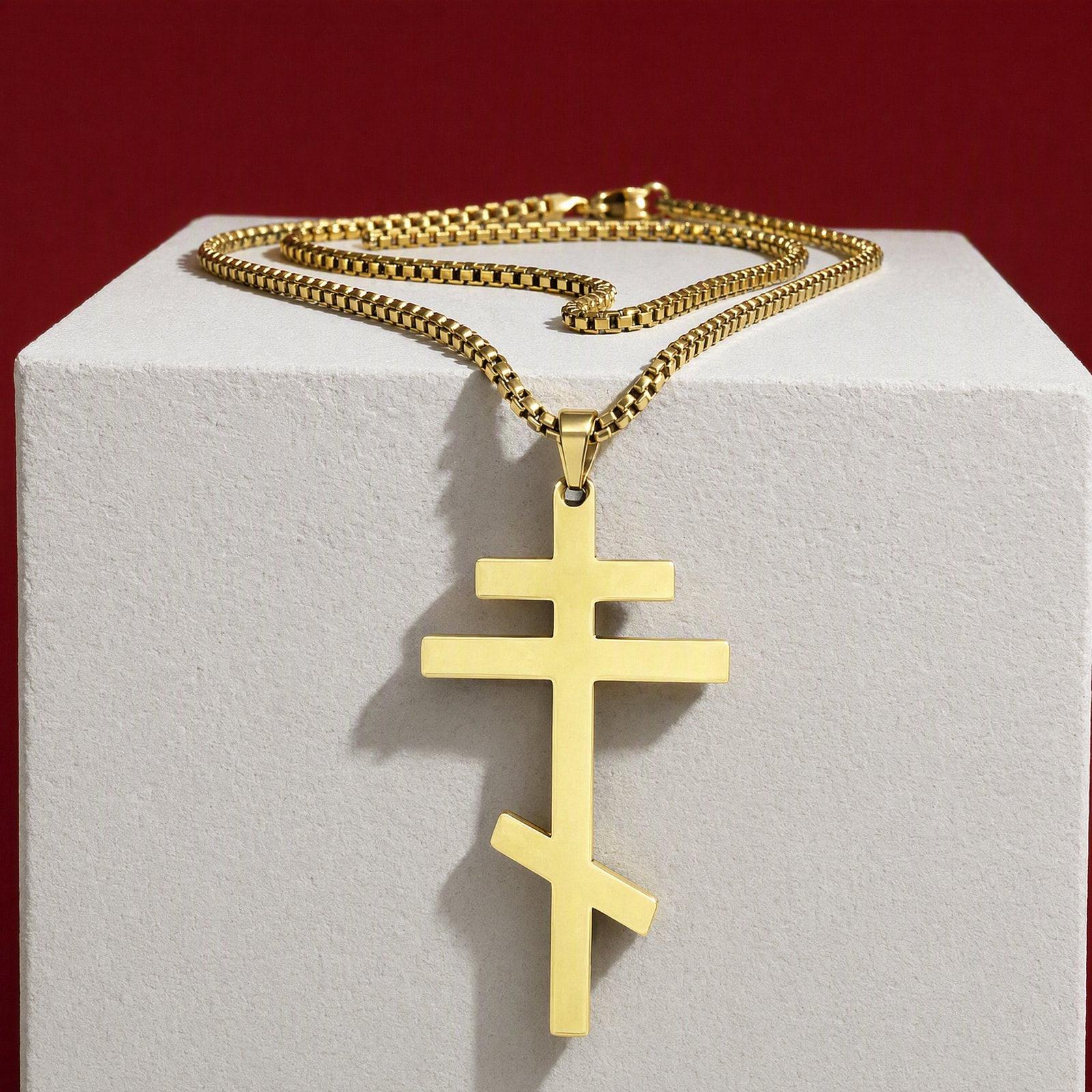 Cruce
Three-Bar Lamplight
Auriu · Lănțișor 60cm · Oțel inoxidabil$92$64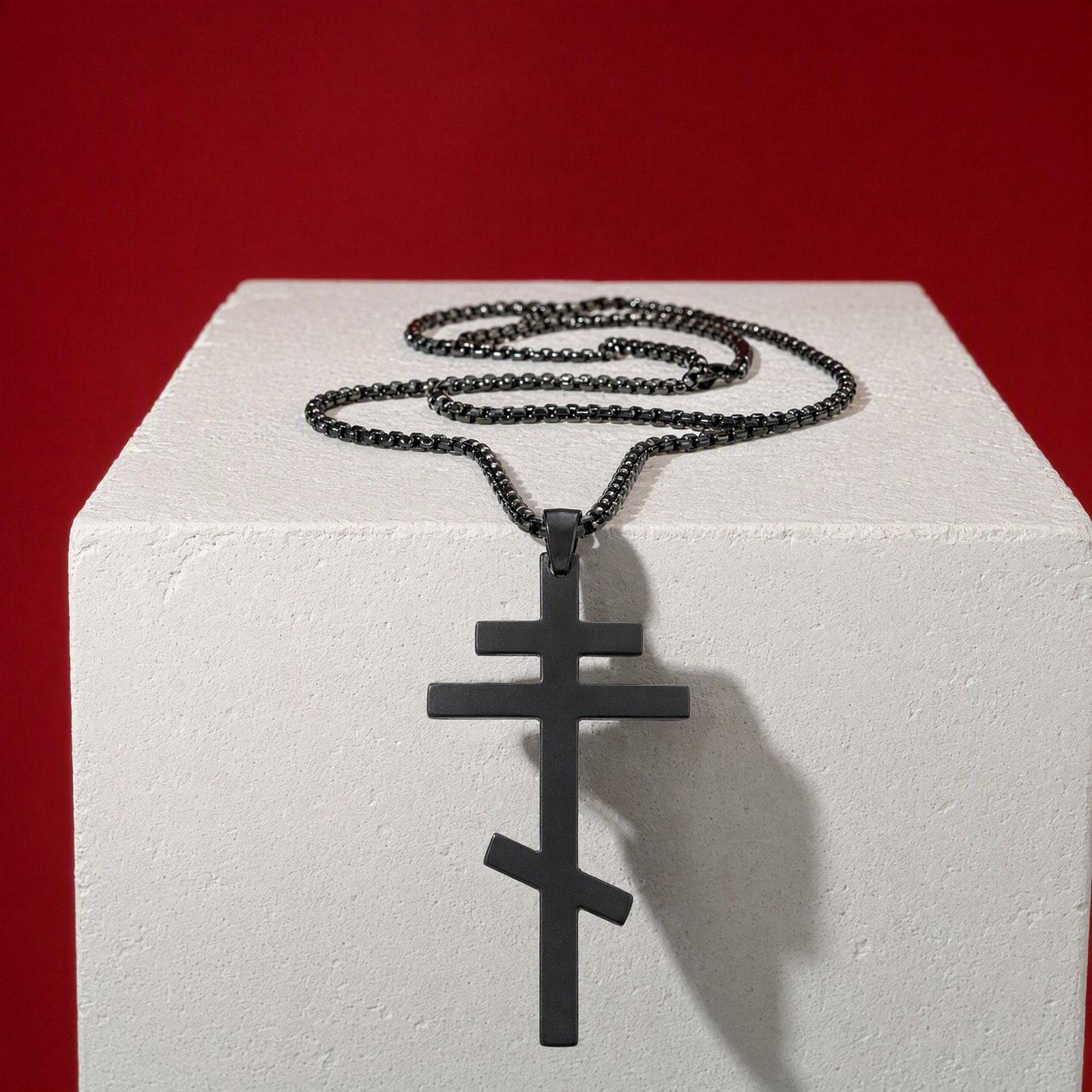 Cruce
Three-Bar Midnight
Negru · Lănțișor 60cm · Oțel inoxidabil$92$64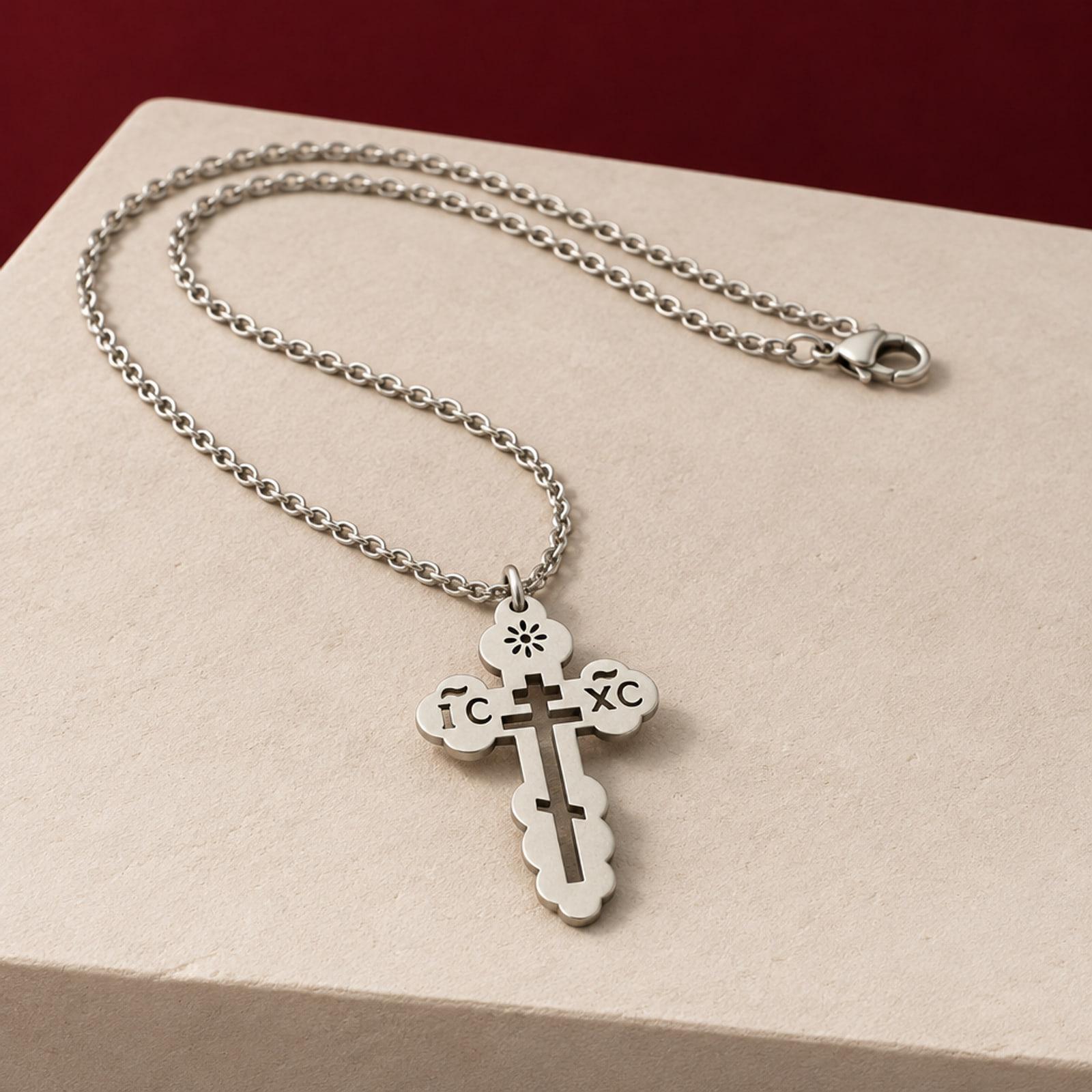 Cruce
Monogram Bright
Argintiu · Oțel inoxidabil$78$54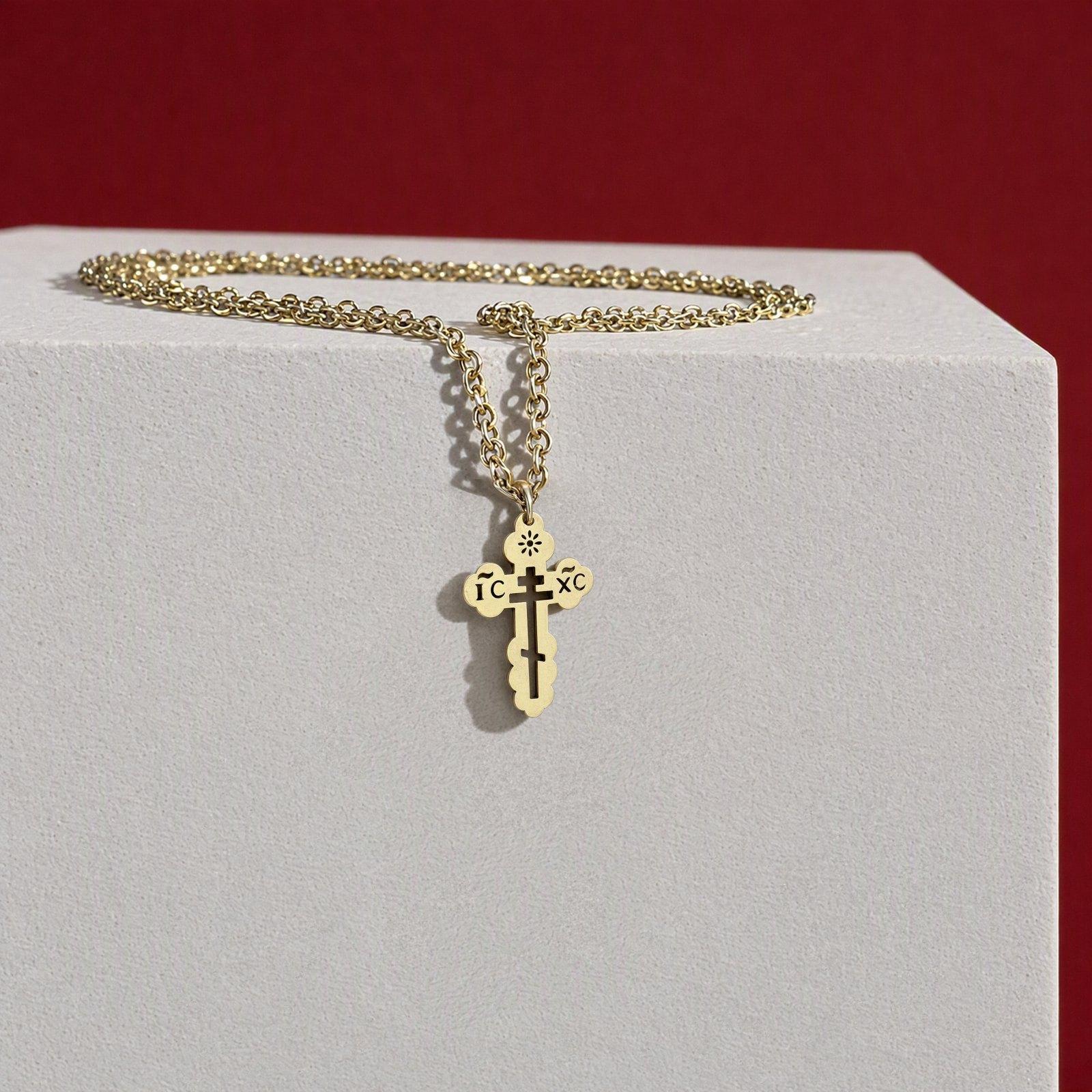 Cruce
Monogram Lamplight
Auriu · Oțel inoxidabil$78$54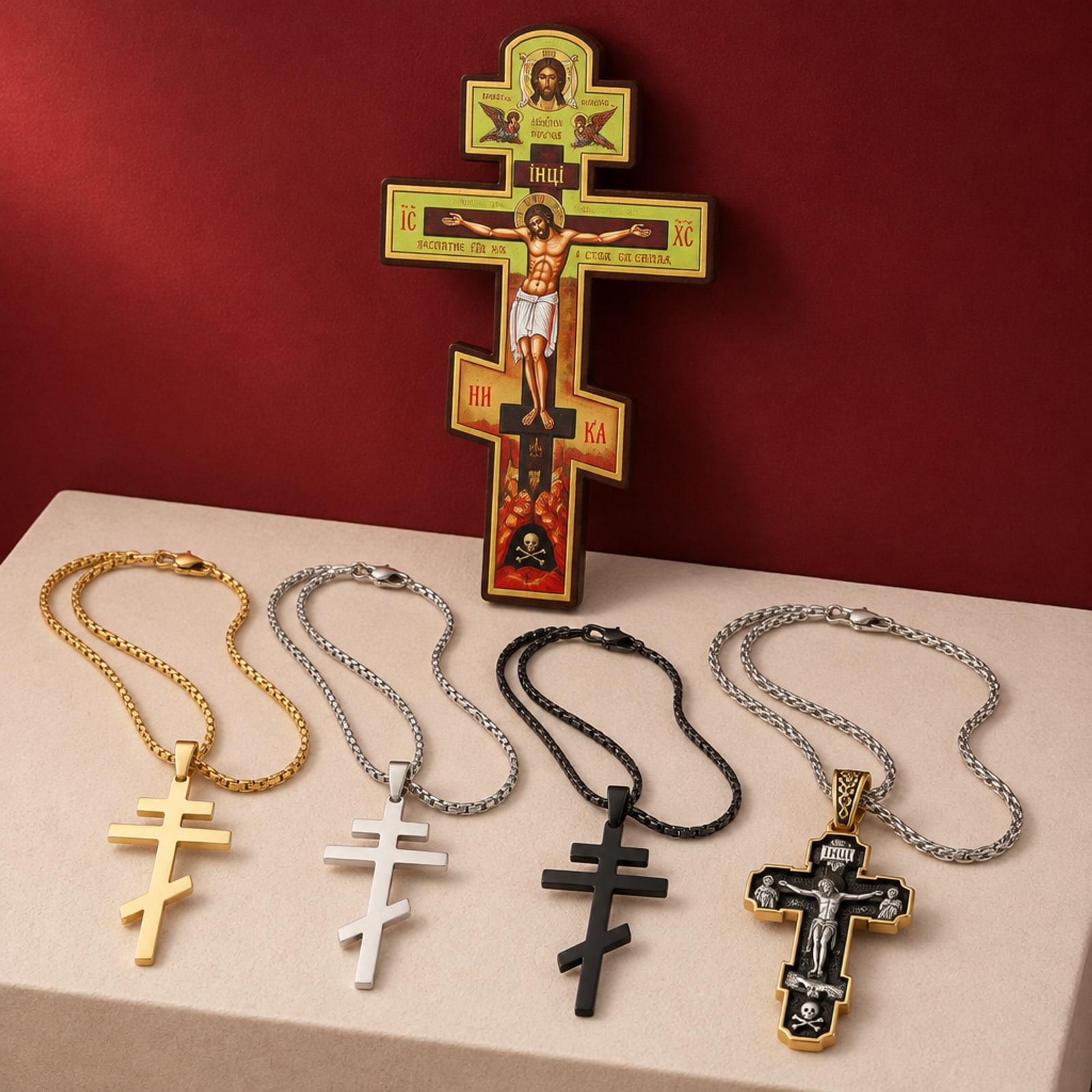 Set cadou
Set de cruci pentru familie
$342$239
CU SEDIUL ÎN SUA. EXPEDIERE DIN FLORIDA
Delivery in 5–8 business days.
Questions
What does the three-bar cross mean?
Wikidata describes it as a three beam slanted cross and gives nothing more. The Church’s tradition reads the bars as the title board over Christ’s head, the beam of His arms, and the footrest, slanted toward the thief who repented.
Is the three-bar cross the Orthodox cross?
Our source names it the Orthodox three-bar cross, and our catalogue sells an Orthodox cross of three bars, plain, with no figure on it.
What finishes does the plain cross come in?
Silver-tone, gold-tone and black stainless steel, each on a 60 cm chain.
Do you have a three-bar cross with a figure on it?
This page shows the plain crosses, which have no figure. Crucifixes with the figure of Christ are separate items in the catalogue.
Why is the bottom bar of the three bar cross slanted?
The lower bar is the footrest of the cross. Tradition says it tilts up toward the thief on Christ’s right, who repented and was promised Paradise, and down toward the thief on His left, who mocked Him. The slant is a reminder of the choice each person makes.
What is an 8 pointed cross?
It is another name for the same Orthodox cross. Count the ends: two on the short top bar, two on the long crossbar, two on the slanted footrest, and the top and foot of the upright. Eight points in all.
Can anyone wear a three bar cross necklace?
Yes. Orthodox Christians usually receive the cross at baptism and wear it for life, under their clothes, but anyone who wants to wear it as a sign of faith may. It is a cross, not a fashion symbol, so wear it with respect.
What size three bar cross necklace should I choose?
For daily wear under a shirt, a small cross is easy to forget you have on; a larger one is seen when worn over clothes. Our plain crosses come on a 60 cm chain, which sits at the breastbone on most adults, and the sizes are in the guide below.