Psalm 145: the psalm, its kathisma and its numbers
Psalm 145 (Septuagint 144). Two numberings are in use. English Bibles that follow the Hebrew, the King James among them, give this psalm the number 145; the Greek Psalter of the Orthodox Church gives it 144. The King James text has 21 verses and Brenton’s Septuagint text has 22; the two count the verses differently. The King James text opens with a title line.
The psalm in the King James Version.
I will extol thee, my God, O king; and I will bless thy name for ever and ever. Every day will I bless thee; and I will praise thy name for ever and ever. Great is the LORD, and greatly to be praised; and his greatness is unsearchable. One generation shall praise thy works to another, and shall declare thy mighty acts.
I will speak of the glorious honour of thy majesty, and of thy wondrous works. And men shall speak of the might of thy terrible acts: and I will declare thy greatness. They shall abundantly utter the memory of thy great goodness, and shall sing of thy righteousness. The LORD is gracious, and full of compassion; slow to anger, and of great mercy.
The LORD is good to all: and his tender mercies are over all his works.
All thy works shall praise thee, O LORD; and thy saints shall bless thee. They shall speak of the glory of thy kingdom, and talk of thy power; To make known to the sons of men his mighty acts, and the glorious majesty of his kingdom. Thy kingdom is an everlasting kingdom, and thy dominion endureth throughout all generations.
The LORD upholdeth all that fall, and raiseth up all those that be bowed down. The eyes of all wait upon thee; and thou givest them their meat in due season. Thou openest thine hand, and satisfiest the desire of every living thing. The LORD is righteous in all his ways, and holy in all his works.
The LORD is nigh unto all them that call upon him, to all that call upon him in truth. He will fulfil the desire of them that fear him: he also will hear their cry, and will save them. The LORD preserveth all them that love him: but all the wicked will he destroy. My mouth shall speak the praise of the LORD: and let all flesh bless his holy name for ever and ever.
The psalm in the Septuagint, in Brenton’s English translation.
David’s Psalm of praise. I will exalt thee, my God, my king; and I will bless thy name for ever and ever.
Every day will I bless thee, and I will praise thy name for ever and ever. The Lord is great, and greatly to be praised; and there is no end of his greatness. Generation after generation shall praise thy works, and tell of thy power. And they shall speak of the glorious majesty of thy holiness, and recount thy wonders.
And they shall speak of the power of thy terrible acts; and recount thy greatness. They shall utter the memory of the abundance of thy goodness, and shall exult in thy righteousness.
The Lord is compassionate, and merciful; long-suffering, and abundant in mercy. The Lord is good to those that wait on him; and his compassions are over all his works. Let all thy works, O Lord, give thanks to thee; and let thy saints bless thee. They shall speak of the glory of thy kingdom, and talk of thy dominion;
to make known to the sons of men thy power, and the glorious majesty of thy kingdom. Thy kingdom is an everlasting kingdom, and thy dominion endures through all generations. The Lord is faithful in his words, and holy in all his works.
The Lord supports all that are falling, and sets up all that are broken down. The eyes of all wait upon thee; and thou givest them their food in due season. Thou openest thine hands, and fillest every living thing with pleasure. The Lord is righteous in all his ways, and holy in all his works.
The Lord is near to all that call upon him, to all that call upon him in truth. He will perform the desire of them that fear him: and he will hear their supplication, and save them. The Lord preserves all that love him: but all sinners he will utterly destroy. My mouth shall speak the praise of the Lord: and let all flesh bless his holy name for ever and ever.
Place in the Psalter. Kathisma 20 contains this psalm. A kathisma is one of the twenty parts into which the Church divides the Psalter for reading.
Where the service book prints it. Hapgood’s Service Book of the Holy Orthodox-Catholic Apostolic Church gives the psalm at page 494.
How the Church reads the Psalter
The Psalter is the book the Church prays from. It divides the Psalms into twenty kathismata, readings taken in order, and Psalm 145 comes round in its place in kathisma 20. The psalms are also set into the services themselves, as the pages of Hapgood’s Service Book show.
An Orthodox Christian will often name a psalm by its kathisma and by the Septuagint number the Church sings it under. If you came for the words, they are above. If you came to pray them as the Church does, the kathisma is the place to begin.
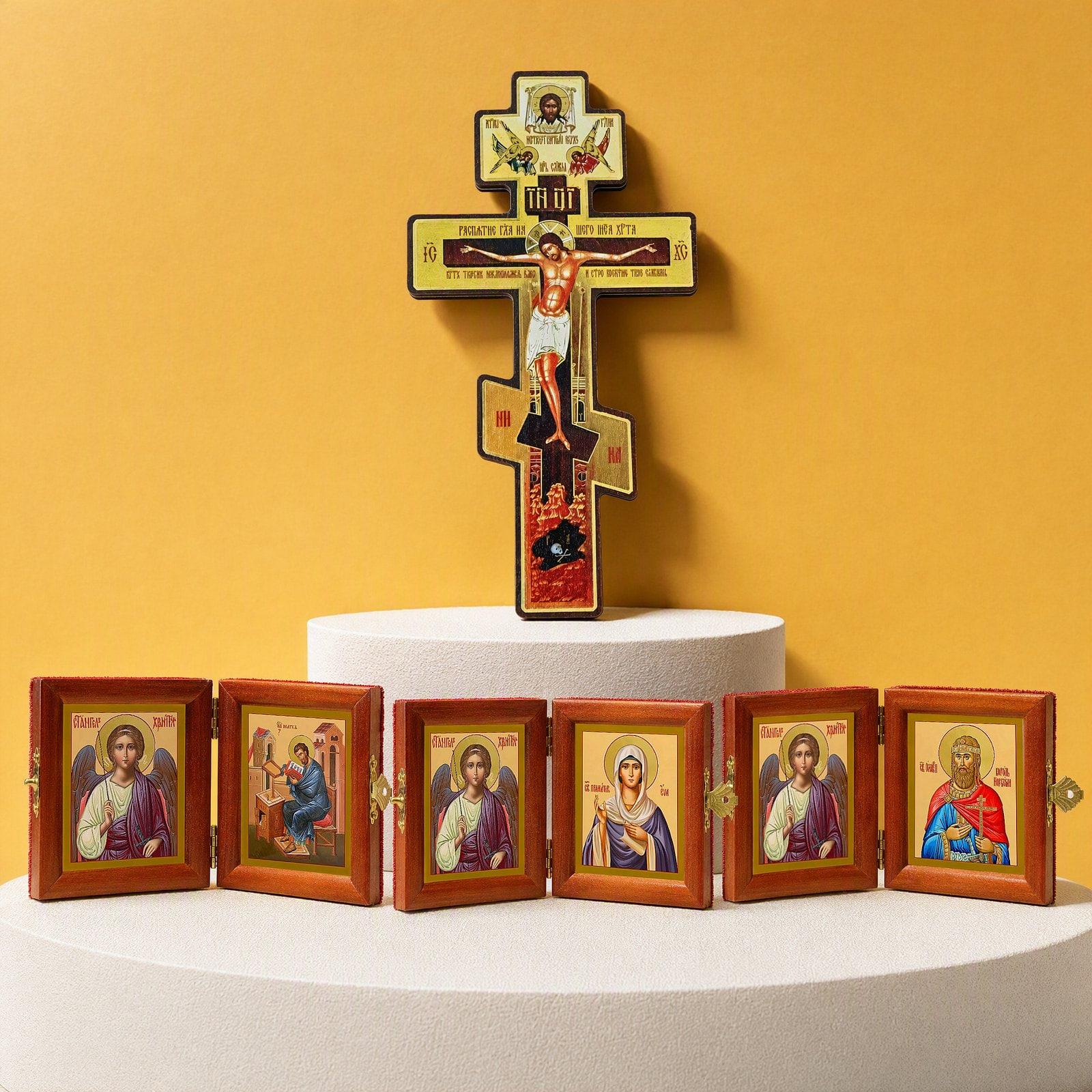
For the whole family’s icon corner
The Family Set holds three patron saint folding icons, one for each name in the family, with a wooden wall crucifix, $249. An Orthodox priest can bless it before it ships; the Blessing is $49.
- Blessing, $49. Blessed by an Orthodox priest before it ships.
- Gift packaging, $20
Questions
What is Psalm 145 in the Septuagint?
It is Psalm 144. The King James Bible numbers it 145; the Septuagint, which the Orthodox Church reads, numbers it 144. The psalm is the same.
How many verses does Psalm 145 have?
The King James text has 21 and Brenton’s Septuagint text has 22, because the two count the verses differently.
Which kathisma is Psalm 145 in?
It is in the twentieth, kathisma 20. The Church divides the Psalter into twenty kathismata and reads them in order.
Where does Hapgood’s Service Book print Psalm 145?
On page 494, as the page references on this page show.
Whose translations are these?
The first is the King James Version. The second is Brenton’s English translation of the Septuagint, the Greek Old Testament that the Orthodox Church reads.