Psalm 112 and Septuagint Psalm 111: the text
Two numbers, one psalm. What a King James reader finds as Psalm 112 is Psalm 111 to an Orthodox reader, because the Church follows the Septuagint’s count. This page gives the psalm under both numbers. Both texts run to 10 verses.
The psalm in the King James Version.
Praise ye the LORD. Blessed is the man that feareth the LORD, that delighteth greatly in his commandments. His seed shall be mighty upon earth: the generation of the upright shall be blessed. Wealth and riches shall be in his house: and his righteousness endureth for ever. Unto the upright there ariseth light in the darkness: he is gracious, and full of compassion, and righteous.
A good man sheweth favour, and lendeth: he will guide his affairs with discretion.
Surely he shall not be moved for ever: the righteous shall be in everlasting remembrance. He shall not be afraid of evil tidings: his heart is fixed, trusting in the LORD. His heart is established, he shall not be afraid, until he see his desire upon his enemies. He hath dispersed, he hath given to the poor; his righteousness endureth for ever; his horn shall be exalted with honour.
The wicked shall see it, and be grieved; he shall gnash with his teeth, and melt away: the desire of the wicked shall perish.
The psalm in the Septuagint, in Brenton’s English translation.
Alleluia. Blessed is the man that fears the Lord: he will delight greatly in his commandments.
His seed shall be mighty in the earth: the generation of the upright shall be blessed. Glory and riches shall be in his house; and his righteousness endures for evermore. To the upright light has sprung up in darkness: he is pitiful, and merciful, and righteous. The good man is he that pities and lends: he will direct his affairs with judgment.
For he shall not be moved for ever; the righteous shall be in everlasting remembrance. He shall not be afraid of any evil report: his heart is ready to trust in the Lord. His heart is established, he shall not fear, till he shall see his desire upon his enemies. He has dispersed abroad; he has given to the poor; his righteousness endures for evermore: his horn shall be exalted with honour.
The sinner shall see and be angry, he shall gnash his teeth, and consume away: the desire of the sinner shall perish.
What the psalm says. The psalm is the portrait of a man who fears the Lord and delights greatly in his commandments. It begins by calling him blessed, and says that his seed shall be mighty upon earth, the generation of the upright shall be blessed, wealth and riches shall be in his house, and his righteousness endures for ever. For the upright there arises light in the darkness; he is gracious and full of compassion and righteous. A good man shows favour and lends; he guides his affairs with discretion. He shall never be moved, and the righteous shall be in everlasting remembrance. He shall not be afraid of evil tidings, since his heart is fixed, trusting in the Lord, and his heart is established; he shall not be afraid until he sees his desire upon his enemies. He has dispersed and given to the poor, and his righteousness endures for ever, and his horn shall be exalted with honour. The last verse turns to the wicked, who shall see it and be grieved, gnash their teeth and melt away, so that the desire of the wicked shall perish.
Where it falls in the Psalter. The Church divides the Psalter into twenty readings called kathismata. This psalm stands in kathisma 16.
Left unsaid. Hapgood’s Service Book of the Holy Orthodox-Catholic Apostolic Church has no psalm heading for this psalm that we could find, and this page does not guess which service uses it.
How the Church reads the Psalter
The Psalter is the book the Church prays from. It divides the Psalms into twenty kathismata, readings taken in order, and Psalm 112 comes round in its place in kathisma 16. The psalms are also set into the services themselves, as the pages of Hapgood’s Service Book show.
An Orthodox Christian will often name a psalm by its kathisma and by the Septuagint number the Church sings it under. If you came for the words, they are above. If you came to pray them as the Church does, the kathisma is the place to begin.
A prayer rope for the psalms
For prayer at home or on the road: a black wool prayer rope with dividing beads and a tassel, $34. Choose the Blessing on its page and an Orthodox priest blesses it before it ships. With the Blessing, $83 (normally $98).
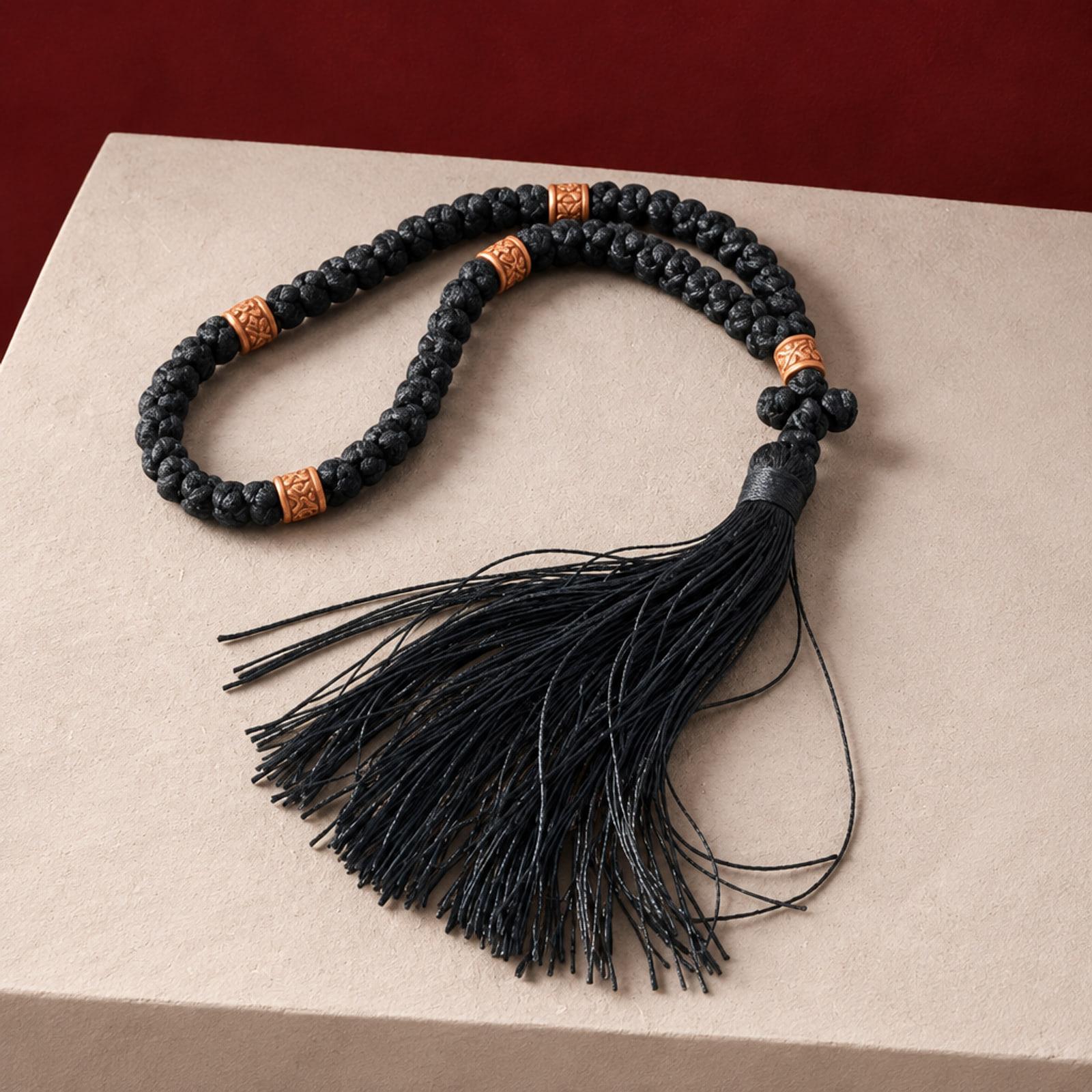
- Blessing, $49. Blessed by an Orthodox priest before it ships.
- Gift packaging, $20
Questions
What is Psalm 112 in the Septuagint?
It is Psalm 111. The King James Bible numbers it 112; the Septuagint, which the Orthodox Church reads, numbers it 111. The psalm is the same.
How many verses does Psalm 112 have?
10, in the King James text and in Brenton’s Septuagint alike.
Which kathisma is Psalm 112 in?
It is in the sixteenth, kathisma 16. The Church divides the Psalter into twenty kathismata and reads them in order.
Is Psalm 112 printed in the service book?
We did not find it under a Psalm heading in Isabel F. Hapgood’s service book, so this page names no service for it.
Whose translations are these?
The first is the King James Version. The second is Brenton’s English translation of the Septuagint, the Greek Old Testament that the Orthodox Church reads.