Byzantine icons: what makes an icon Byzantine, and how to choose one
A Byzantine icon is a holy image painted in the tradition of the Eastern Roman Empire, whose capital was Constantinople: Christ, the Mother of God or a saint shown flat and still, against gold, with large eyes and the name written beside the figure. The style took shape between the 6th and the 15th centuries and is still the way Orthodox and Eastern Catholic churches paint icons today.
Below: where the style comes from, how to recognize it, how to tell a hand-painted icon from a mounted print, where an icon goes in the home, and the icons in the Byzantine tradition we carry.
What the Byzantine style is
“Byzantine” is the name later historians gave the Eastern Roman Empire, which ruled from Constantinople from the 4th century until 1453. Its painters gave the Church its way of showing the holy: not a portrait of a moment, but a window onto the Kingdom of God. Faces are calm, the light seems to come from within, the background is gold for the light of heaven, and the lines of buildings open toward the viewer instead of narrowing into the distance.
The oldest icons that survive are at St Catherine’s Monastery at Sinai, from the 6th century. In the 8th and 9th centuries the iconoclasts destroyed icons across the empire; in 843 the Church restored them for good, a victory still kept as the Triumph of Orthodoxy on the first Sunday of Great Lent. After 1453 the tradition lived on in Crete, on Mount Athos, in the Balkans and in the Slavic lands, where Andrei Rublev painted his Trinity.
How to recognize a Byzantine icon
| Feature | What it means |
|---|---|
| Gold background | The uncreated light of heaven |
| Frontal figures, large eyes | The saint looks at you and prays with you |
| Small mouth, long nose, high forehead | Senses at peace, mind turned to God |
| Reverse perspective | The holy world opens toward the viewer |
| Inscriptions (IC XC, MP ΘΥ) | The icon names who it shows, as a letter is signed |
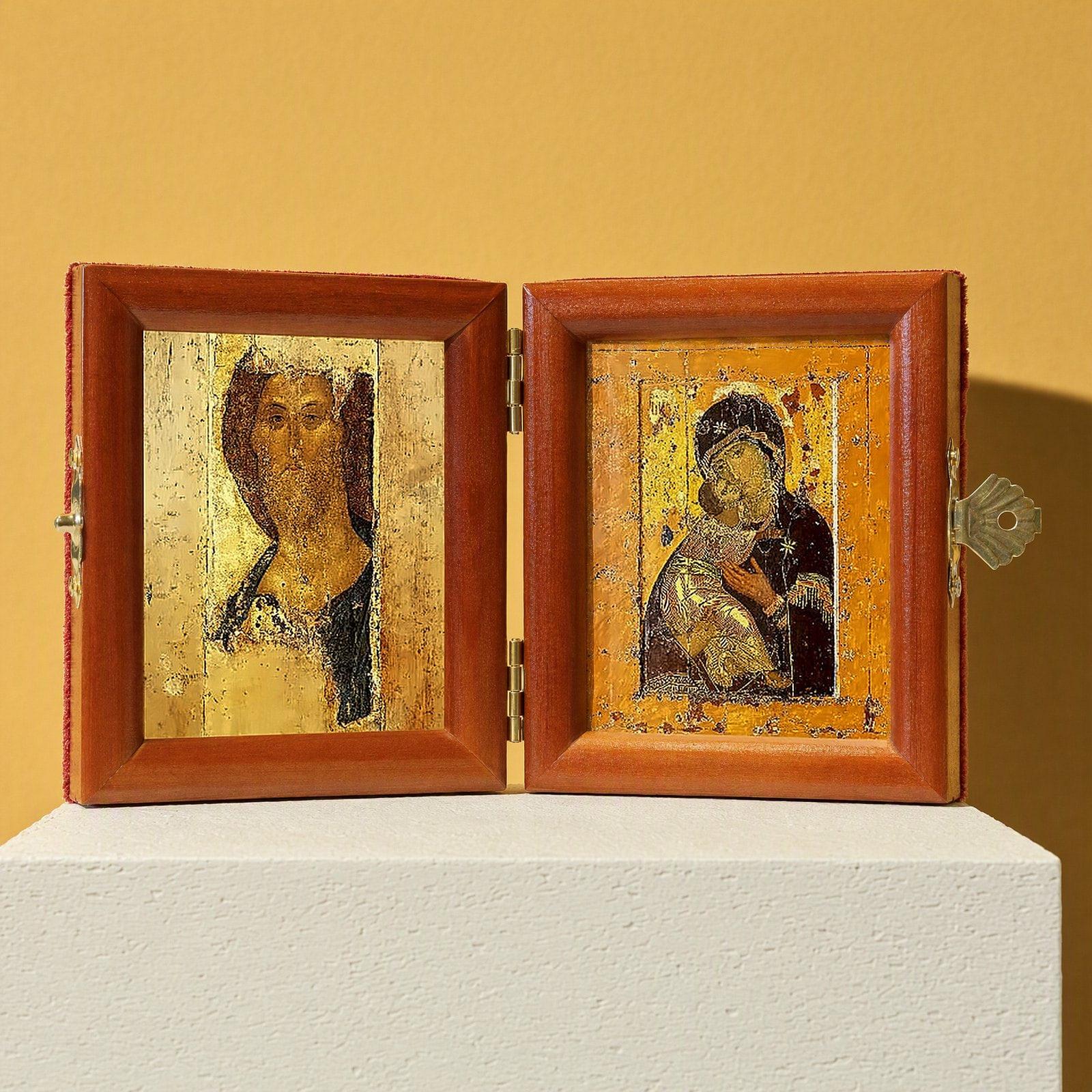
The main types repeat across centuries: the Pantocrator, Christ “Ruler of all,” holding the Gospel and blessing (see Pantocrator icons); the Hodegetria, the Mother of God pointing to the Child; the Eleousa, the Child’s cheek against His Mother’s, as on the Vladimir icon; and the feasts of the Church year.
Hand-painted icons and mounted icons
A hand-painted icon is made the old way: a wooden board covered with gesso, the image laid in egg tempera, often with gold leaf, then sealed. It takes days or weeks of work. A mounted icon is a printed image of a traditional icon on wood or board, varnished; it is the icon most homes begin with, and it is just as fit for prayer. Read how icons are made for the full process.
When choosing, check that the face is clear and the inscriptions are present, that the board is solid and flat, and that the size fits the place it will go: 4 x 6 in for a shelf or car, 8 x 10 in for an icon corner, larger for a wall or a church.
Where a Byzantine icon goes
In an Orthodox home the icons stand together in one corner, traditionally on an east wall: Christ on the right, the Mother of God on the left, the family’s saints around them, with a lamp or candle before them. A single Pantocrator above a desk or a doorway is also traditional. A large hand-painted icon deserves its own wall, out of direct sunlight and away from heat and kitchen smoke.
What we carry
We carry icons made today in the Byzantine tradition. The hand-painted Christ Pantocrator on cypress, 21 x 29 cm ($3,619) is painted by hand. Mounted icons include the Christ Pantocrator in silver and gold tone, 12 x 9 cm ($69) and the Icon of the Saviour Almighty, 17.5 x 20.5 cm ($34). The Christ and Theotokos sets named for Hagia Sophia ($64) and for Athos ($64) give the two icons every icon corner begins with, and the folding diptych of the Zvenigorod Saviour and the Vladimir Mother of God ($109) pairs the image of a 12th-century Constantinople icon with the Saviour attributed to Andrei Rublev. We do not carry antique icons or a wide range of large hand-painted ones; leave your email below if that is what you need. More in icons for the icon corner. Orders arrive in 5–8 business days: US-based, ships from Florida.
Our icons in the Byzantine tradition
A hand-painted Christ Pantocrator on cypress, two mounted Pantocrator icons, two Christ and Theotokos sets, and the Vladimir Mother of God in a folding diptych. Each card shows its live price.


US-BASED. SHIPS FROM FLORIDA
Delivery in 5–8 business days.
Want us to stock it?
We carry close items, not every kind of Byzantine icon. Leave your email and we will write once if we stock more.
Questions
What makes an icon Byzantine?
A gold or plain background, figures facing the viewer, calm faces with large eyes, little depth, and the name of the person shown written on the icon. The image follows patterns the Church has handed down, so a Byzantine icon of Christ is recognizable across centuries.
Are Byzantine icons Catholic or Orthodox?
Both use them. The style was born before the split of 1054, and it remains the tradition of the Orthodox Church and of the Eastern Catholic churches of the Byzantine rite. Roman Catholic churches and homes also often keep Byzantine icons.
How can I tell a hand-painted icon from a print?
Look closely at the surface and the edges. A hand-painted icon shows brush strokes, layers of color and, often, gold leaf with a slight relief. A mounted print is a flat printed image laid on wood or board and varnished, with no texture.
What is the most famous Byzantine icon?
The Christ Pantocrator of St Catherine’s Monastery at Sinai, from the 6th century, is among the oldest and best known. The Vladimir Mother of God, painted in Constantinople in the 12th century, is among the most loved in the Orthodox world.
Do you sell antique Byzantine icons?
No. We carry icons made today in the Byzantine tradition, mounted on wood and hand-painted. Old icons need proof of where they come from and can fall under export laws, so buy them only with full papers.
Where should a Byzantine icon hang?
In the icon corner of the home, traditionally on an east-facing wall, with Christ on the right and the Mother of God on the left. Hang it at eye level, away from direct sun and heat, so the colors and gold last.