Psalm 90, which the Church numbers 89
Psalm 90 is Psalm 89 in the Septuagint. The Hebrew numbering, which the King James Bible follows, calls this psalm 90; the Septuagint, the Greek Old Testament that the Orthodox Church reads, calls it 89. The psalm is the same under both numbers. Both texts run to 17 verses. The King James text opens with a title line.
The psalm in the King James Version.
Lord, thou hast been our dwelling place in all generations. Before the mountains were brought forth, or ever thou hadst formed the earth and the world, even from everlasting to everlasting, thou art God. Thou turnest man to destruction; and sayest, Return, ye children of men. For a thousand years in thy sight are but as yesterday when it is past, and as a watch in the night.
Thou carriest them away as with a flood; they are as a sleep: in the morning they are like grass which groweth up. In the morning it flourisheth, and groweth up; in the evening it is cut down, and withereth.
For we are consumed by thine anger, and by thy wrath are we troubled. Thou hast set our iniquities before thee, our secret sins in the light of thy countenance. For all our days are passed away in thy wrath: we spend our years as a tale that is told. The days of our years are threescore years and ten; and if by reason of strength they be fourscore years, yet is their strength labour and sorrow; for it is soon cut off, and we fly away.
Who knoweth the power of thine anger? even according to thy fear, so is thy wrath.
So teach us to number our days, that we may apply our hearts unto wisdom. Return, O LORD, how long? and let it repent thee concerning thy servants. O satisfy us early with thy mercy; that we may rejoice and be glad all our days. Make us glad according to the days wherein thou hast afflicted us, and the years wherein we have seen evil.
Let thy work appear unto thy servants, and thy glory unto their children. And let the beauty of the LORD our God be upon us: and establish thou the work of our hands upon us; yea, the work of our hands establish thou it.
The psalm in the Septuagint, in Brenton’s English translation.
A Prayer of Moses the man of God. Lord, thou hast been our refuge in all generations.
Before the mountains existed, and before the earth and the world were formed, even from age to age, Thou art. Turn not man back to his low place, whereas thou saidst, Return, ye sons of men? For a thousand years in thy sight are as the yesterday which is past, and as a watch in the night. Years shall be vanity to them: let the morning pass away as grass.
In the morning let it flower, and pass away: in the evening let it droop, let it be withered and dried up. For we have perished in thine anger, and in thy wrath we have been troubled. Thou hast set our transgressions before thee: our age is in the light of thy countenance. For all our days are gone, and we have passed away in thy wrath: our years have spun out their tale as a spider.
As for the days of our years, in them are seventy years; and if men should be in strength, eighty years: and the greater part of them would be labour and trouble; for weakness overtakes us, and we shall be chastened. Who knows the power of thy wrath? and who knows how to number his days because of the fear of thy wrath? So manifest thy right hand, and those that are instructed in wisdom in the heart.
Return, O Lord, how long? and be intreated concerning thy servants. We have been satisfied in the morning with thy mercy; and we did exult and rejoice: let us rejoice in all our days, in return for the days wherein thou didst afflict us, the years wherein we saw evil. And look upon thy servants, and upon thy works; and guide their children.
And let the brightness of the Lord our God be upon us: and do thou direct for us the works of our hands.
Where it falls in the Psalter. The Church divides the Psalter into twenty readings called kathismata. This psalm stands in kathisma 12.
Found in Hapgood’s book. Look for it in Isabel F. Hapgood’s Service Book of the Holy Orthodox-Catholic Apostolic Church at page 38, in the All-Night Vigil service.
One Psalter, two numberings
The Church’s Psalter follows the Septuagint, and its numbering is not always the Hebrew numbering of English Bibles. That is why this page gives two numbers, and the kathisma, 12, the reading that holds the psalm.
Prayer from the Psalter, for an Orthodox Christian, is prayer in the Church’s order: twenty kathismata, taken in turn, with the psalms also sung in the services.
For someone in a hard season
In the Comfort Set you receive a folding icon of their patron saint beside the Guardian Angel, a bronze-tone Holy Face crucifix, a prayer rope, a gold-tone Mother of God icon in an arched frame and a printed prayer with their names, and the story of their saint’s life and feast day, sent to you by email, $209. The Blessing is offered on its page. With the Blessing, $258 (normally $348).
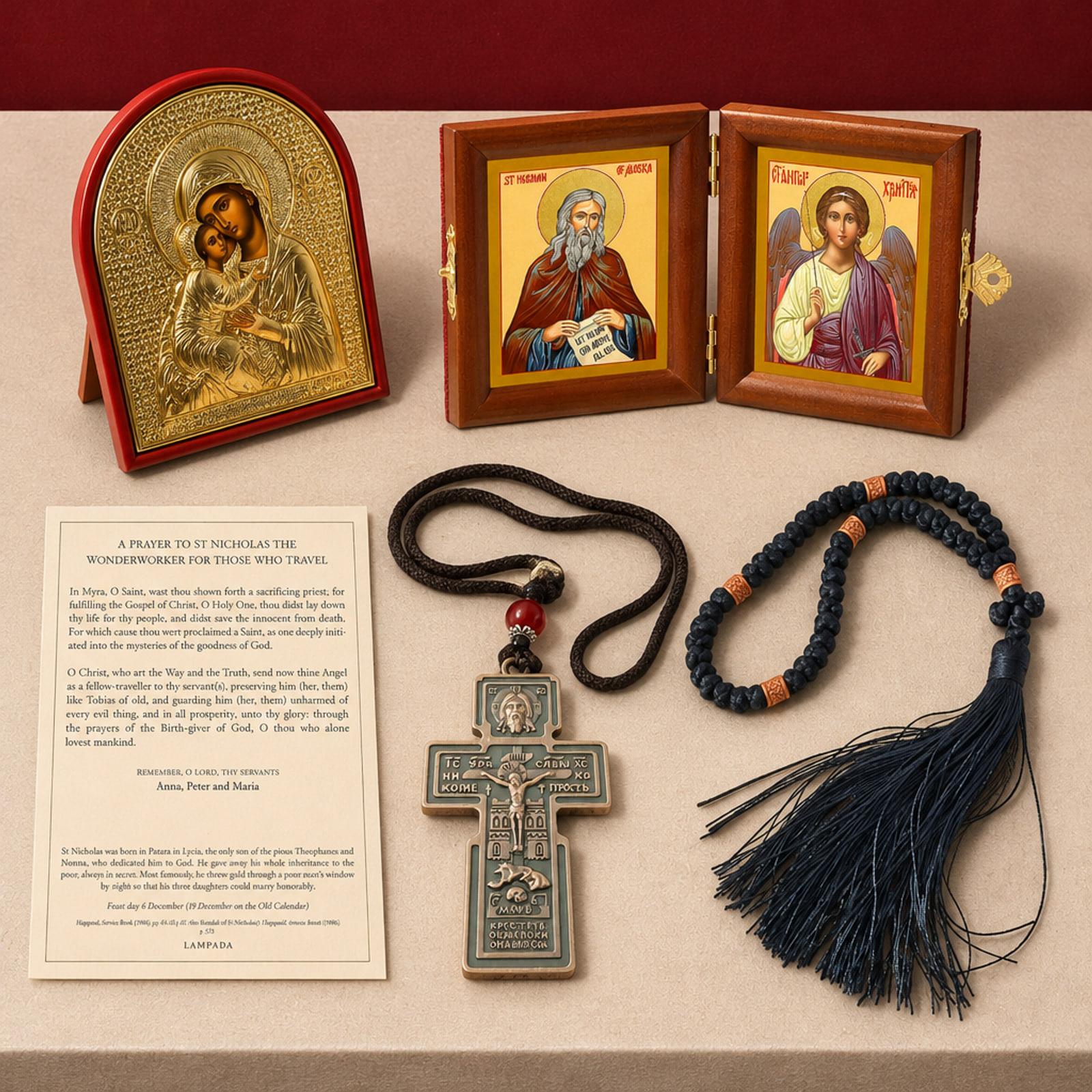
- Blessing, $49. Blessed by an Orthodox priest before it ships.
- Gift packaging, $20
Questions
What is Psalm 90 in the Septuagint?
It is Psalm 89. The King James Bible numbers it 90; the Septuagint, which the Orthodox Church reads, numbers it 89. The psalm is the same.
How many verses does Psalm 90 have?
17, in the King James text and in Brenton’s Septuagint alike.
Which kathisma is Psalm 90 in?
It is in the twelfth, kathisma 12. The Church divides the Psalter into twenty kathismata and reads them in order.
Where does Hapgood’s Service Book print Psalm 90?
On page 38, as the page references on this page show.
Whose translations are these?
The first is the King James Version. The second is Brenton’s English translation of the Septuagint, the Greek Old Testament that the Orthodox Church reads.