Psalm 138, which the Church numbers 137
Two numbers, one psalm. What a King James reader finds as Psalm 138 is Psalm 137 to an Orthodox reader, because the Church follows the Septuagint’s count. This page gives the psalm under both numbers. Both texts run to 8 verses. The King James text opens with a title line.
The psalm in the King James Version.
I will praise thee with my whole heart: before the gods will I sing praise unto thee. I will worship toward thy holy temple, and praise thy name for thy lovingkindness and for thy truth: for thou hast magnified thy word above all thy name. In the day when I cried thou answeredst me, and strengthenedst me with strength in my soul. All the kings of the earth shall praise thee, O LORD, when they hear the words of thy mouth.
Yea, they shall sing in the ways of the LORD: for great is the glory of the LORD.
Though the LORD be high, yet hath he respect unto the lowly: but the proud he knoweth afar off. Though I walk in the midst of trouble, thou wilt revive me: thou shalt stretch forth thine hand against the wrath of mine enemies, and thy right hand shall save me. The LORD will perfect that which concerneth me: thy mercy, O LORD, endureth for ever: forsake not the works of thine own hands.
The psalm in the Septuagint, in Brenton’s English translation.
A Psalm for David, of Aggæus and Zacharias. I will give thee thanks, O Lord, with my whole heart; and I will sing psalms to thee before the angels; for thou hast heard all the words of my mouth.
I will worship toward thy holy temple, and give thanks to thy name, on account of thy mercy and thy truth; for thou hast magnified thy holy name above every thing. In whatsoever day I shall call upon thee, hear me speedily; thou shalt abundantly provide me with thy power in my soul. Let all the kings of the earth, O Lord, give thanks unto thee; for they have heard all the words of thy mouth. And let them sing in the ways of the Lord; for great is the glory of the Lord.
For the Lord is high, and yet regards the lowly; and he knows high things from afar off. Though I should walk in the midst of affliction, thou wilt quicken me; thou hast stretched forth thine hands against the wrath of mine enemies, and thy right hand has saved me. O Lord, thou shalt recompense them on my behalf: thy mercy, O Lord, endures for ever: overlook not the works of thine hands.
What the psalm says. The psalm is a thanksgiving that begins in the first person and grows into a statement about kings and the proud. I will praise you with my whole heart, the one who prays says; before the gods I will sing praise to you. He will worship toward the holy temple and praise the name of the Lord for his lovingkindness and truth, for the Lord has magnified his word above all his name. In the day that he cried, the Lord answered him and strengthened his soul. The third and fourth verses widen the thanks: all the kings of the earth shall praise the Lord, when they hear the words of his mouth, and they shall sing in the ways of the Lord, because great is the glory of the Lord. Though the Lord is high, he has respect to the lowly, but the proud he knows from afar. Though I walk in the midst of trouble, the psalm continues, you will revive me; you will stretch forth your hand against the wrath of my enemies, and your right hand shall save me. The Lord will perfect what concerns me, and his mercy endures for ever; the last prayer is that he not forsake the works of his own hands.
Where it falls in the Psalter. The Church divides the Psalter into twenty readings called kathismata. This psalm stands in kathisma 19.
In the Service Book. We found no page of Isabel F. Hapgood’s Service Book of the Holy Orthodox-Catholic Apostolic Church that prints this psalm under its own Psalm heading, so this page names no service for it.
How the Church reads the Psalter
The Psalter is the book the Church prays from. It divides the Psalms into twenty kathismata, readings taken in order, and Psalm 138 comes round in its place in kathisma 19. The psalms are also set into the services themselves, as the pages of Hapgood’s Service Book show.
An Orthodox Christian will often name a psalm by its kathisma and by the Septuagint number the Church sings it under. If you came for the words, they are above. If you came to pray them as the Church does, the kathisma is the place to begin.
For someone in a hard season
The Comfort Set, $209, brings together a folding icon of their patron saint beside the Guardian Angel, a bronze-tone Holy Face crucifix, a prayer rope, a gold-tone Mother of God icon in an arched frame and a printed prayer with their names, and the story of their saint’s life and feast day, sent to you by email. Choose the Blessing on its page and an Orthodox priest blesses it before it ships. With the Blessing, $258 (normally $348).
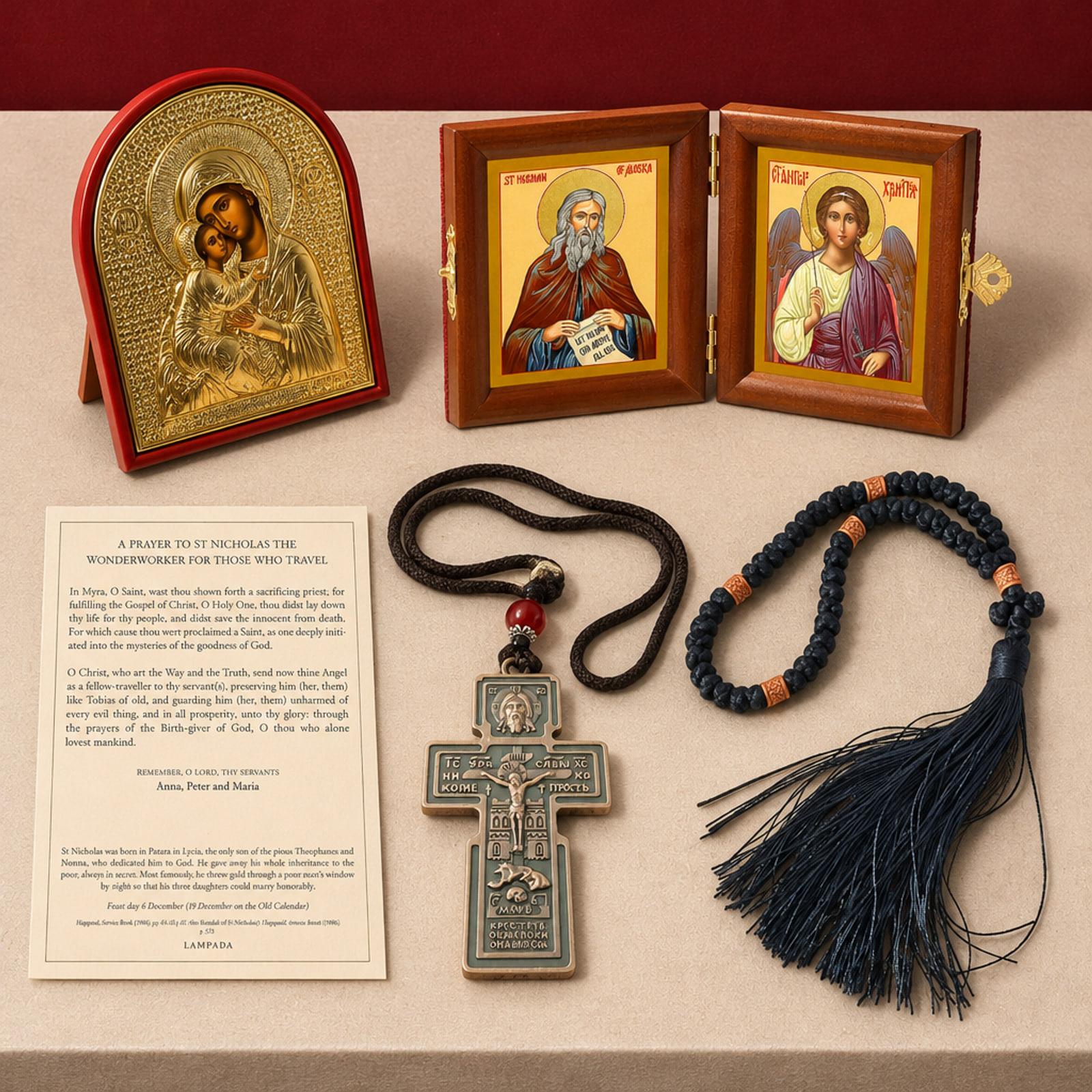
- Blessing, $49. Blessed by an Orthodox priest before it ships.
- Gift packaging, $20
Questions
What is Psalm 138 in the Septuagint?
It is Psalm 137. The King James Bible numbers it 138; the Septuagint, which the Orthodox Church reads, numbers it 137. The psalm is the same.
How many verses does Psalm 138 have?
8, in the King James text and in Brenton’s Septuagint alike.
Which kathisma is Psalm 138 in?
It is in the nineteenth, kathisma 19. The Church divides the Psalter into twenty kathismata and reads them in order.
Is Psalm 138 printed in the service book?
We did not find it under a Psalm heading in Isabel F. Hapgood’s service book, so this page names no service for it.
Whose translations are these?
The first is the King James Version. The second is Brenton’s English translation of the Septuagint, the Greek Old Testament that the Orthodox Church reads.