White gold and rose gold Orthodox crosses: coming to Lampada
Not in our store todayWe do not carry white gold or rose gold crosses today. Below: what each is, how to choose and care for one, and our closest items, Orthodox crosses in silver-tone, copper-red and bronze-tone stainless steel.
A white gold chain cross, or a rose gold one, is a cross and chain in karat gold of a paler or a pinker color, and this page explains how to choose either. Lampada does not sell white gold or rose gold Orthodox crosses yet. They are coming, and this page sets out what the two names mean so that you can read a listing with confidence. What we sell today is stainless steel in silver-tone, bronze-tone and copper-red finishes, and a finish is not a metal.
White gold is gold mixed with one or more white metals. Wikipedia names nickel, silver, platinum and palladium as the usual choices, and gives its purity in karats, as for yellow gold. Rose gold is gold mixed with copper, and is also called pink gold or red gold. Wikipedia adds that coloured golds are less pure than 24 karat by definition and commonly come as 18 karat at 75 percent gold, 14 karat at 58.3 percent, 10 karat at 41.7 percent or 9 karat at 37.5 percent. So the colour name tells you what the gold is mixed with, and the karat tells you how much of it is gold.
The nearest crosses we sell now, by finish:
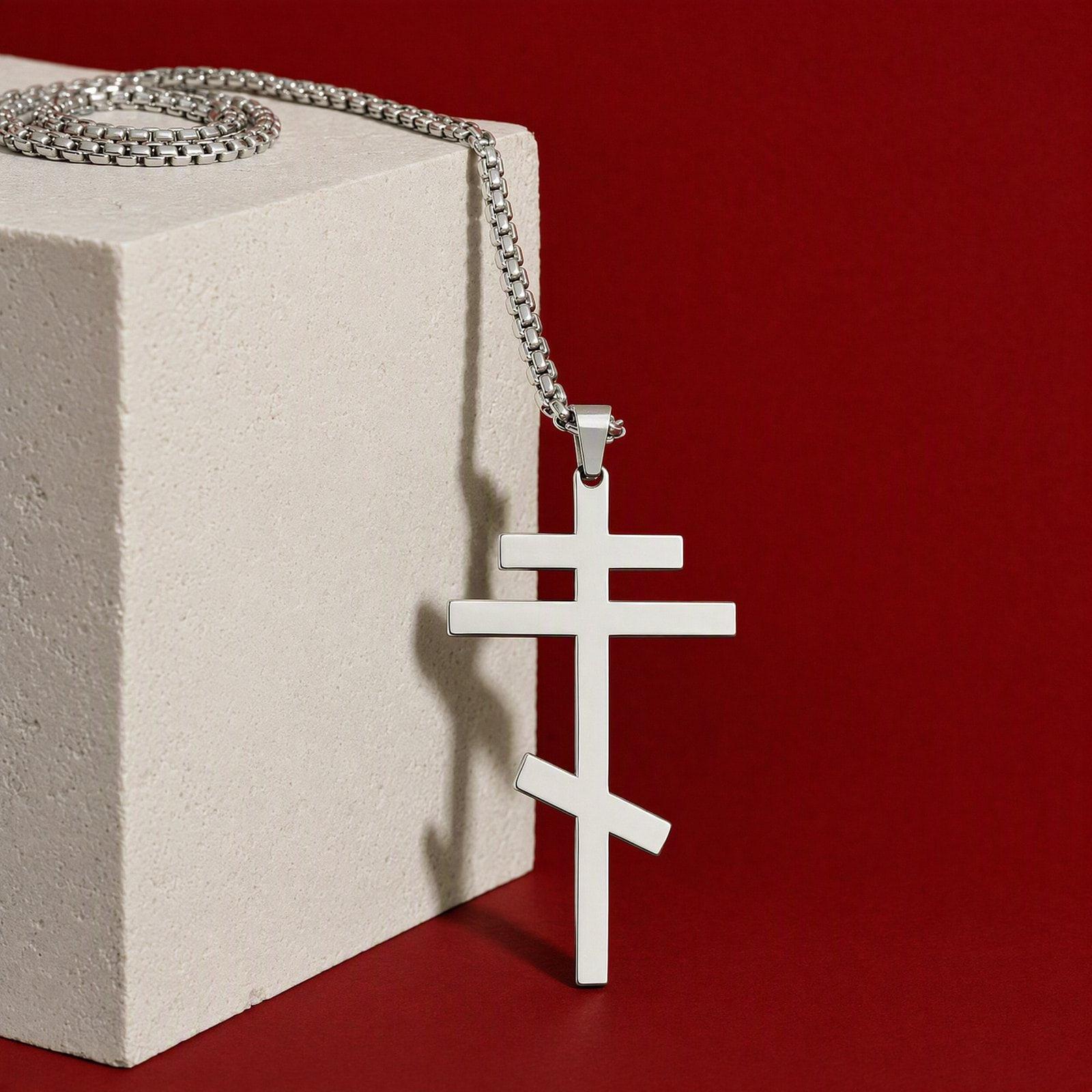
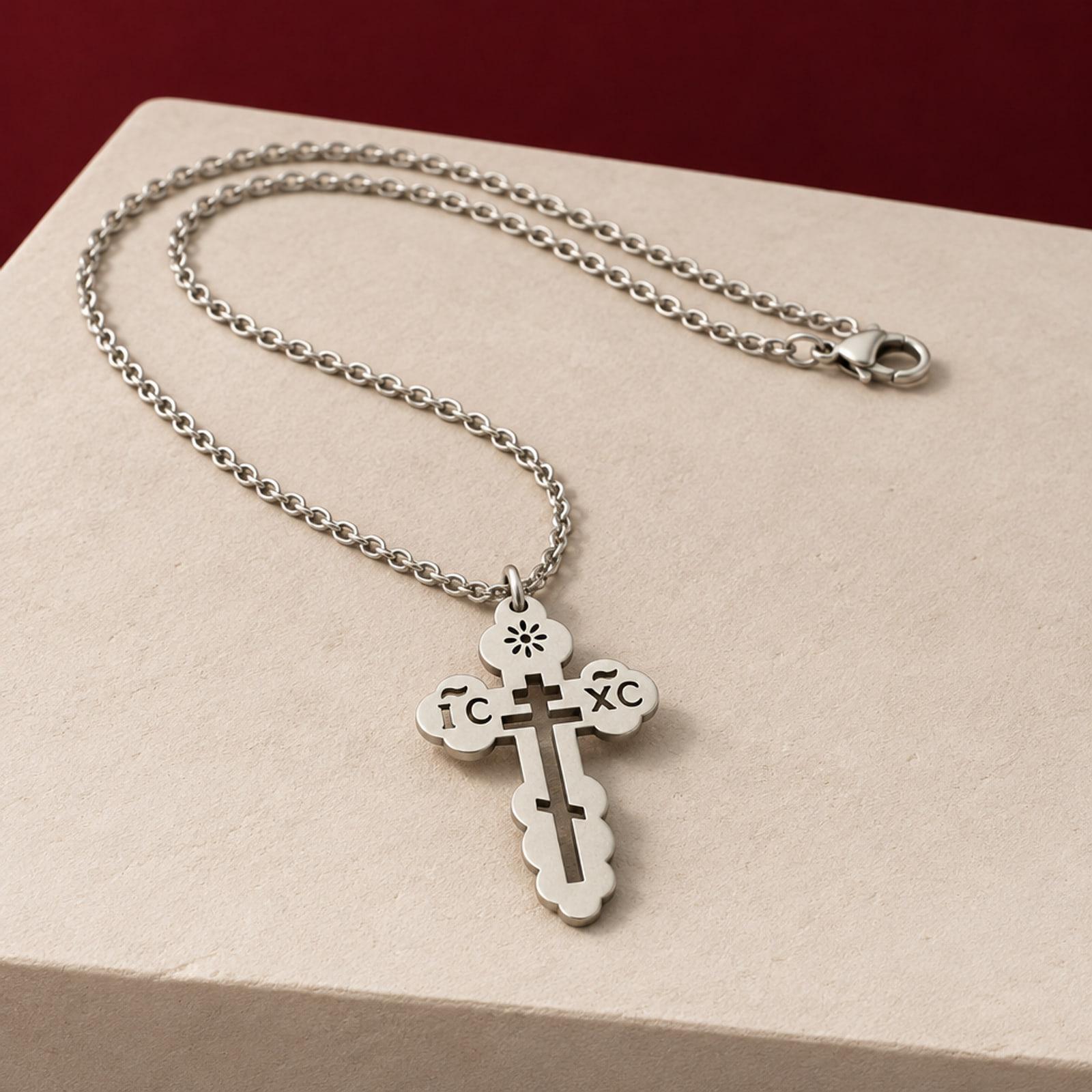
- for white gold, the silver-tone plain three-bar cross on a 60 cm chain, and the small cut-out cross with IC XC, a pendant;
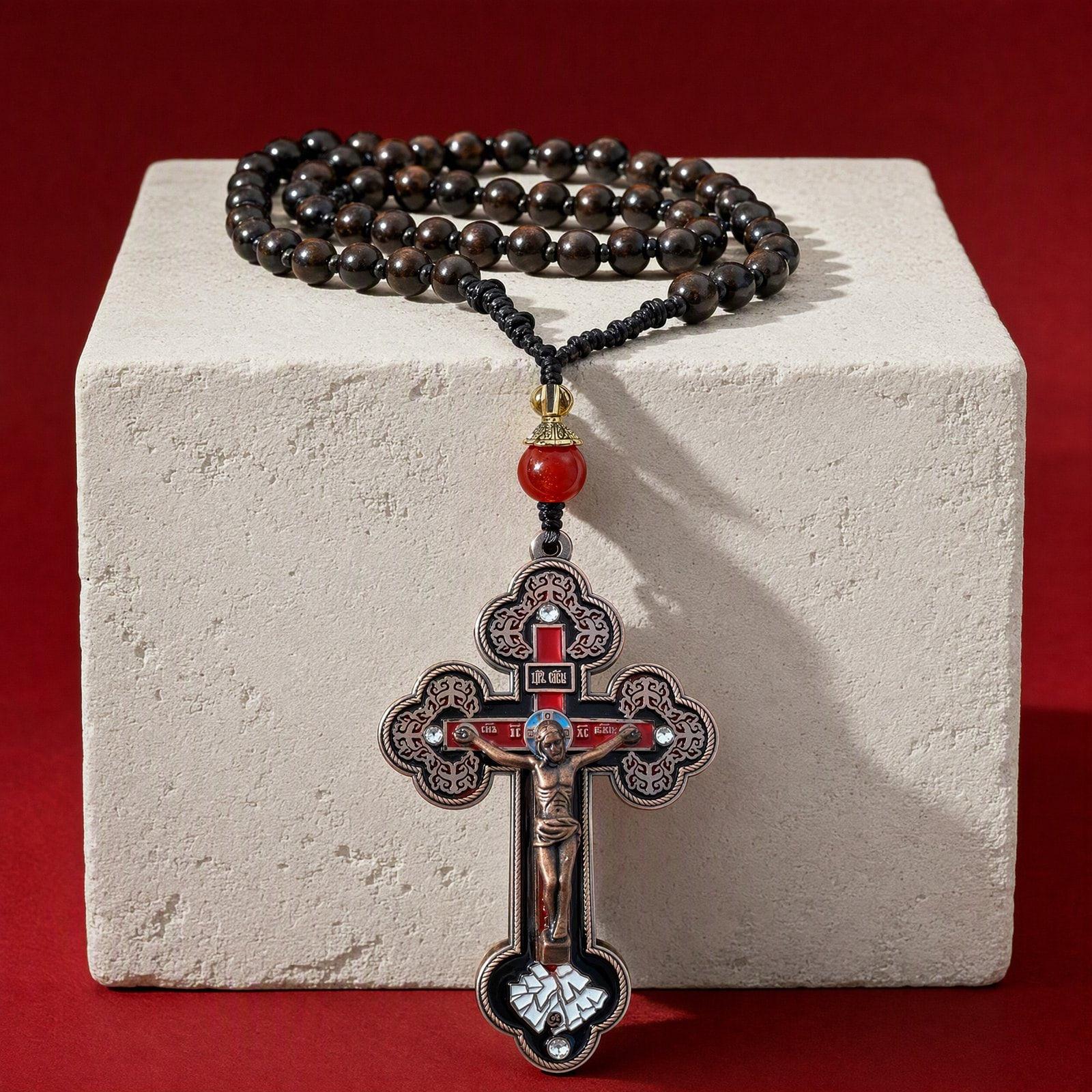
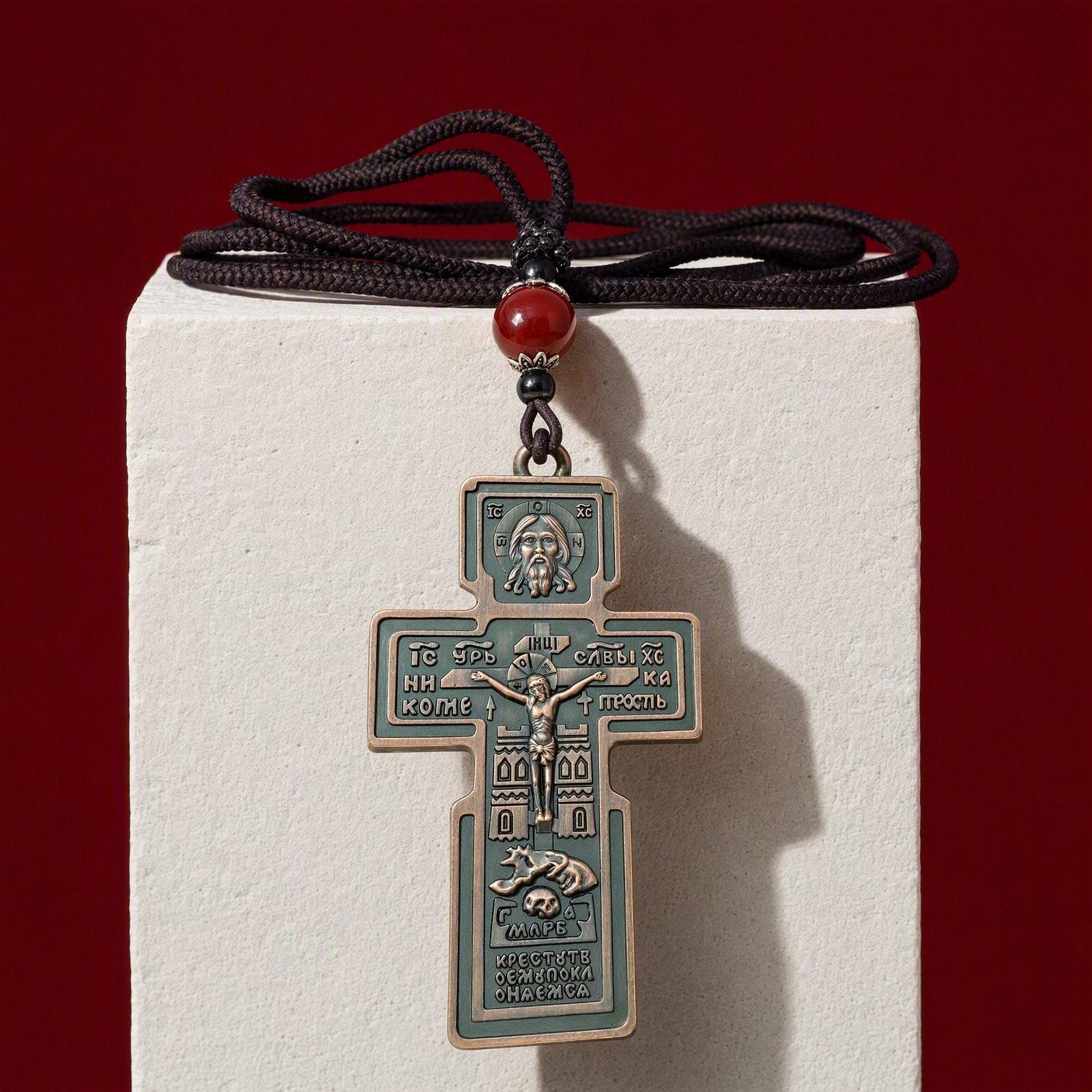
- for rose gold, the copper-red crucifix over red and black enamel, and the bronze-tone Holy Face crucifix on a dark cord of about 70 cm.
White gold chain cross: what to look for
A white gold cross on a chain has the bright look of silver with the weight and value of gold. Before you buy one, check:
- The karat stamp on the cross, the chain and the clasp: 14K or 585 is the most common in the United States, 18K or 750 is richer in gold.
- The plating. Most white gold is plated with rhodium for its bright white color. Look closely at the edges and the bail: yellow showing through means the plating has worn.
- The alloy. White gold made with nickel can irritate some people’s skin. If yours reacts to cheap earrings, ask for palladium white gold.
- The size. A small white gold cross pendant of half an inch to an inch is the usual dainty choice for a woman, on a 16 to 18 in chain; a man’s cross is often 1 to 1.5 in on a 20 to 24 in chain.
- The chain. A cable, box or rope chain in the same karat, so the chain lasts as long as the cross.
Rose gold cross necklace: the warm color
Rose gold is gold mixed with copper, also called pink gold or red gold. The more copper, the deeper the color, so a 14k rose gold cross is often a little redder than an 18k one. Because the color runs all through the metal, rose gold needs no plating and does not fade; over many years it can deepen slightly. A rose gold cross necklace for women is a popular gift for a confirmation, a wedding or a mother, because the warm color suits most skin tones.
Yellow, white and rose gold side by side
| Yellow gold | White gold | Rose gold | |
|---|---|---|---|
| Mixed with | Silver and copper | Nickel, palladium or silver, often plated with rhodium | Copper |
| Look | Warm, classic | Bright, silver-like | Pink to coppery |
| Upkeep | Polish now and then | Re-plating every year or two | Polish now and then |
| Karats | 10k, 14k or 18k | 10k, 14k or 18k | 10k, 14k or 18k |
The color name tells you what the gold is mixed with; the karat tells you how much is gold. Our page on the 14k gold Orthodox cross explains the karat marks in full.
Colour is a choice, form is what makes the cross
The colour of a cross, white, rose or plain steel, is a matter of taste and of what looks right beside the wearer’s skin and clothes. The OrthodoxWiki article on the cross says nothing about colour. It does describe the form many Orthodox churches use, the three-bar cross, with its short top bar for the notice above Christ, its long middle bar for his arms and its lowest bar for the footrest, and it describes a small cross on a chain round the neck as the usual thing to wear. Look for those first, then for the metal. An Orthodox priest can bless the crosses below before they ship. See the Orthodox three-bar cross for the meaning of each bar.
White gold, platinum, sterling or steel?
| Metal | What it is | Keep in mind |
|---|---|---|
| White gold | Karat gold with white metals, rhodium-plated | Re-plating keeps it bright |
| Platinum | A naturally white precious metal, often 95% platinum | Heavier and costlier than white gold |
| Sterling silver | 92.5% silver | Tarnishes, polish brings it back; see sterling silver crosses |
| Silver-tone stainless steel | Steel, no precious metal | Does not tarnish, made for daily wear |
Many people searching for a white gold cross with diamonds are after a sparkle more than the metal; the guide to the diamond cross necklace covers those.
Caring for a white or rose gold cross
Wash it in warm water with a drop of mild soap, brush the corners with a soft toothbrush, rinse and dry. Take it off in the pool and the hot tub, because chlorine can harm gold alloys over time, and before cleaning with bleach. Store it apart from other jewelry so it is not scratched. For white gold, ask a jeweler to re-plate it with rhodium when yellow begins to show.
What we carry instead
Our closest items are stainless steel crosses, each at its live price. In silver tone, nearest to white gold: the plain three-bar cross on a 60 cm chain ($64) and the small cut-out IC XC cross, a pendant ($54). In warm tones, nearest to rose gold: the copper-red crucifix over red and black enamel ($54) and the bronze-tone Holy Face crucifix on a dark cord ($54). More warm tones are in bronze and copper crosses, and the whole range in all our Orthodox cross necklaces. Orders arrive in 5–8 business days: US-based, ships from Florida.
Silver-tone and copper-red crosses on sale now
None of these is gold, and the email box under them is the waiting list for white gold and rose gold pieces.
SA SEDIŠTEM U SAD. ŠALJEMO IZ FLORIDE
Delivery in 5–8 business days.
Want us to stock it?
We don't carry a white gold chain cross today. Leave your email and we will write once if we stock it.
Questions
Does Lampada sell white gold Orthodox crosses?
Not yet. They are coming. The nearest we have is silver-tone stainless steel, such as the plain three-bar cross on a 60 cm chain.
What is the difference between white gold and rose gold?
White gold is gold mixed with white metals, and rose gold is gold mixed with copper. Both give their purity in karats, so a 14 karat white gold cross and a 14 karat rose gold cross hold the same share of gold.
Is rose gold the same as pink gold?
Wikipedia lists pink gold and red gold as other names for rose gold.
Are the copper-red and bronze-tone crosses rose gold?
No. They are stainless steel in copper-red and bronze-tone finishes, and the catalogue states no karat for any cross. We show them as the nearest finish, nothing more.
How will I hear when white or rose gold crosses arrive?
Leave your email in the box on this page. It is the waiting list for those pieces.
What should I look for in a white gold chain cross?
A karat stamp, such as 14K or 18K, on the cross, the chain and the clasp; a bright rhodium finish with no yellow showing at the edges; and, if your skin reacts to nickel, white gold made with palladium instead.
Does white gold turn yellow?
Most white gold is plated with rhodium, a bright white metal. With wear the plating thins and the warmer color of the gold beneath shows through. A jeweler can plate it again, and many owners have this done every year or two.
Does rose gold fade?
No. Its color comes from the copper mixed all through the gold, not from a coating, so there is nothing to wear off. Over many years it can deepen a little. Clean it with warm water and mild soap and dry it well.