Processional crucifix, what it is and where it is used
Not in our store todayWe do not carry processional crosses today: we have no cross made to be carried on a staff. The cards below are our closest items for the home, a wall crucifix and two small wooden crosses.
Processional crosses lead the way when a church walks in procession. A processional crucifix is a cross, or a crucifix, carried by hand at the head of a Christian procession. Orthodox parishes carry one in the cross-processions of Palm Sunday, Paschal Matins and Bright Week, and Greek-tradition churches also bring it in at the Entrances of the services. Lampada does not sell a processional cross. Our crucifixes are made for the home and for wearing.
Wikipedia takes the custom back to the mission of Augustine of Canterbury, which according to Bede went ahead carrying a cross like a banner. In time the cross came off its staff, and the first altar crosses were simply processional crosses mounted on a base once a procession ended. Big churches preferred the crux gemmata, a richly jeweled cross in precious metal, and the Cross of Lothair and the Cross of Cong are early examples.
Out of doors the Orthodox order is set. A large lantern and a deacon with incense go first, then the cross, then the banners and icons, then the chanters and clergy, and the people come last. Between services the cross can rest behind the altar table, inside the sanctuary.
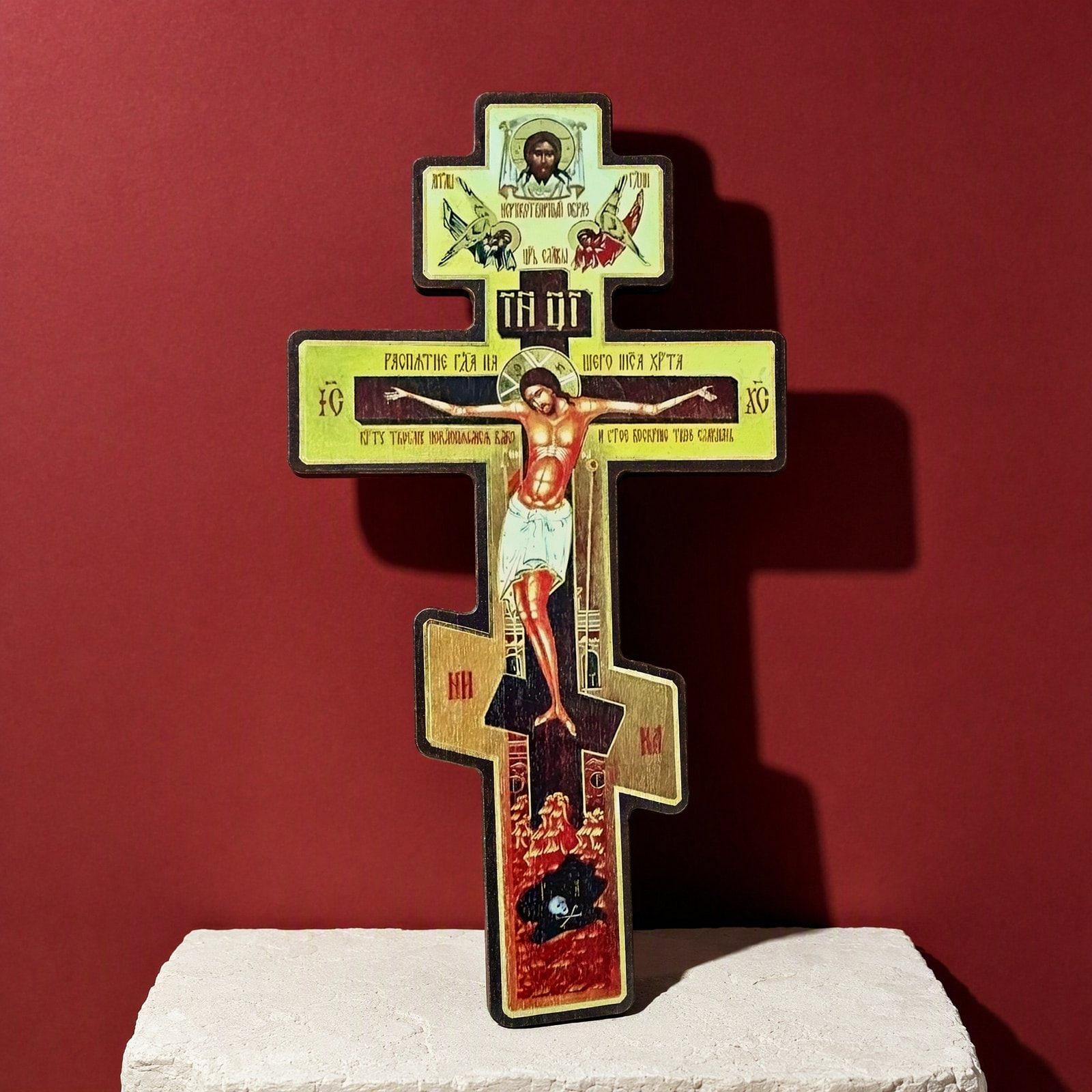
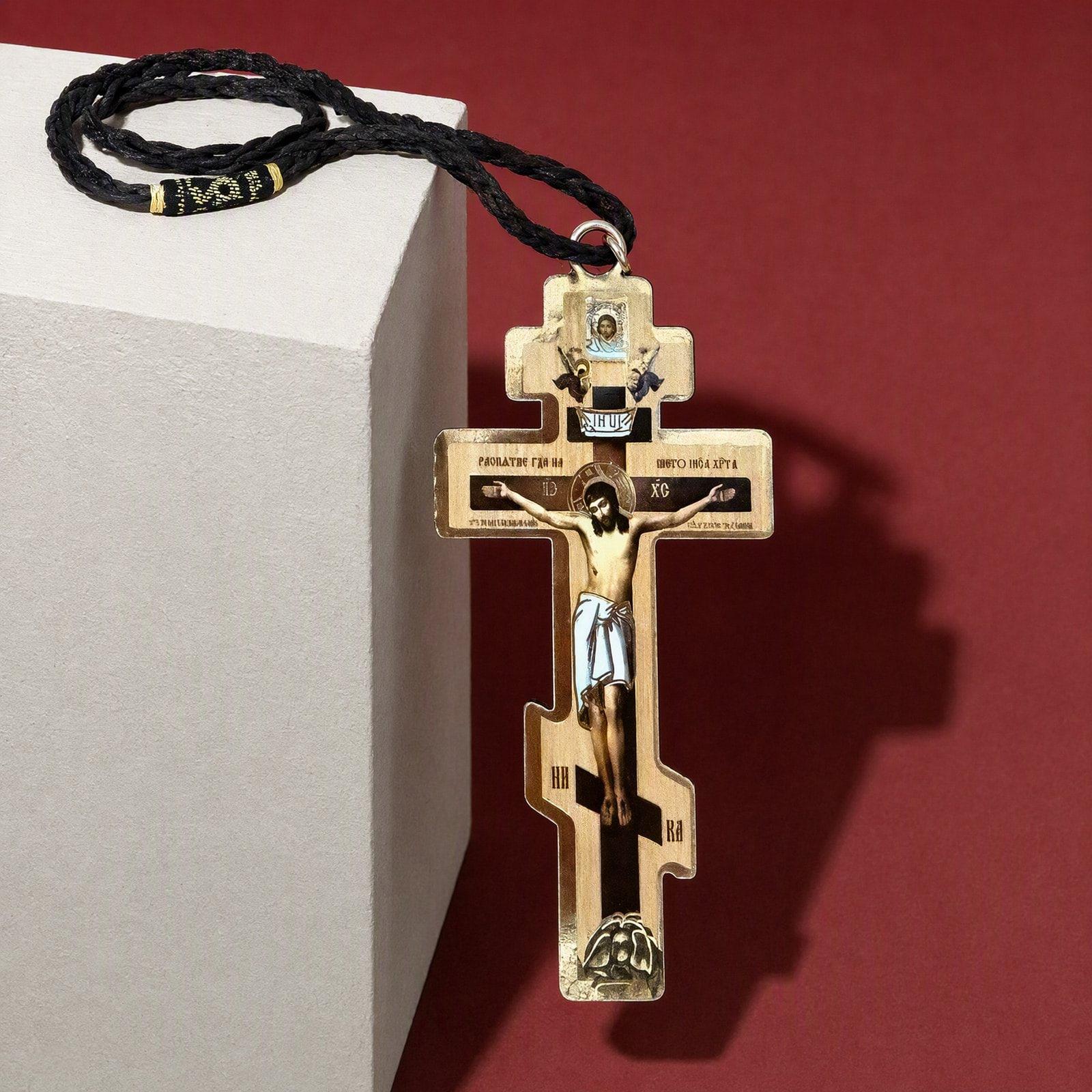
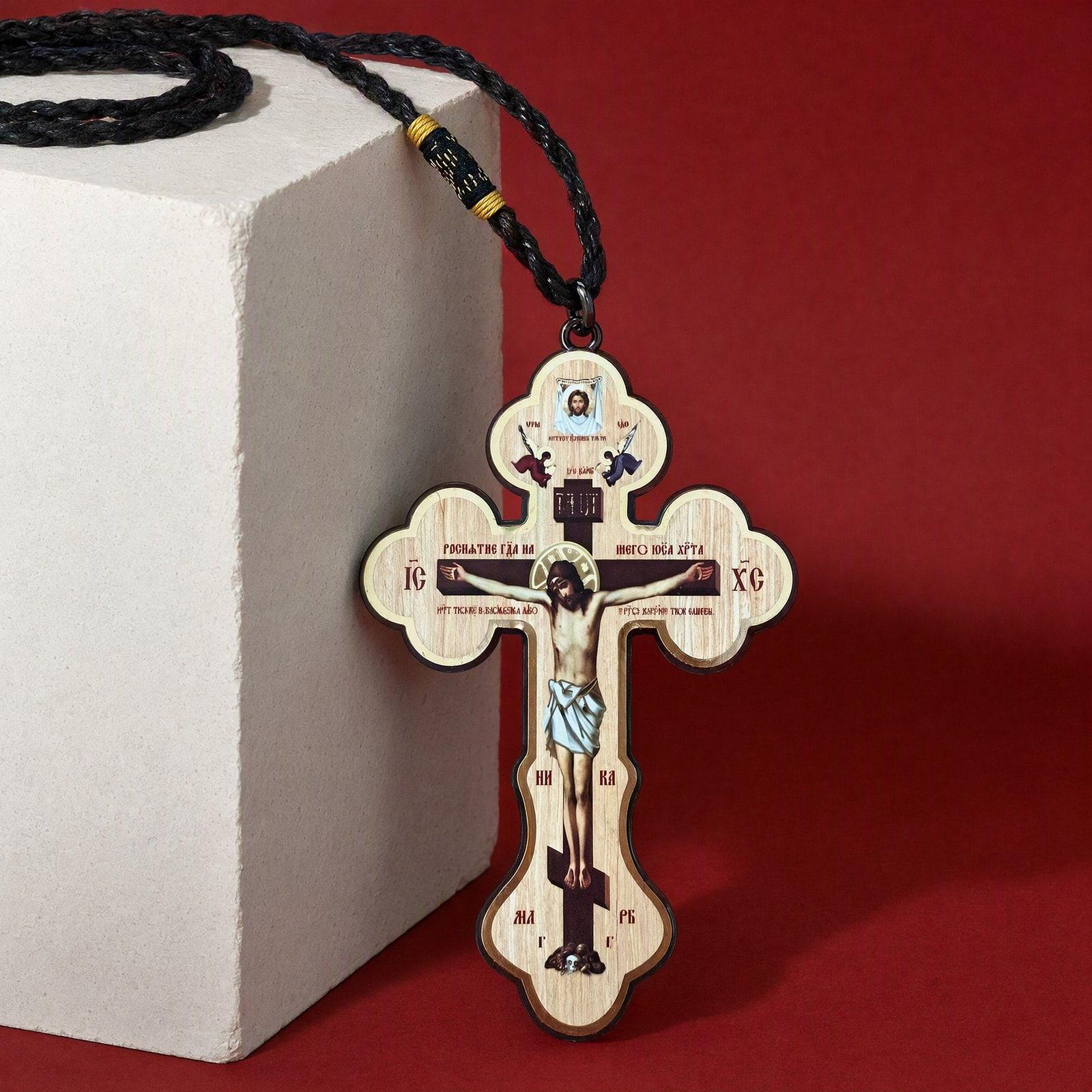
What we carry instead: the wooden wall crucifix, with the Crucifixion printed in color on the front, and two light wooden crosses on a dark cord, the eight-pointed one and the budded one.
Where processional crosses come from
A processional cross is named for its use, not its shape. Any cross becomes one when it is set on a pole and carried at the front of the faithful as they walk: around the church, through a town, to a river for the blessing of the waters, or to a cemetery. The custom is very old. Bede’s account of Augustine’s mission, the first altar crosses that began as processional crosses set on a base, and the jeweled crosses of the great medieval churches all point the same way: the cross goes first. See the history of the cross for how the sign itself came to stand for Christ.
The parts of a processional cross
| Part | What it is |
|---|---|
| The head | The cross itself, often double-sided, with the Crucifixion on one face and the Resurrection or the Mother of God on the other |
| The knop | A rounded boss where the cross meets the staff, often decorated |
| The staff | A long pole of wood or metal, sometimes in sections, so the cross is seen above the crowd |
| The stand | A socket or base where the cross rests between processions, beside the altar or in the sanctuary |
Orthodox processional crosses are often flanked by two liturgical fans on poles, round or six-winged discs with the face of a seraph, carried by servers on either side. Together the cross, the fans, the banners and the icons make up the front of the procession.
How it differs from the Orthodox three-bar cross
The Orthodox three-bar cross is a shape: a short top bar for the title over Christ’s head, the long bar for His arms and a slanted footrest below. A processional cross is a use. Many Orthodox processional crosses are three-bar crosses; many in the Greek tradition are four-armed crosses with flaring ends; Ethiopian ones are lattices of small crosses. What makes them processional is the staff and the place at the head of the line. The same cross at home, hung on a wall or set on a table, is a home cross.
Byzantine, Ethiopian and Coptic processional crosses
Byzantine processional crosses that survive, many now in museum collections, are mostly of silver or bronze, with flaring arms and engraved or embossed figures of Christ, the Mother of God and the saints. They are the ancestors of the flat metal crosses many Greek-tradition parishes still carry. Read more about the shape on our Byzantine cross page.
Ethiopian processional crosses are among the best known in the world: large, cast or cut heads of brass or bronze, worked into a lattice of smaller crosses, carried on tall staffs at the great feasts such as Timkat, the Epiphany, and Meskel, the Finding of the Cross. A colored cloth is often tied below the head. See Ethiopian crosses.
Coptic processional crosses, from the Church of Egypt, usually take the Coptic form of equal arms ending in three points each, the three standing for the Holy Trinity. Coptic priests also hold a small hand cross for blessing. See Coptic crosses.
The cross in the hand of the priest and on the road
OrthodoxWiki says that Orthodox believers imagine the crucified Christ as the Victor and King reigning from the Tree. It adds that after the Liturgy the people come forward one by one to kiss the cross the priest holds out. Wikipedia describes a cross whose two faces carry the Crucifixion and the Resurrection, turned so that the Resurrection shows on Sundays and through the Paschal season. A cross in your own home belongs to the same reverence on a smaller scale. The Blessing, which an Orthodox priest gives before the cross ships, is offered with each of the crosses on this page.
What we carry instead
We do not carry processional crosses today, and nothing in our catalogue is made to go on a staff. For a cross in the home, our closest items are:
- the wooden wall crucifix, 8 in, with the Crucifixion printed in color on the front and a dark wooden back, made to hang at home ($74);
- two light wooden crosses on a dark cord, 10 cm, with Christ crucified printed in color: the eight-pointed one ($44) and the budded one ($44), for a car, a bedside or the neck.
Each price is the one the item’s page opens at. More wooden crosses are on our wooden cross page. Orders arrive in 5–8 business days: US-based, ships from Florida.
A wall crucifix or a small wooden cross instead
The nearest thing we carry to a cross for a room is the wooden wall crucifix, which is made to hang at home and not to be worn.
SA SEDIŠTEM U SAD. ŠALJEMO IZ FLORIDE
Delivery in 5–8 business days.
Want us to stock it?
We don't carry a processional cross today. Leave your email and we will write once if we stock it.
Questions
What is a processional cross?
Wikipedia defines it as a cross or crucifix carried in Christian processions, usually on a staff. Some sources expect every church to own one.
When do Orthodox churches use a processional cross?
Outdoors on Palm Sunday, at Paschal Matins, in Bright Week, for a saint’s relics or icon, and round the church on its patronal feast, and at funerals. In the Greek tradition it is also carried in at the Entrances of the services.
Why do some processional crosses show two scenes?
Some Orthodox ones carry the Crucifixion on one face and the Resurrection on its reverse. The Resurrection faces forward on Sundays and in the Paschal season, the Crucifixion on other days.
Is a processional cross the same as an altar cross?
Not today, but they began together. Wikipedia says the first altar crosses were processional crosses mounted on a base once a procession ended.
Does Lampada sell a processional crucifix?
No. We have no cross made to be carried on a staff. The closest are a wooden wall crucifix and two small wooden crosses on a cord, all made for the home.
What are processional crosses made of?
Most are metal, such as brass, bronze or silver-plated metal, or carved and painted wood, fixed to a long staff of wood or metal. Ethiopian processional crosses are known for their large openwork heads, cast or cut into a lattice of smaller crosses.
Who carries the processional cross?
Usually an altar server, a reader or another layman chosen for the task, walking at the front just behind the lantern. On the great feasts in some parishes a deacon or priest carries a cross as well, and the people follow behind.