Patriarchal cross meaning
A patriarchal cross is a cross with two horizontal bars, the upper one shorter than the lower. The patriarchal cross, in Wikidata’s wording, is a variant on the Christian cross. It is an instance of the two-barred cross and of Christian symbolism, and it is named after the patriarch.
Two more lines of our source help to place it. It is a subclass of the cross and, more narrowly, of the Latin cross. And Wikidata says it is different from the cross of Lorraine, which it keeps as a separate item.
Four points to take away
- It has two bars, because our source calls it a two-barred cross.
- It belongs to the Latin cross as well as to the wider family of crosses.
- Its name points to the patriarch.
- It is not the cross of Lorraine.
What is missing. Wikidata gives no date, no account of which patriarchs use it and no meaning for its bars. The sections below add what other public sources record on all three.
Lampada does not sell a patriarchal cross, and the nearest cross in the catalogue is a different shape.
What a patriarchal cross looks like
The patriarchal cross keeps the upright and crossbar of a Latin cross and adds a second, shorter bar above. Both bars are straight and both are set high on the upright, the upper one nearer the top. There is no footrest. That is the whole difference from its neighbors:
| Cross | Bars | Footrest |
|---|---|---|
| Latin cross | One | No |
| Patriarchal cross | Two, the upper shorter | No |
| Orthodox three-bar cross | Two straight bars and a third below | Yes, slanted |
| Cross of Lorraine | Two, often of equal length, the lower set low | No |
| Papal cross | Three, each shorter toward the top | No |
The patriarchal cross in history
The double-barred cross is old. It appears in Byzantine art from about the ninth and tenth centuries, most famously on reliquaries made to hold a piece of the True Cross: the relic itself was often cut and set in this two-barred shape. From Constantinople the sign traveled west and north. It came to be carried before archbishops and patriarchs in procession, which gave it the names patriarchal and archiepiscopal cross, and in Western heraldry a double cross behind a coat of arms still marks an archbishop.
The same cross became a national sign in Central Europe: it stands on three hills in the arms of Slovakia, on the arms of Hungary, and on the knight’s shield in the arms of Lithuania.
What the two bars mean
The most common reading is the simplest. The short upper bar is the title board that Pilate had nailed over Christ’s head (what INRI means), and the long bar is the beam of His arms. Read that way, the patriarchal cross is the cross of the Crucifixion drawn with its title. Other explanations have been offered over the centuries, such as a second bar for a higher church office, but none of them changes the first.
Two bars and three bars
Our source sets the patriarchal cross apart by its two bars. The Orthodox cross in our catalogue has three, and the plain version carries no figure at all. Wikidata does not say which churches use the patriarchal cross; the history above shows it in Byzantine art and in Western use for archbishops. We choose the plain three-bar cross as the nearest we sell on a single ground, that it has no figure on it, and not because the two crosses are the same.
Patriarchal cross necklace: our closest crosses
We do not carry a patriarchal cross necklace or pendant today. The nearest shape we sell is the Orthodox three-bar cross, which has the same two upper bars with a slanted footrest added below:
- the plain three-bar cross, about 2¼ in, no figure, on a 60 cm chain, in silver-tone ($64), gold-tone ($64) or black stainless steel ($64);
- the small IC XC three-bar cross, 1⅜ in, cut out with the letters IC XC, in silver-tone ($54) or gold-tone ($54).
Each price is the one the item’s page opens at, and each can be blessed by an Orthodox priest before shipping. If you would like us to stock a two-barred cross, leave your email below. Orders arrive in 5–8 business days: US-based, ships from Florida.
A plain three-bar cross to give
The three finishes of our plain three-bar cross, silver-tone, gold-tone and black, each can be blessed by an Orthodox priest before shipping. Two small IC XC crosses of the same three-bar shape sit beside them.
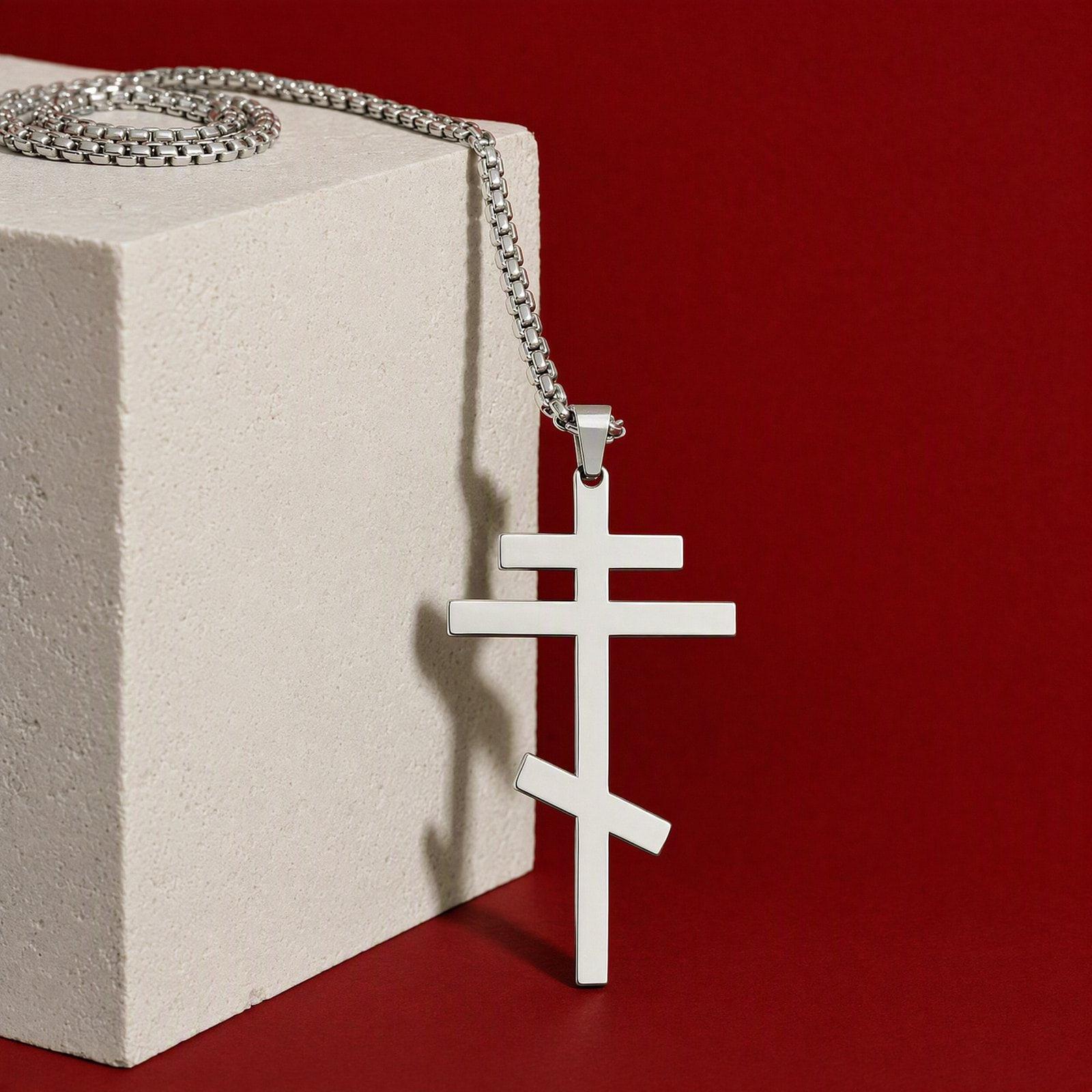 Krst
Three-Bar Bright
srebrna boja · lančić 60cm · nerđajući čelik$92$64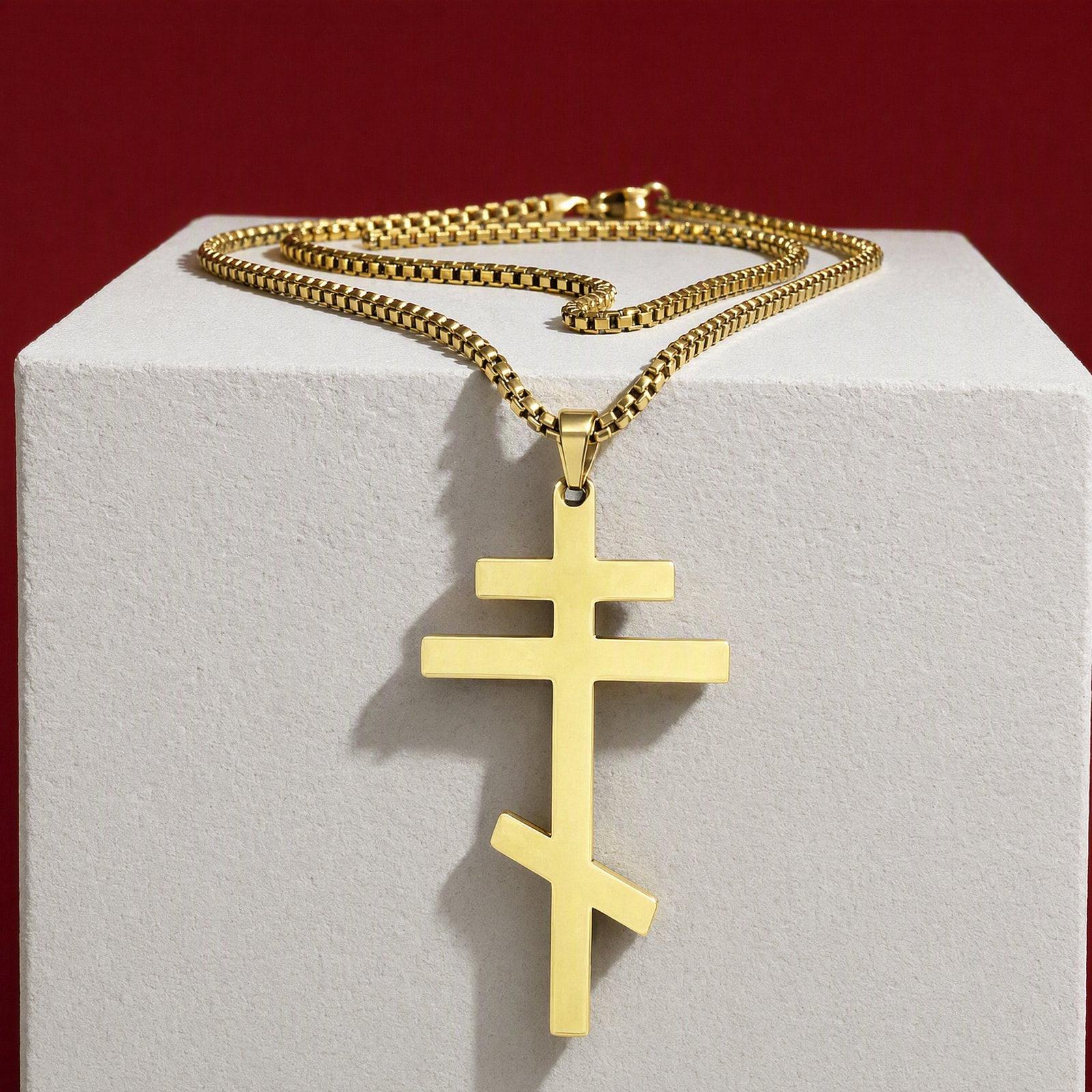 Krst
Three-Bar Lamplight
zlatna boja · lančić 60cm · nerđajući čelik$92$64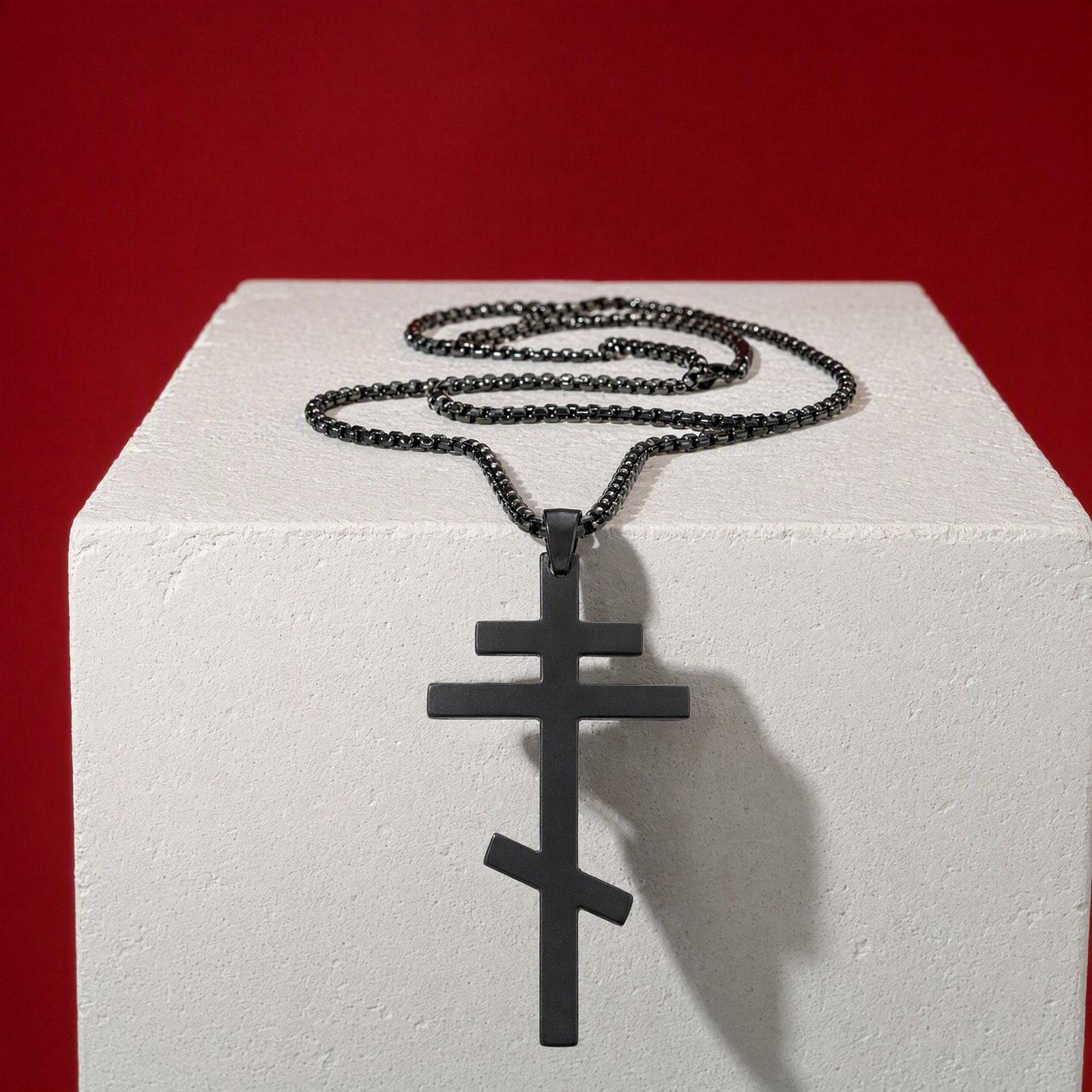 Krst
Three-Bar Midnight
crna boja · lančić 60cm · nerđajući čelik$92$64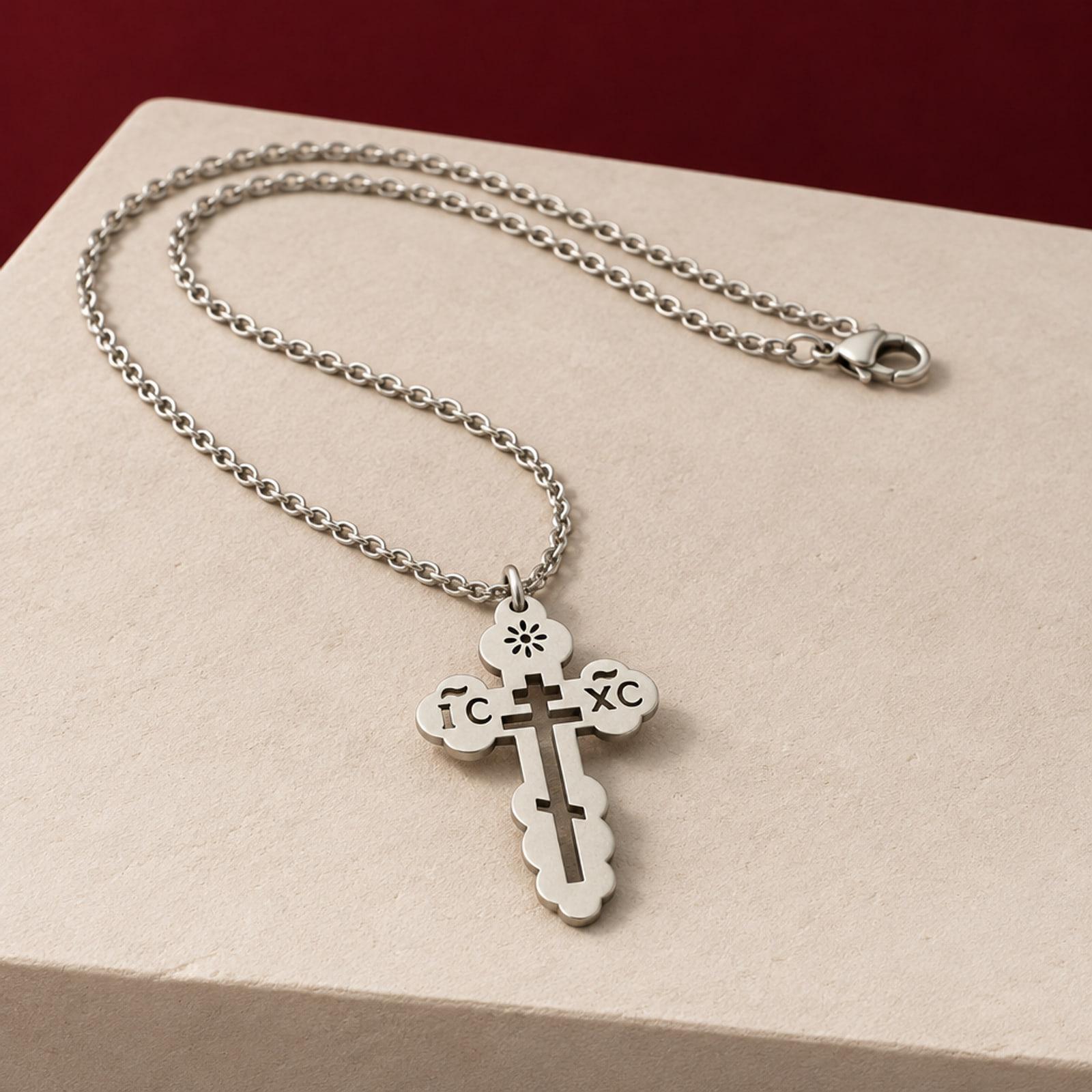 Krst
Monogram Bright
srebrna boja · nerđajući čelik$78$54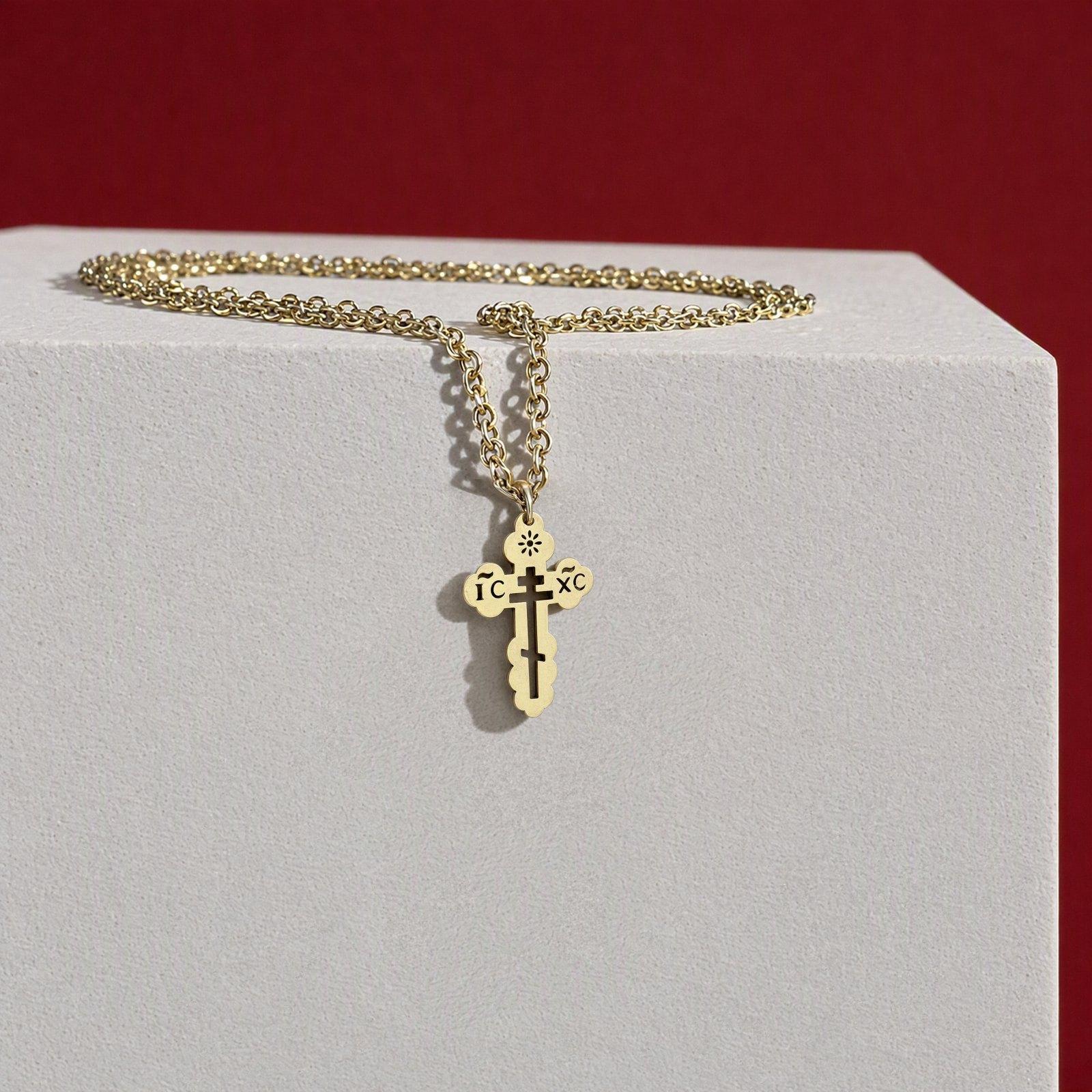 Krst
Monogram Lamplight
zlatna boja · nerđajući čelik$78$54
SA SEDIŠTEM U SAD. ŠALJEMO IZ FLORIDE
Delivery in 5–8 business days.
Want us to stock it?
We carry close items, not every kind of patriarchal cross. Leave your email and we will write once if we stock more.
Questions
What does the patriarchal cross mean?
Our source says only that it is a variant on the Christian cross, named after the patriarch. Tradition reads the short upper bar as the title board over Christ’s head and the longer bar as the beam of His arms, and the second bar as a mark of a high church office.
Is a patriarchal cross the same as the cross of Lorraine?
No. Wikidata marks the patriarchal cross as different from the cross of Lorraine.
Is it a Latin cross?
Wikidata lists the Latin cross among the things the patriarchal cross is a subclass of.
Which patriarch is the cross named after?
Our source says only that it is named after the patriarch. It gives no name and no church. The name points to the office, not to one man: the cross was carried before archbishops and patriarchs, which is why it is also called the archiepiscopal cross.
Do you sell a patriarchal cross pendant?
We do not. The Orthodox crosses we sell have three bars and, in the plain version, no figure.
Is the patriarchal cross an Orthodox cross?
It appears in Byzantine art, on relic crosses of the True Cross, and it is close to the Orthodox cross: add a slanted footrest below the two bars and you have the Orthodox three-bar cross. It is used in Western churches too, for archbishops.
Which countries have a patriarchal cross on their flag or arms?
The double cross is on the coat of arms of Slovakia, standing on three hills, on the arms of Hungary, and on the shield of the knight in the arms of Lithuania. In each it goes back to medieval kings and the Christian faith of the land.