Orthodox wedding crowns: what they mean and how the crowning is done
Not in our store todayWe do not carry Orthodox wedding crowns today. Below: what the crowns mean, the service, who provides them, and our wedding icons and gifts.
Orthodox wedding crowns are placed on the heads of the bride and groom at the high point of an Orthodox wedding, which is called the service of crowning. In Greek and Antiochian parishes they are light stefana, two circlets joined by a ribbon; in Serbian, Ukrainian and other Slavic parishes they are tall metal crowns, often held above the couple’s heads. Either way, they crown the couple as king and queen of a new household, and as witnesses who give their lives for each other.
We do not carry wedding crowns today. Below: the kinds of crown, the service step by step, who usually provides them, how to keep them, and the wedding icons and gifts we carry.
Stefana and metal crowns: the two kinds
| Stefana | Metal crowns | |
|---|---|---|
| Where | Greek, Cypriot and many Antiochian parishes | Serbian, Ukrainian, Romanian and other Eastern European parishes |
| Made of | Thin circlets of metal, flowers, pearls or crystal | Brass or silver-tone metal, often with small icons |
| Joined | By one ribbon between the two | Separate |
| Worn | On the head | On the head, or held above it by the sponsors or best men |
| After the wedding | Kept by the couple in a case | Usually returned to the parish |
Coptic and Ethiopian Orthodox weddings are also crownings, with their own crowns and robes. Serbian Orthodox wedding crowns and Coptic Orthodox wedding crowns differ in shape, but each marks the same moment.
The service of crowning, step by step
- The betrothal. At the back of the church the priest blesses the rings and exchanges them three times on the couple’s right hands. The couple hold lit candles.
- The procession. The couple walk to the center of the church, where a table holds the crowns, the Gospel and a cup of wine.
- The prayers. Long prayers ask God to bless the marriage, remembering couples of the Old Testament.
- The crowning. The priest places the crowns, saying “The servant of God is crowned,” and sings “O Lord our God, crown them with glory and honor.” The crowns are exchanged three times.
- The common cup. After the Epistle and Gospel, the couple drink three times from one cup of wine.
- The walk around the table. The priest leads the crowned couple three times around the table as hymns are sung; many call it the Dance of Isaiah.
- The removal of the crowns. The priest lifts the crowns with a blessing for the couple’s life together.
What the crowns mean
The crowns carry two meanings at once. They are royal: the couple begin a household, a small kingdom of their own, to rule with love and justice. And they are the crowns of martyrs, a word that means witnesses: marriage asks each to lay down life for the other, as Christ did for the Church. That is why the hymns of the walk around the table include the hymn to the holy martyrs. The ribbon between the stefana adds a third sign: two lives joined as one.
Buying, borrowing and keeping crowns
Before buying orthodox wedding crowns for sale, ask your priest. Many parishes keep a pair of crowns, especially Slavic ones, and expect every couple to use them. In Greek custom the sponsor buys the stefana and often a case to keep them in.
If you do buy, check that the crowns are light enough to wear through a long service, that the ribbon is long enough to hang easily between two people, and that the case fits them. Greek couples hang their stefana in the case over the bed or keep them near their icons. A couple’s wedding icons usually stand nearby; see our home prayer corner guide.
Wedding icons and gifts we carry
We do not carry wedding crowns. For the wedding itself and the couple’s home we carry the traditional wedding pair of icons, Our Lady of Kazan and the Saviour ($1,819), painted by hand on cypress, each in a carved ash case with glass. A smaller choice is the folding diptych of Christ Pantocrator and Our Lady of Kazan ($94), made for a newly married couple and their home. Sts Peter and Fevronia with a dove ($74), honored as patrons of marriage, comes in a gold-tone frame; see Sts Peter and Fevronia.
For the candles the couple hold, see our prayer candle guide. As gifts, the Couple’s Protector Set ($239) holds a folding icon, a St Michael medallion, a crucifix and two prayer ropes, and the hand-carved triptych ($169) is made to mark a wedding. More ideas in our wedding and anniversary gifts. Orders arrive in 5–8 business days: US-based, ships from Florida.
Our closest items
The traditional pair of wedding icons, painted by hand, a folding icon of Christ and Our Lady of Kazan, Sts Peter and Fevronia, a couple’s gift set and a carved triptych. Each card shows its live price.
 Икона
Православная венчальная пара икон
написана вручную — Казанская и Спас, 15x20 см$2,599$1,819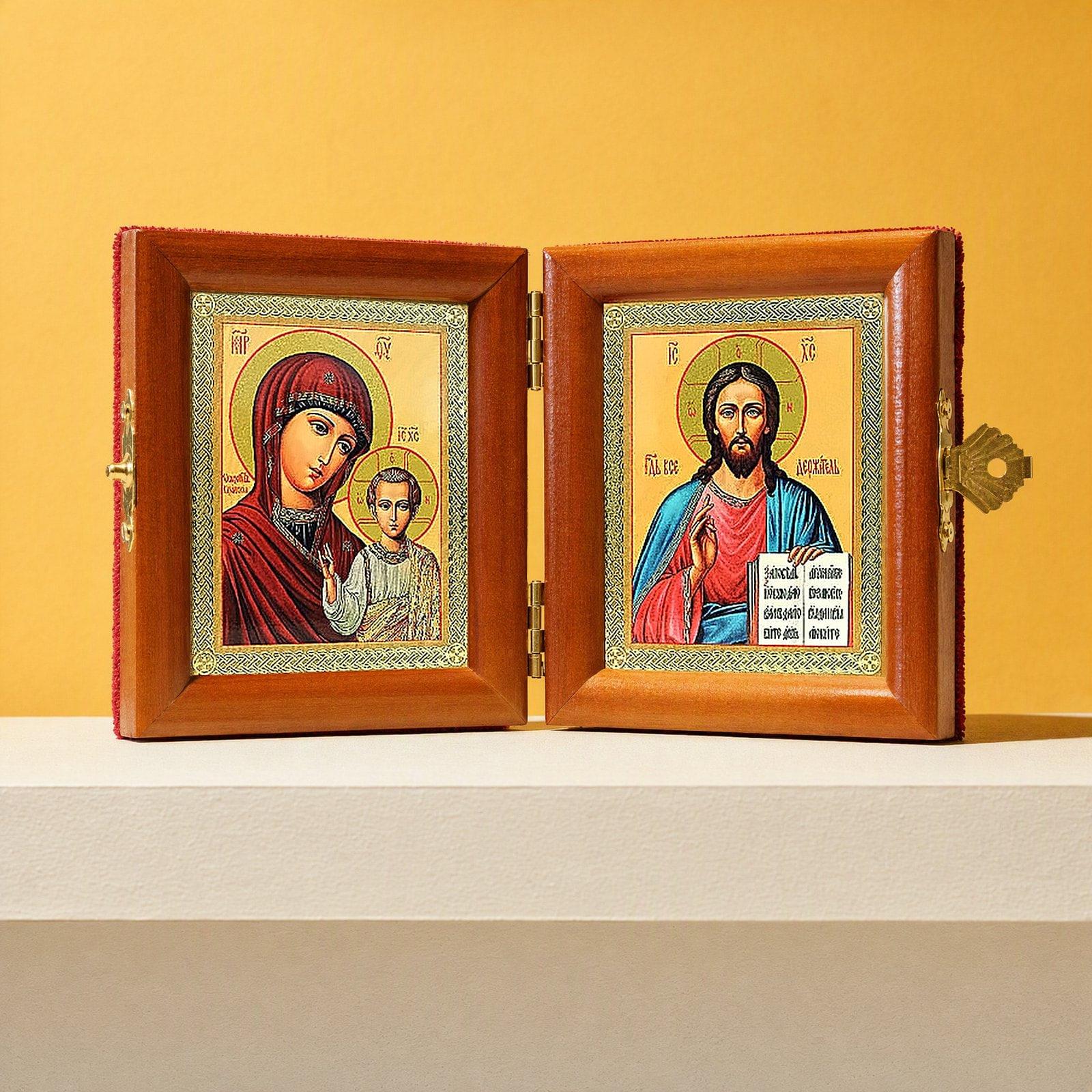 Складень
 «Господь Вседержитель и Казанская икона Божией Матери»
$135$94 Икона
Святые Пётр и Феврония Муромские с голубем — православная икона в рамке 21.5x25 см
$106$74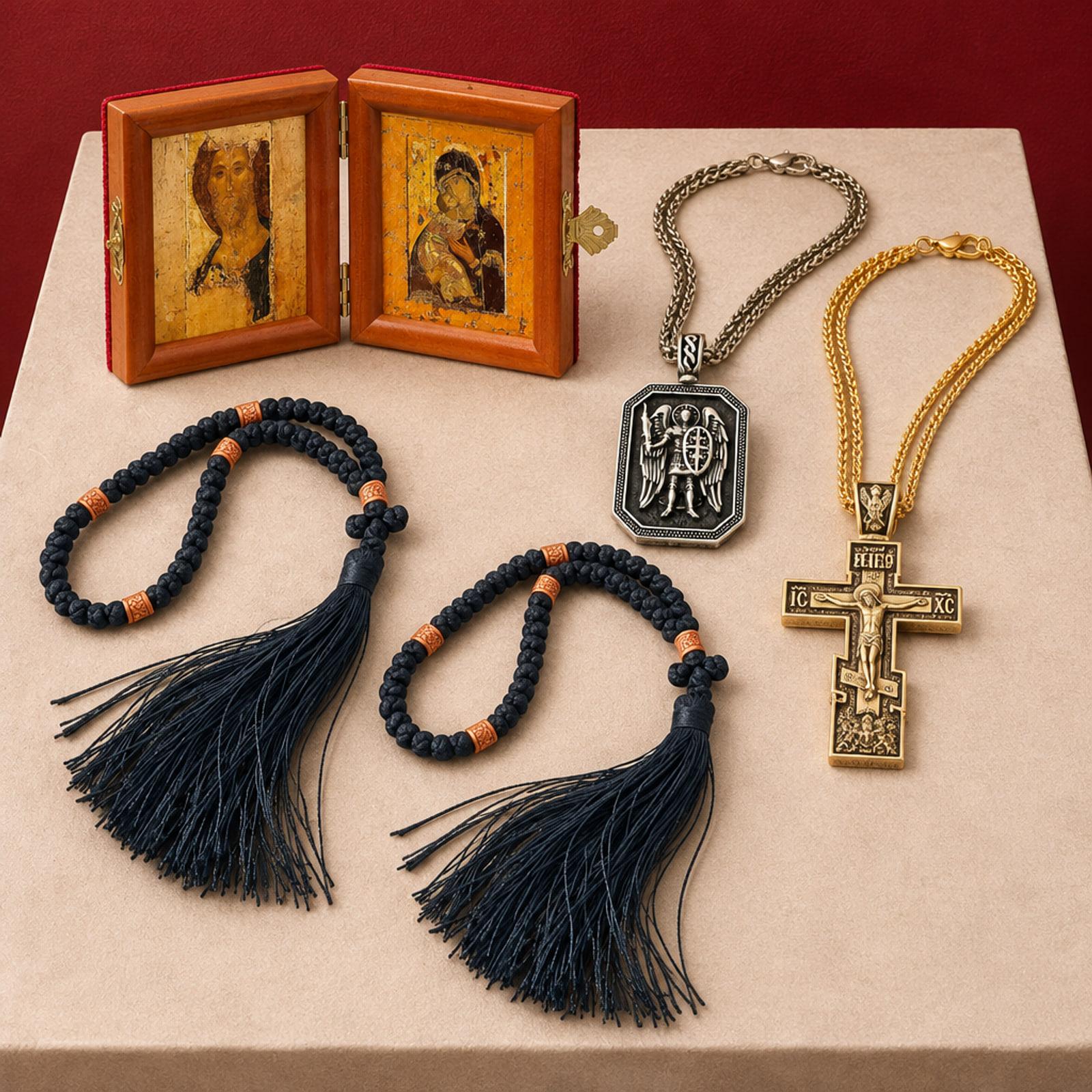 Подарочный набор
Набор «Покровитель» для пары
$342$239 Икона
Православный резной складной триптих ручной работы
$242$169
МЫ В США. ОТПРАВКА ИЗ ФЛОРИДЫ
Delivery in 5–8 business days.
Want us to stock it?
We don't carry Orthodox wedding crowns today. Leave your email and we will write once if we stock it.
Questions
Do you sell Orthodox wedding crowns?
Not today. We carry wedding icons and gifts for the couple. Leave your email on this page and we will write once if we stock wedding crowns.
What do the crowns mean in an Orthodox wedding?
They crown the couple as king and queen of their own small kingdom, the home, and as martyrs, in the old sense of witnesses, ready to give themselves for each other. The priest sings, “O Lord our God, crown them with glory and honor.”
Who buys the wedding crowns?
Customs differ. In Greek families the sponsor, the koumbaros or koumbara, usually provides the stefana. Many Slavic parishes own a pair of metal crowns that every couple uses. Ask your priest before you buy, because the parish may already have them.
What are stefana?
Stefana are the Greek wedding crowns: two thin circlets of metal, flowers, pearls or crystal, joined by a single ribbon to show the couple’s union. After the wedding they are kept in a glass case called a stefanothiki, often above the bed.
How many times are the crowns exchanged?
Three. The priest, or the sponsor in Greek custom, exchanges the crowns over the couple’s heads three times, in the name of the Father, and of the Son, and of the Holy Spirit.
Do Coptic and Serbian weddings use crowns too?
Yes. The Coptic Orthodox wedding is also a crowning, with crowns placed on the couple. Serbian weddings use metal crowns like other Slavic churches. The rite differs in details, but the crowning is always its center.