History of the Greek Orthodox Church
The Greek Orthodox Church traces its roots to churches the Apostles founded in the Eastern Mediterranean in the first century, and it grew with the Greek-speaking Byzantine Empire. Its modern chapters are the self-governing Church of Greece, from 1833, and the Greek Orthodox Archdiocese of America.
The first centuries. The Church in Greek lands began with the Apostle Paul, who visited Athens, Philippi, Thessaloniki and Corinth. In Acts a vision calls him: “Come over into Macedonia, and help us.” Others, among them Andrew, Titus and Philip, are remembered there as well. Across the first eight centuries the main theological writings came from the Byzantine world and were written in Greek, with Constantinople an early center of the faith.
What the name means. Greek Orthodox has three meanings. It can mean the whole Eastern Orthodox communion, the churches that keep Greek in worship, or the Church of Greece alone. Long ago the label covered every Eastern Orthodox church, since Greek recalled the Byzantine inheritance.
The Church of Greece. Until 1833 the Church in Greece was under the Ecumenical Patriarchate of Constantinople. After the Greek War of Independence it was declared self-governing in 1833, and the Patriarchate recognized the change by a tomos in 1850. Its primate is the archbishop of Athens and All Greece.
In America. The first Greek colonists reached St. Augustine, Florida, in 1768. Greek merchants in New Orleans founded the earliest Greek Orthodox community of the Americas in 1864, and New York City got the first permanent one in 1892. A single archdiocese for both American continents was incorporated in 1921 and recognized by New York State in 1922, the year it was placed again under the Ecumenical Patriarchate. In 1996 the Patriarchate divided it into four, leaving the Archdiocese of America with the United States. It has about 530 parishes and 20 monasteries, with its headquarters in New York City and a seminary, Holy Cross, in Brookline, Massachusetts.
In short. Greek Orthodoxy began with the Apostles, grew in the Byzantine Empire, and came to America with Greek immigrants in the eighteenth and nineteenth centuries.
One faith in many languages
The name Greek Orthodox points to a heritage and a language more than to a separate faith, since in its widest sense it covers the whole of Orthodox Christianity. A Greek Orthodox parish in America looks to the Archdiocese and, through it, to the Ecumenical Patriarchate. To learn which jurisdiction a given parish belongs to, and how its own story began, ask the parish priest.
From the Greek tradition
Christ Pantocrator, a Greek name meaning ruler of all, appears in an icon under an embossed gold-tone cover on an arched dark wooden frame, $69, that stands on its own for the prayer corner or a desk. The round IC XC NIKA medallion, $54, in silver-tone stainless steel, is made to wear every day.
 Икона
Икона «Господь Вседержитель»
золотистая, дерево$99$69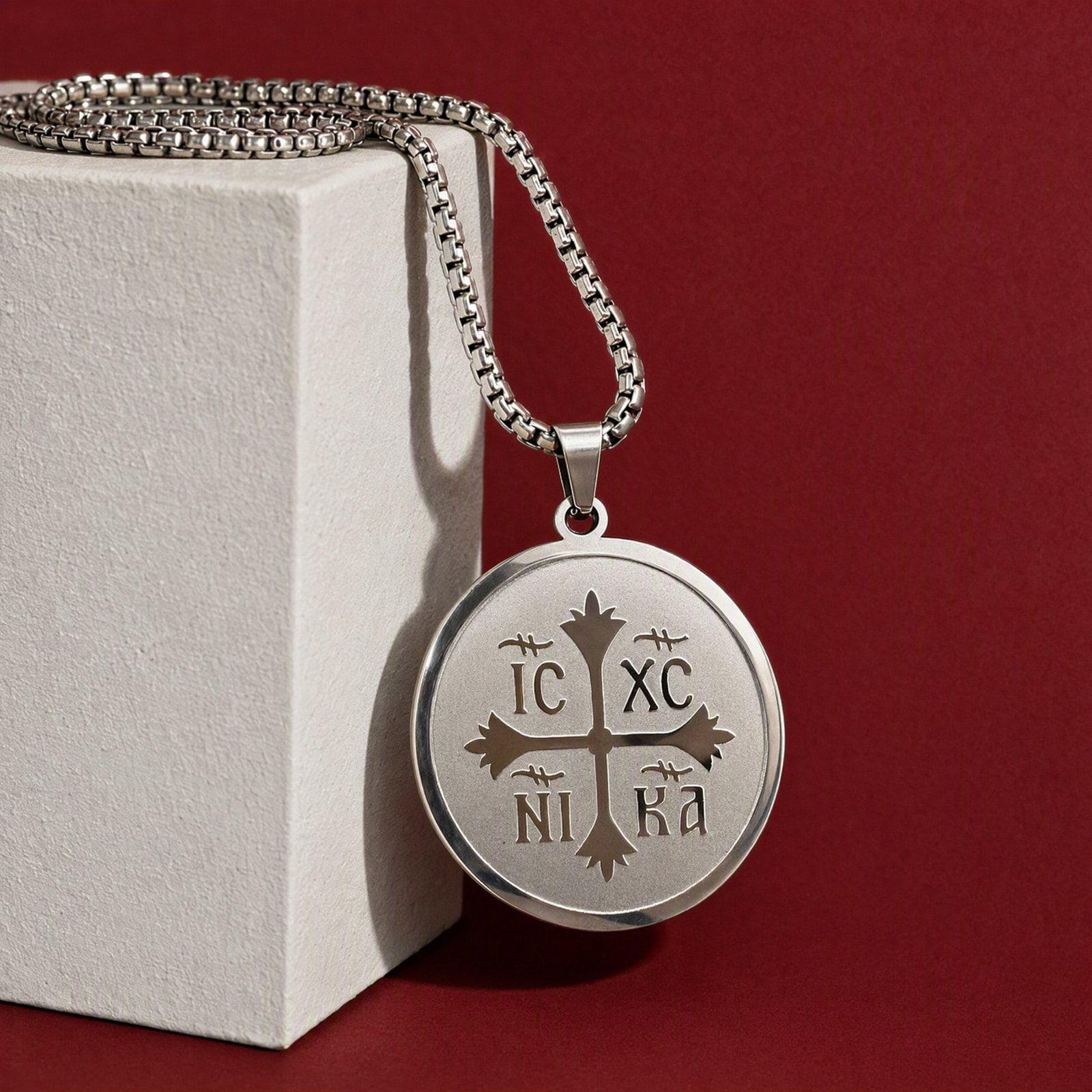 Образок
Nika Bright
серебристый, нержавеющая сталь$78$54
- Blessing, $49. Blessed by an Orthodox priest before it ships.
- Gift packaging, $20
Questions
What is the Greek Orthodox Church?
A family of Eastern Orthodox churches that use Greek, descended from the churches the Apostles founded; the name can also mean the Church of Greece or the whole Orthodox communion.
When did the Church of Greece become independent?
It was declared self-governing in 1833, and Constantinople recognized this in 1850.
When did Greek Orthodoxy come to America?
The first Greek colonists arrived in 1768, the first community was formed in New Orleans in 1864 and the first lasting one in New York in 1892.
Does Greek Orthodox mean the same as Orthodox?
In its widest sense the name covers the whole Orthodox communion; in the narrower senses it means the churches that use Greek, or the Church of Greece.