Psalm 133, which the Church numbers 132
Psalm 133 (Septuagint 132). Two numberings are in use. English Bibles that follow the Hebrew, the King James among them, give this psalm the number 133; the Greek Psalter of the Orthodox Church gives it 132. Both texts run to 3 verses. The King James text opens with a title line.
The psalm in the King James Version.
Behold, how good and how pleasant it is for brethren to dwell together in unity. It is like the precious ointment upon the head, that ran down upon the beard, even Aaron’s beard: that went down to the skirts of his garments; As the dew of Hermon, and as the dew that descended upon the mountains of Zion: for there the LORD commanded the blessing, even life for evermore.
The psalm in the Septuagint, in Brenton’s English translation.
A Song of Degrees. See now. what is so good, or what so pleasant, as for brethren to dwell together?
It is as ointment on the head, that ran down to the beard, even the beard of Aaron; that ran down to the fringe of his clothing. As the dew of Aermon, that comes down on the mountains of Sion: for there the Lord commanded the blessing, even life for ever.
What the psalm says. The psalm has three verses and two images. The first verse is a statement: behold, how good and how pleasant it is for brethren to dwell together in unity. The second compares that unity to the precious ointment on the head that runs down the beard, even Aaron’s beard, and goes down to the skirts of his garments. The third compares it to the dew of Hermon, which descends on the mountains of Zion. The psalm closes with the reason for the comparisons: there the Lord commanded the blessing, even life for evermore.
It is a psalm of comparison. The first verse names unity among brothers as both good and pleasant, and the following verses explain what kind of good and what kind of pleasant it is by comparing it to two things the singer knew. One is the precious ointment, a rich oil poured on the head, which ran down the beard of Aaron to the skirts of his garments; the other is the dew of Hermon, which falls on the mountains of Zion. Each is a thing that flows downward and spreads, and the psalm ends by saying that the Lord commanded the blessing there, even life for evermore.
Where it falls in the Psalter. The Church divides the Psalter into twenty readings called kathismata. This psalm stands in kathisma 18.
Found in Hapgood’s book. Look for it in Isabel F. Hapgood’s Service Book of the Holy Orthodox-Catholic Apostolic Church at page 499.
Psalm and kathisma
A kathisma is a reading of the Psalter, and the Church counts twenty of them. Psalm 133 belongs to the eighteenth. Orthodox Christians who pray the Psalter pray it by these divisions, and the psalms also appear inside the services, which Hapgood’s Service Book prints.
Readers from other traditions may know the Psalms by their numbers alone. In the Orthodox books the number is paired with the kathisma, and the number itself may be the Septuagint’s rather than the Hebrew.
For the road
The Travel Set holds a travel diptych of Christ and the Mother of God, a wooden cross for the car and a prayer rope, $99. An Orthodox priest can bless it before it ships. With the Blessing, $148 (normally $191).
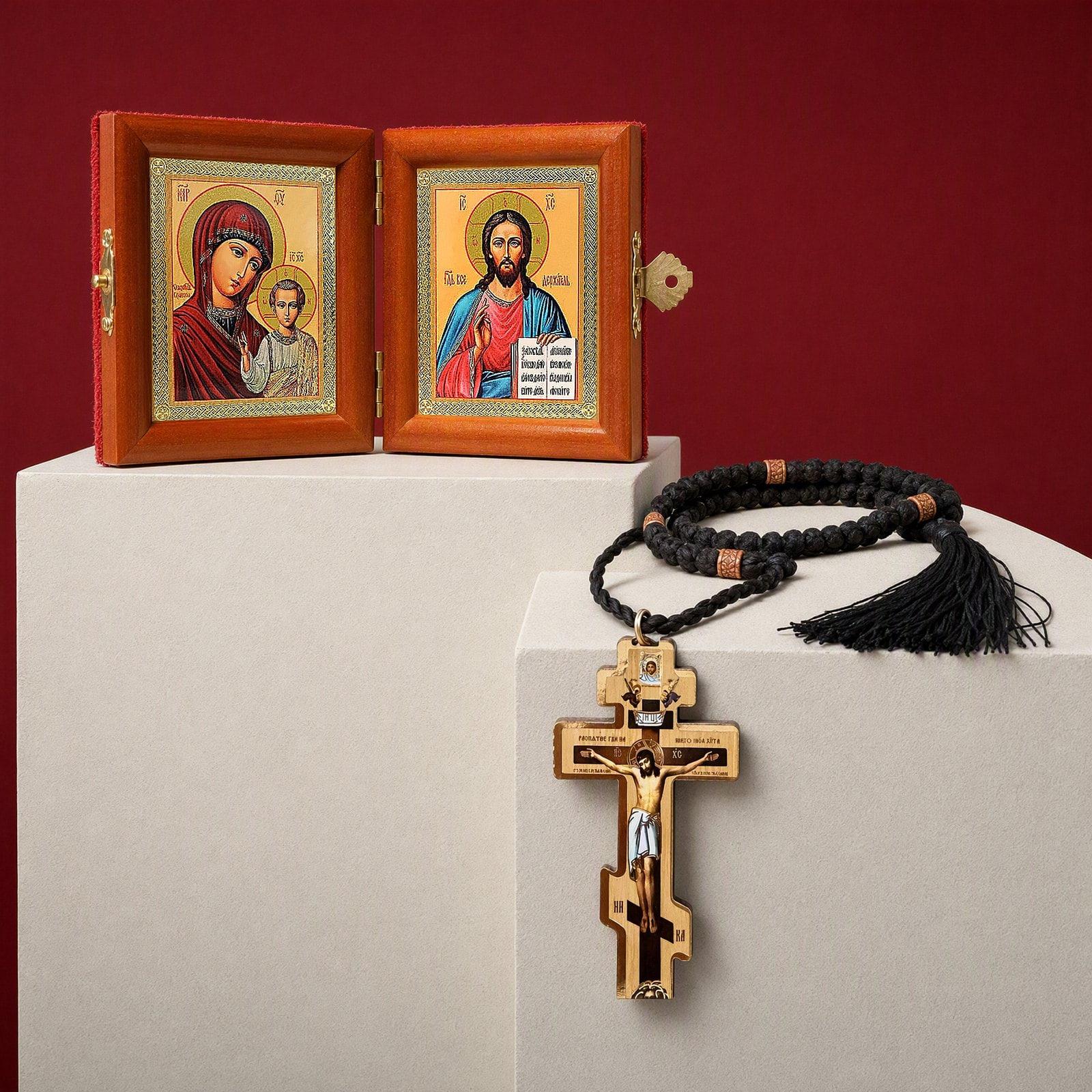
- Blessing, $49. Blessed by an Orthodox priest before it ships.
- Gift packaging, $20
Questions
What is Psalm 133 in the Septuagint?
It is Psalm 132. The King James Bible numbers it 133; the Septuagint, which the Orthodox Church reads, numbers it 132. The psalm is the same.
How many verses does Psalm 133 have?
3, in the King James text and in Brenton’s Septuagint alike.
Which kathisma is Psalm 133 in?
It is in the eighteenth, kathisma 18. The Church divides the Psalter into twenty kathismata and reads them in order.
Where does Hapgood’s Service Book print Psalm 133?
On page 499, as the page references on this page show.
Whose translations are these?
The first is the King James Version. The second is Brenton’s English translation of the Septuagint, the Greek Old Testament that the Orthodox Church reads.