Psalm 14 and Septuagint Psalm 13: the text
Two numbers, one psalm. What a King James reader finds as Psalm 14 is Psalm 13 to an Orthodox reader, because the Church follows the Septuagint’s count. This page gives the psalm under both numbers. Both texts run to 7 verses. The King James text opens with a title line.
The psalm in the King James Version.
The fool hath said in his heart, There is no God. They are corrupt, they have done abominable works, there is none that doeth good. The LORD looked down from heaven upon the children of men, to see if there were any that did understand, and seek God. They are all gone aside, they are all together become filthy: there is none that doeth good, no, not one.
Have all the workers of iniquity no knowledge? who eat up my people as they eat bread, and call not upon the LORD. There were they in great fear: for God is in the generation of the righteous. Ye have shamed the counsel of the poor, because the LORD is his refuge. Oh that the salvation of Israel were come out of Zion. when the LORD bringeth back the captivity of his people, Jacob shall rejoice, and Israel shall be glad.
The psalm in the Septuagint, in Brenton’s English translation.
For the end, a Psalm of David. The fool has said in his heart, There is no God. They have corrupted themselves, and become abominable in their devices; there is none that does goodness, there is not even so much as one.
The Lord looked down from heaven upon the sons of men, to see if there were any that understood, or sought after God. They are all gone out of the way, they are together become good for nothing, there is none that does good, no not one. Their throat is an open sepulchre; with their tongues they have used deceit; the poison of asps is under their lips: whose mouth is full of cursing and bitterness; their feet are swift to shed blood: destruction and misery are in their ways; and the way of peace they have not known: there is no fear of God before their eyes.
Will not all the workers of iniquity know, who eat up my people as they would eat bread? they have not called upon the Lord. There were they alarmed with fear, where there was no fear; for God is in the righteous generation. Ye have shamed the counsel of the poor, because the Lord is his hope. Who will bring the salvation of Israel out of Sion? when the Lord brings back the captivity of his people, let Jacob exult, and Israel be glad.
What the psalm says. It begins with a verdict: the fool has said in his heart that there is no God. The psalm looks down with the Lord from heaven upon the children of men to see whether any understand and seek God, and finds that they have all gone aside and become filthy, and that there is none that does good, no, not one. The psalm then speaks of the workers of iniquity who eat up the people of God as they eat bread and do not call upon the Lord, and of the great fear that falls on them because God is in the generation of the righteous. It closes with a wish that the salvation of Israel would come out of Zion, and with the promise that when the Lord brings back his captive people, Jacob shall rejoice and Israel be glad.
The psalm can be read as a court case in three parts. In the first the accusation is made: the fool has said there is no God, and their works are corrupt. In the second the Lord looks down to see whether there is anyone who understands, and finds that the whole human race has turned aside, so that the verdict is general and not directed at one group. In the third the accused are told that they have shamed the counsel of the poor, because the Lord is his refuge, and the closing wish is for salvation from Zion and for the end of captivity. The poor man in the psalm is not a bystander but the person whose counsel is put to shame and who finds that the Lord is his refuge.
Its kathisma. In the Church’s reading of the Psalter this psalm belongs to kathisma 2, one of twenty divisions of the book.
In the Service Book. We found no page of Isabel F. Hapgood’s Service Book of the Holy Orthodox-Catholic Apostolic Church that prints this psalm under its own Psalm heading, so this page names no service for it.
Psalm and kathisma
A kathisma is a reading of the Psalter, and the Church counts twenty of them. Psalm 14 belongs to the second. Orthodox Christians who pray the Psalter pray it by these divisions, and the psalms also appear inside the services, which Hapgood’s Service Book prints.
Readers from other traditions may know the Psalms by their numbers alone. In the Orthodox books the number is paired with the kathisma, and the number itself may be the Septuagint’s rather than the Hebrew.
A prayer rope for the psalms
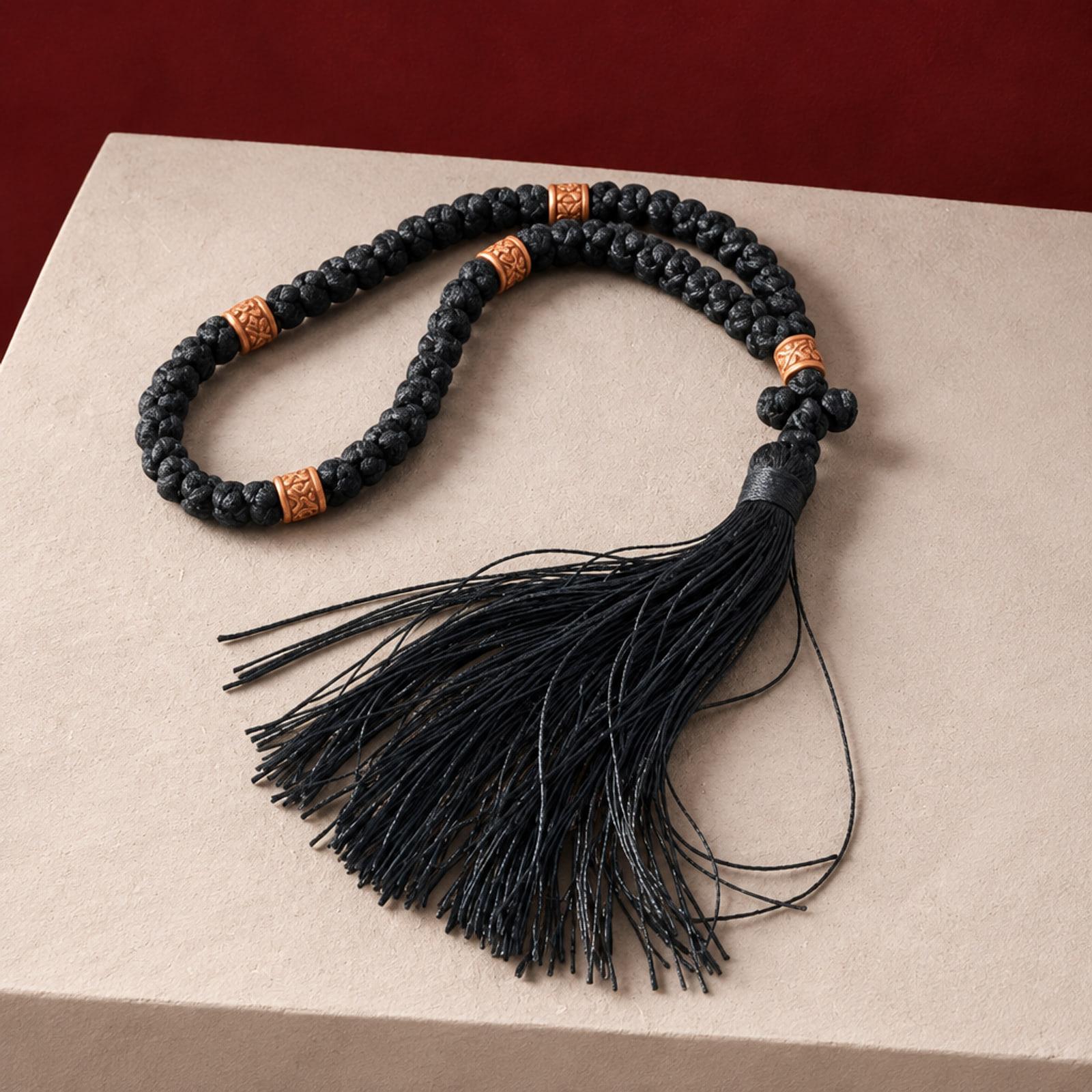
This black wool prayer rope has dividing beads and a tassel and is made for the Jesus Prayer, at home or on the road, $34. The Blessing is offered on its page. With the Blessing, $83 (normally $98).
- Blessing, $49. Blessed by an Orthodox priest before it ships.
- Gift packaging, $20
Questions
What is Psalm 14 in the Septuagint?
It is Psalm 13. The King James Bible numbers it 14; the Septuagint, which the Orthodox Church reads, numbers it 13. The psalm is the same.
How many verses does Psalm 14 have?
7, in the King James text and in Brenton’s Septuagint alike.
Which kathisma is Psalm 14 in?
It is in the second, kathisma 2. The Church divides the Psalter into twenty kathismata and reads them in order.
Is Psalm 14 printed in the service book?
We did not find it under a Psalm heading in Isabel F. Hapgood’s service book, so this page names no service for it.
Whose translations are these?
The first is the King James Version. The second is Brenton’s English translation of the Septuagint, the Greek Old Testament that the Orthodox Church reads.