Jerusalem cross meaning
Not in our store todayWe do not carry a Jerusalem cross today. Below: what the Jerusalem cross is, what its five crosses are said to mean, what to look for in one, and our closest items, plain Orthodox crosses and a wooden crucifix.
Wikidata gives the Jerusalem cross two descriptions in one line: a heraldic symbol and a Christian cross. Its other name, as our source has it, is the cross and crosslets.
The rest of what we hold is classification. The Jerusalem cross is an instance of the crosses in heraldry, and it is a subclass of the cross. That is the full list. It places the cross in heraldry and in the Christian family of crosses, and it stops there.
Many people search for this cross, and we would like to answer them better. Wikidata gives no date, no account of the shape, and no meaning for its parts, so the guide below draws on the wider public record for those, and says where it is unsure.
What we know in one table
| Question | Our source |
|---|---|
| What is it? | a heraldic symbol and Christian cross |
| Another name? | cross and crosslets |
| What class is it? | an instance of crosses in heraldry |
| What is it a kind of? | a cross |
Lampada does not sell the Jerusalem cross, in any form or finish.
The Jerusalem cross: the shape and where it comes from
The Jerusalem cross is one large cross with four small crosses set in the corners between its arms, five crosses in all. In heraldry it is called the cross and crosslets, or a cross potent with four crosslets, because the arms of the large cross often end in short bars like the head of a T.
It is a medieval emblem. After the First Crusade it became the coat of arms of the Kingdom of Jerusalem, usually drawn in gold on silver, and from then on it stood for the Holy Land itself. Pilgrims to Jerusalem and Bethlehem have carried it home for centuries, often carved in olive wood or mother-of-pearl by local Christian craftsmen.
What the five crosses are said to mean
No early source fixes a single meaning, and several readings are common:
- Christ and the four Evangelists: the large cross for Christ, the small ones for Matthew, Mark, Luke and John.
- The Gospel to the four corners of the world, going out from Jerusalem.
- The five wounds of Christ: in His hands, His feet and His side.
All of them point the same way, to Christ and the place of His death and Resurrection.
A heraldic cross beside a plain Orthodox one
Take our source at its word and the Jerusalem cross is both a heraldic symbol and a Christian cross. The plain Orthodox cross in our catalogue is described differently: three bars, no figure, made for daily wear. It can be blessed, if you wish, by an Orthodox priest before it ships. We cannot say how Orthodox Christians regard the Jerusalem cross, because nothing we hold says so, and this page does not try to rank the two.
| Jerusalem cross | Orthodox three-bar cross | |
|---|---|---|
| Shape | One large cross and four small ones | A title bar, the arms and a slanted footrest |
| First use | Heraldry of the Holy Land | The cross as the Greek and Slavic churches draw it |
| Figure | None | Often IC XC, or a flat figure of Christ |
Read more on the Orthodox three-bar cross.
Who uses the Jerusalem cross today
The Franciscan Custody of the Holy Land, which looks after many of the holy places, and the Catholic Order of the Holy Sepulchre use it as their emblem. The flag of Georgia, a country whose people are mostly Orthodox, carries five red crosses on white in the same pattern; see the Georgian cross for that country’s own cross. It also appears in Lutheran, Anglican and other Protestant churches, so a Jerusalem cross pendant is a gift many Christians recognise.
What to look for in a Jerusalem cross necklace
If you buy one elsewhere, look at four things. The material: olive wood is the traditional pilgrim’s choice and is light to wear; sterling silver and gold are the jewelry choices and cost more. The detail: the four small crosses should be clear, not blurred into the large one, which is harder in a small pendant. The size: about an inch for a woman’s fine chain, 1.5 in or more for a man’s Jerusalem cross necklace. The chain: 18 to 20 in for most women, 22 to 24 in for most men.
What we carry instead
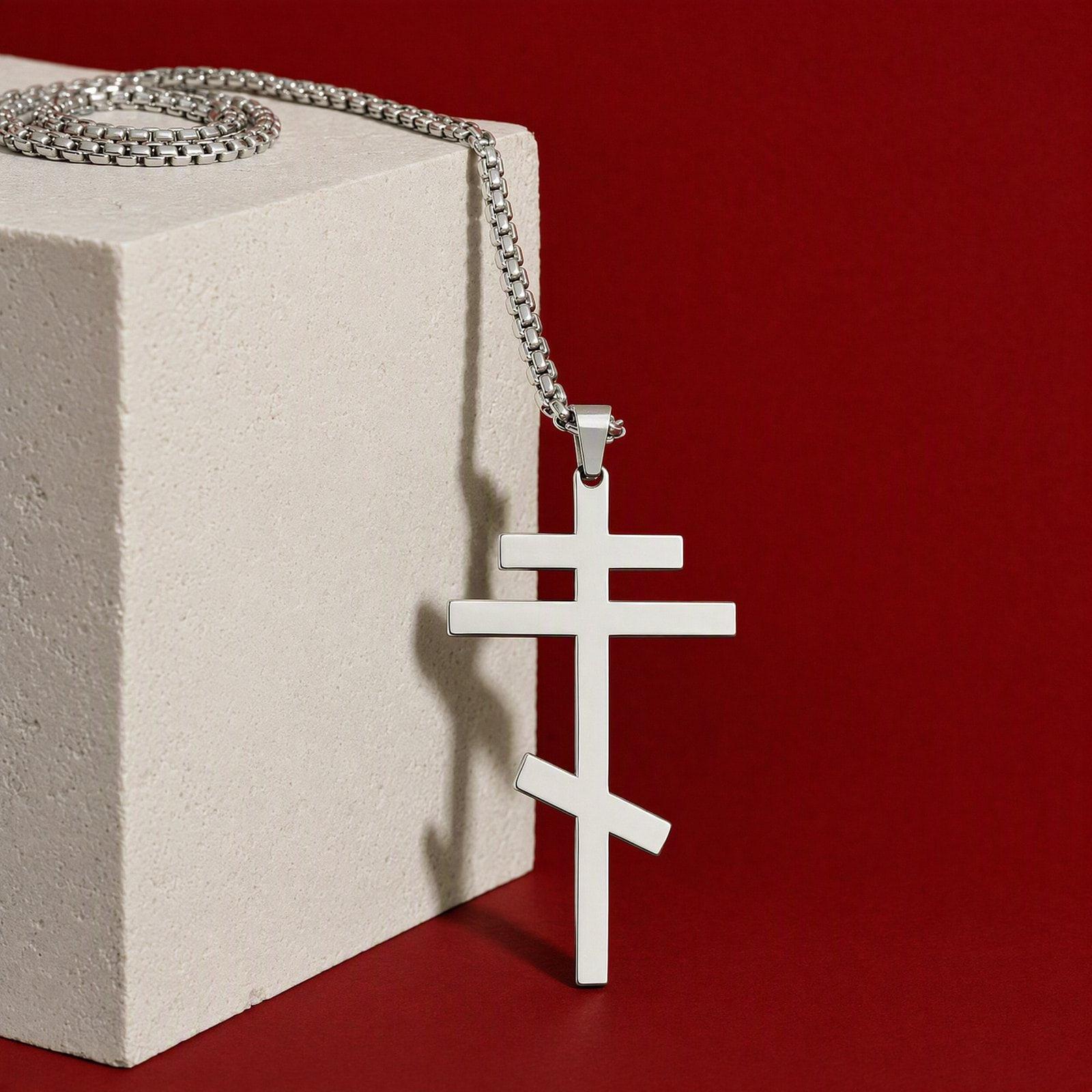
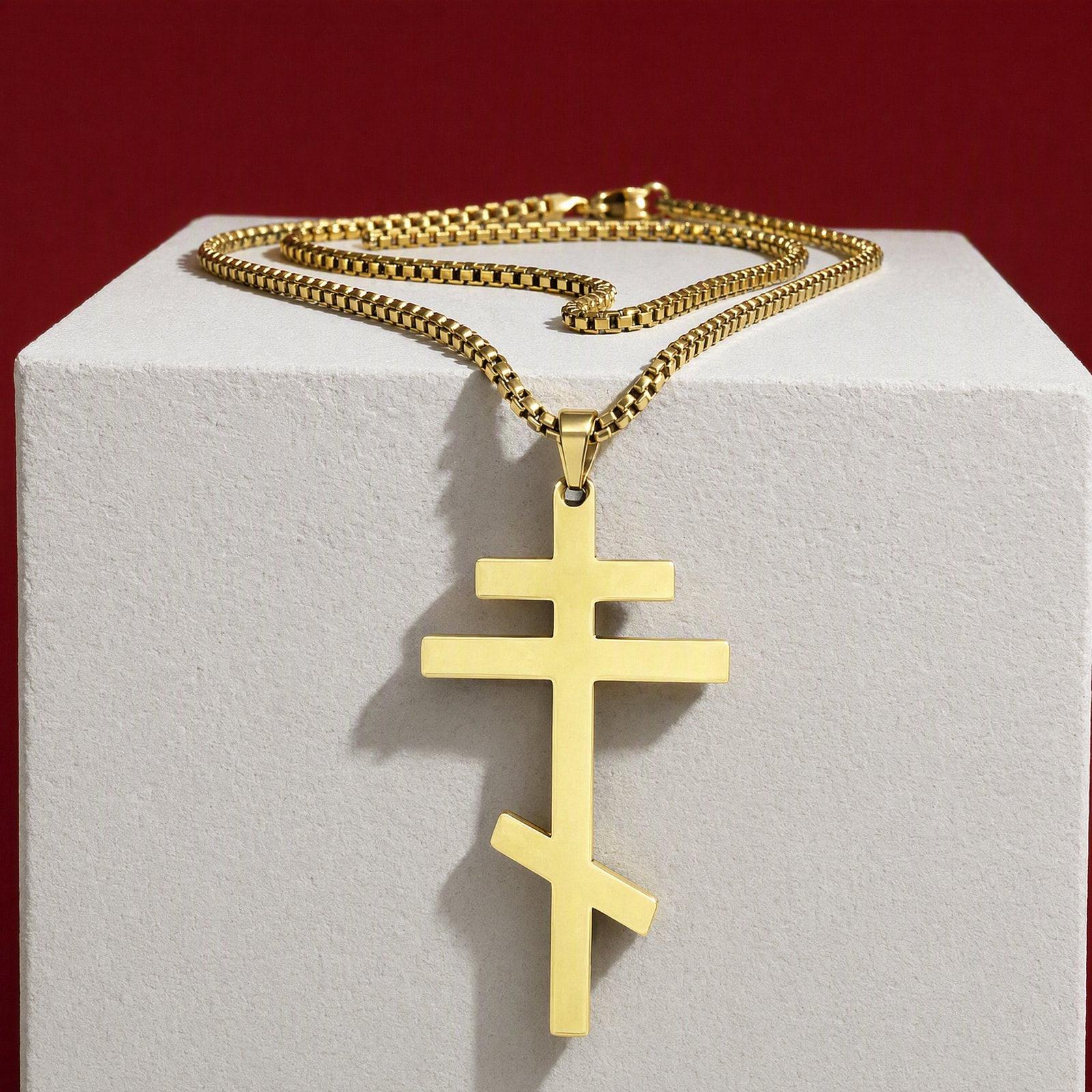
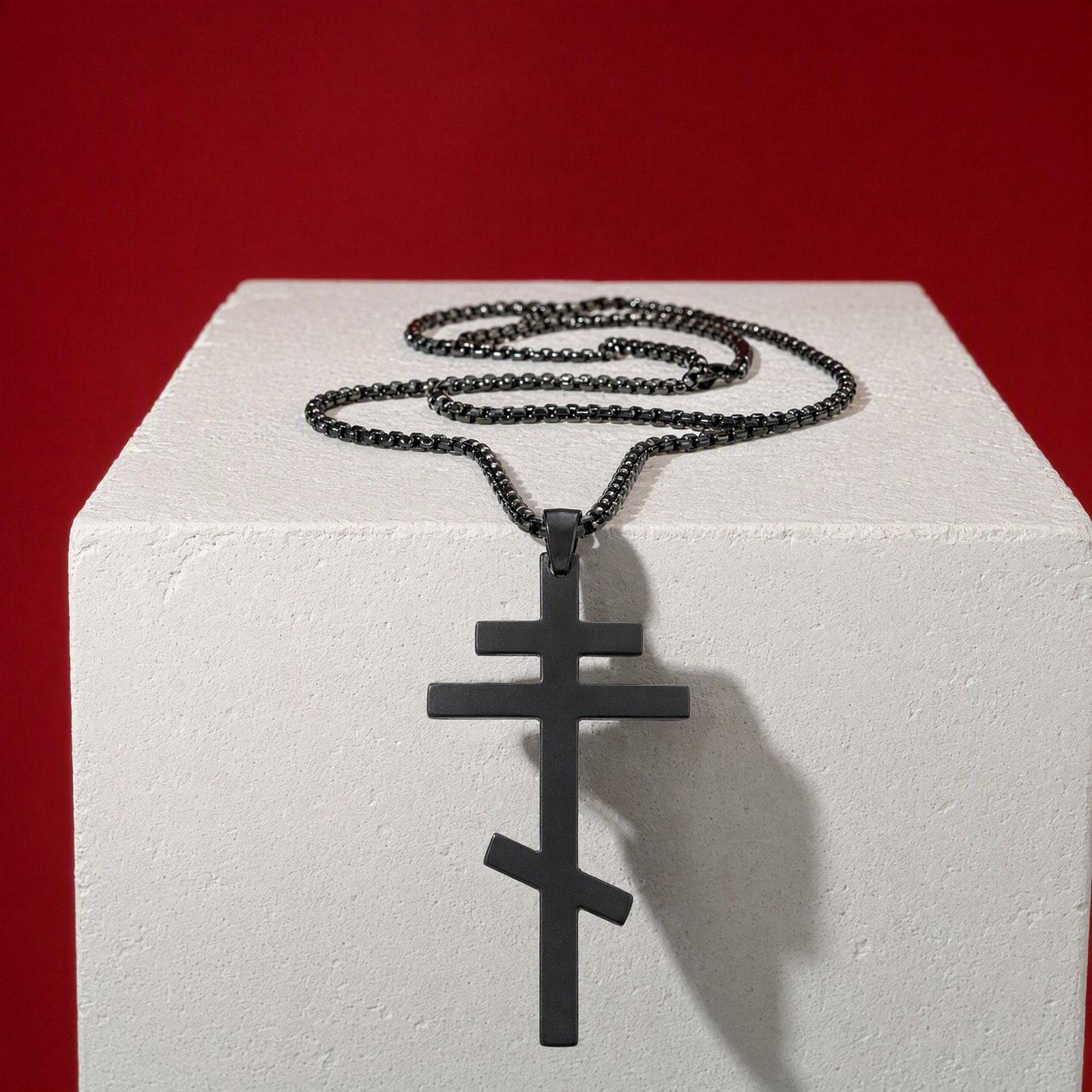
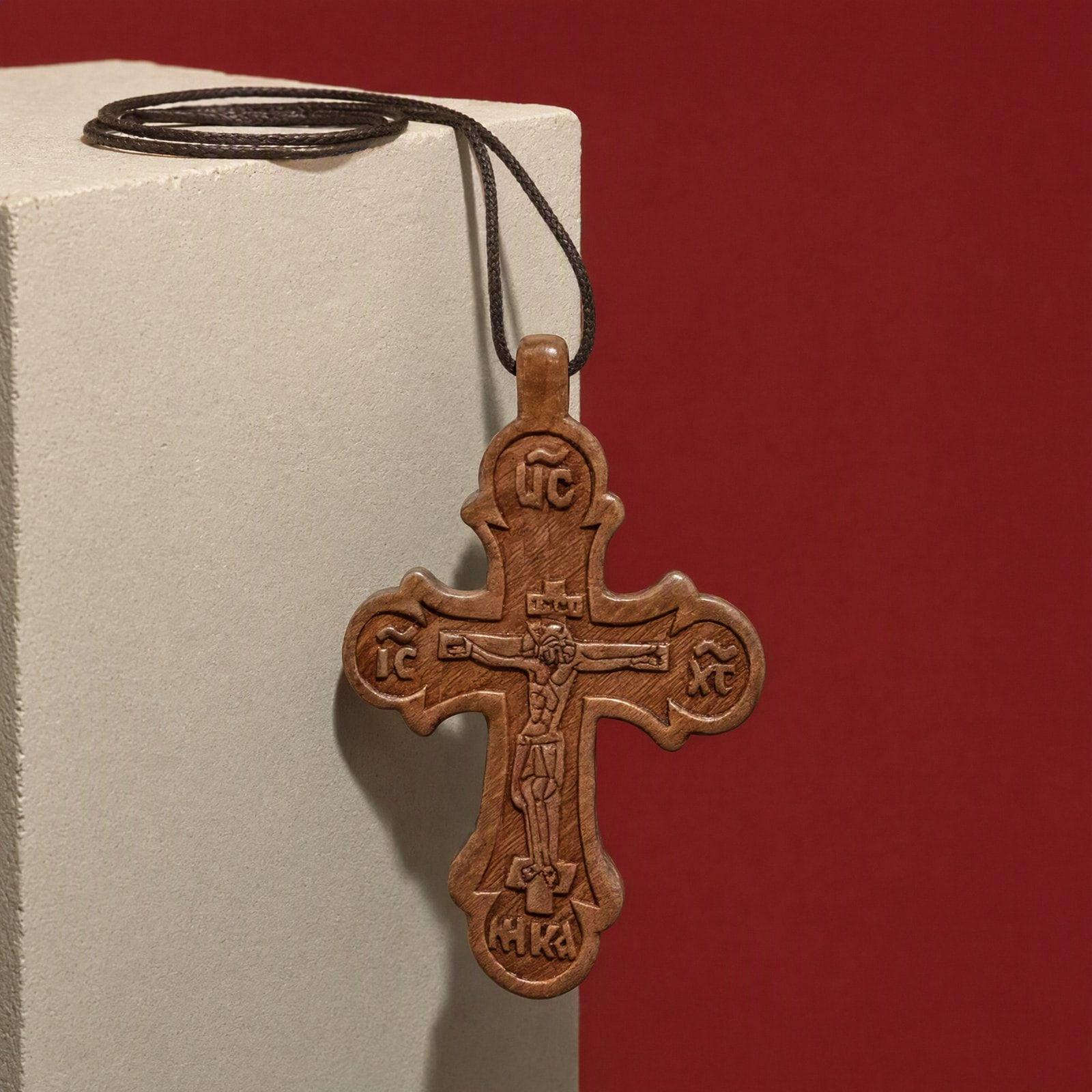
Our closest items are the plain Orthodox three-bar cross with no figure, about 2¼ in, on a 60 cm chain, in silver-tone ($64), gold-tone ($64) and black ($64) stainless steel, and a carved wooden crucifix with budded ends and IC XC, about 3 in ($44), the nearest to a pilgrim’s wooden cross. More wooden crosses are in wooden Orthodox crosses, and every cross in all our Orthodox cross necklaces. Orders arrive in 5–8 business days: US-based, ships from Florida.
Another cross for the neck, plain and Orthodox
If a Jerusalem cross was the cross you wanted, the silver-tone plain cross is the quietest alternative, and the gold-tone and the black are close behind. For a cross of wood, there is a carved wooden crucifix with budded ends.
CU SEDIUL ÎN SUA. EXPEDIERE DIN FLORIDA
Delivery in 5–8 business days.
Want us to stock it?
We don't carry a Jerusalem cross today. Leave your email and we will write once if we stock it.
Questions
What does the Jerusalem cross mean?
Our source gives no meaning. It describes a heraldic symbol and Christian cross, also named the cross and crosslets. The common reading is that the large cross stands for Christ and the four small ones for the four Evangelists, or for the Gospel going out to the four corners of the world.
What is the cross and crosslets?
It is a second name for the Jerusalem cross in our source we use. Our source does not describe the shape beyond that; heraldry describes it as one large cross with a small cross, a crosslet, in each of its four corners.
Do you sell a Jerusalem cross pendant or necklace?
No. There is no Jerusalem cross in Lampada’s catalogue. The plain Orthodox crosses are the nearest thing on offer.
Can the plain cross be blessed before delivery?
Yes, by an Orthodox priest. You choose the Blessing on the cross’s own page.
How old is the Jerusalem cross?
It is a medieval emblem. It became the arms of the Kingdom of Jerusalem, founded after the First Crusade, and has stood for the Holy Land ever since. Pilgrims have brought Jerusalem crosses home from Jerusalem and Bethlehem for centuries.
Who uses the Jerusalem cross today?
Catholic bodies tied to the Holy Land, such as the Franciscan Custody of the Holy Land and the Order of the Holy Sepulchre, use it as their emblem, and the flag of Georgia carries five red crosses in the same pattern. Christians of many churches wear it.
What is the closest cross Lampada carries?
A plain Orthodox three-bar cross with no figure, in silver-tone, gold-tone or black stainless steel, on a chain, or a carved wooden crucifix with budded ends and the letters IC XC.