Patron saint of tax collectors: the saints and their feast days
St Matthew the Apostle is the patron saint of tax collectors in the Orthodox calendar we hold.
| Saint | Feast | Day kept |
|---|---|---|
| St Matthew the Apostle | Commemoration | 16 November on the New Calendar, 29 November on the Old |
St Matthew the Apostle. In the Orthodox calendar we hold the entry is St Matthew the Apostle. The Church keeps the feast of Commemoration, 16 November (29 November on the Old Calendar). Rome’s church of San Luigi dei Francesi holds three paintings by Caravaggio of Matthew being called by Christ away from his work as a tax gatherer. Those paintings rank high among the works that define Western art. Matthew is shown in art, as the other evangelists are, with one of the living creatures in Revelation, the winged man. The Roman Catholic Church, the Eastern Orthodox Church and the Lutheran and Anglican churches all recognise Matthew as a saint. The Eastern Orthodox Church keeps a day for him in November and also remembers him with the other apostles at the Synaxis of the Twelve Apostles. The New Testament lists him among the Twelve and records that as a disciple he followed Jesus. The call story, in Matthew 9 and in the parallel passages of Mark 2 and Luke 5, is the passage that Western custom reads as making him the patron of tax collectors. Tax collecting was his work before he became an apostle, which is the plain reason for the link. Lampada’s saints file lists tax collectors for Matthew and marks the patronage as Western usage.
Where this comes from. Wikidata (Q1139055) links tax collectors to these saints; Wikipedia is the source of the facts about them, told in our own words; Orthocal confirms the feast days for 2027.
The tax collector the Gospels name twice
Matthew is the apostle who was a tax collector, and the Gospels give his story twice, once under the name Matthew and once under the name Levi. The Orthodox calendar we hold gives him a day, with the dates in the table above. The Western custom of making him the patron of tax collectors follows from his earlier trade, and Lampada’s saints file marks it as Western usage. A tax collector or a revenue officer who keeps the Orthodox year can mark the day of the apostle who left the receipt of custom to follow Jesus.
A saint’s gift for tax collectors
To give with the saint, there is the St Matthew the Apostle and Guardian Angel folding diptych at $89 and the Protector Set, which holds a folding icon of St John the Warrior and the Guardian Angel, a St Michael the Archangel medallion, a black and gold-tone crucifix and a prayer rope, and the story of each saint’s life, sent to you by email, at $169. With the Blessing by an Orthodox priest, $138 and $218 respectively.
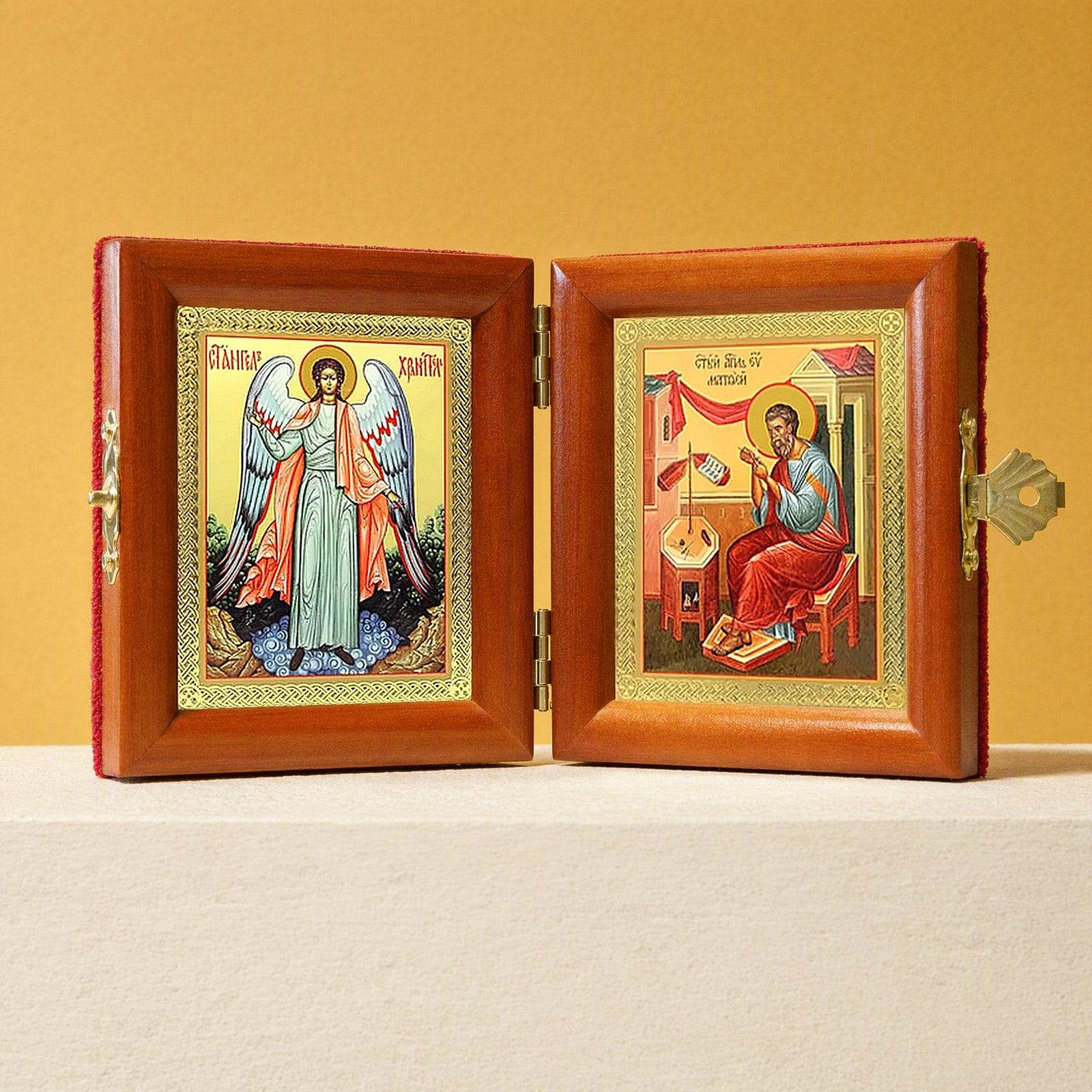 Díptico plegable
 de San Mateo Apóstol y el Ángel de la Guarda
$128$89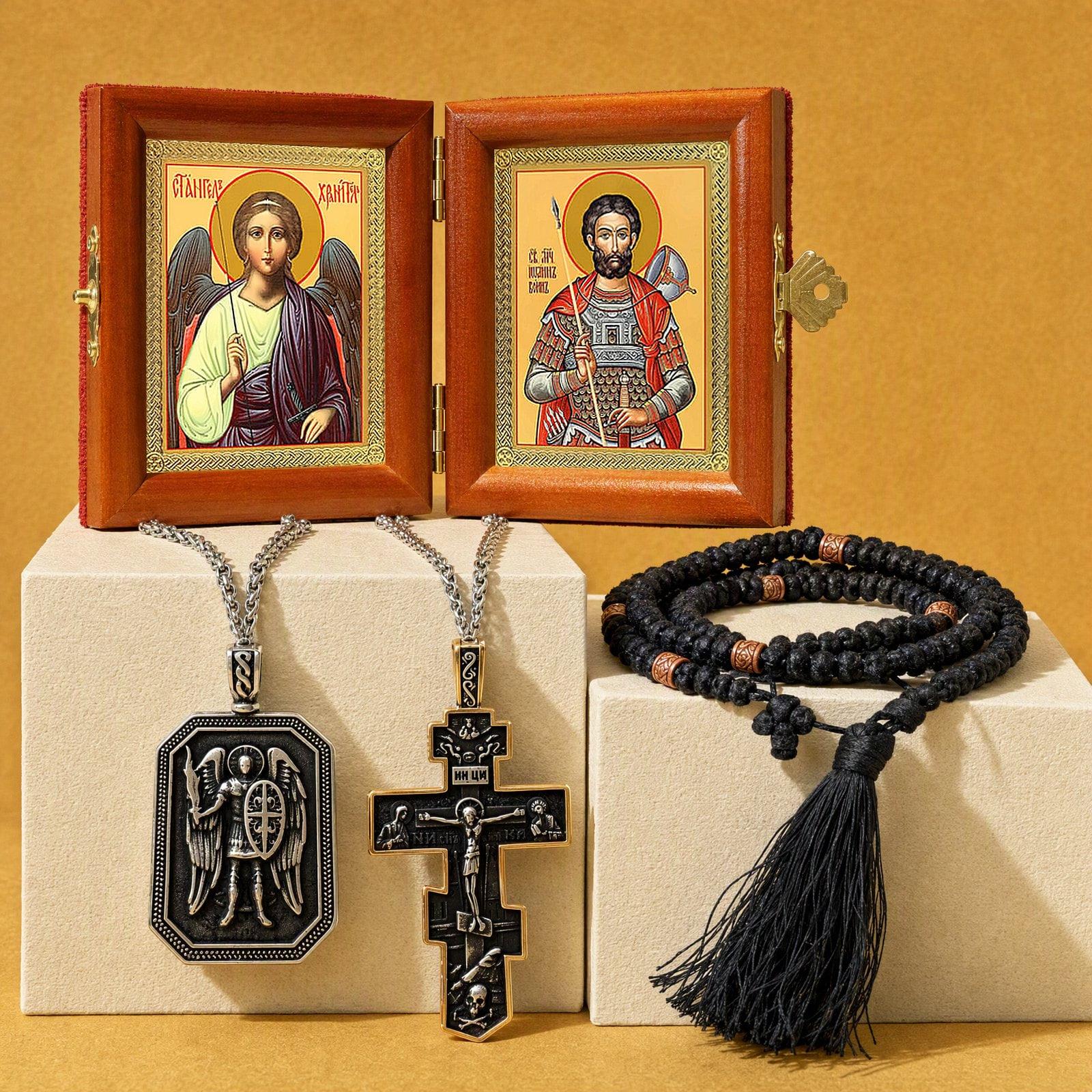 Set de regalo
Set Protector
$242$169
- Blessing, $49. Blessed by an Orthodox priest before it ships.
- Gift packaging, $20
Questions
Who is the patron saint of tax collectors?
St Matthew the Apostle is named for tax collectors on Wikidata and found in the Orthodox calendar we hold.
When is the feast day of St Matthew the Apostle?
16 November on the New Calendar and 29 November on the Old; the calendar lists the day as Commemoration.
Why is St Matthew the patron saint of tax collectors?
He was a tax collector at Capernaum when Jesus called him to follow. The link is the Western one, and Lampada’s saints file marks it as Western usage.
Are Matthew and Levi the same person?
The Gospel of Matthew gives the name Matthew for the call of a tax collector, and the Gospels of Mark and Luke give the name Levi, son of Alphaeus. Tradition reads them as one man.
What can I give with the patron saint of tax collectors?
To give with the saint, there is the St Matthew the Apostle and Guardian Angel folding diptych at $89 and the Protector Set, which holds a folding icon of St John the Warrior and the Guardian Angel, a St Michael the Archangel medallion, a black and gold-tone crucifix and a prayer rope, and the story of each saint’s life, sent to you by email, at $169. With the Blessing by an Orthodox priest, $138 and $218 respectively.