Hodegetria icon: the Virgin who shows the way, and how to choose one
The Hodegetria icon shows the Mother of God holding the Christ Child on one arm and pointing to Him with her other hand. Its Greek name means “She who shows the Way”: Mary directs us to her Son, who said, “I am the way.” It is the oldest and most copied image of the Virgin, attributed by tradition to St Luke, and famous icons such as Our Lady of Kazan follow it.
Below: what the Hodegetria shows, its history, how it differs from other icons of Mary, the best-known copies, how to choose one, and the Hodegetria icons we carry.
What the Hodegetria shows
| Detail | What it means |
|---|---|
| Christ seated upright on her arm | The Child is the Lord, not a baby to be cradled |
| Her hand pointing to Him | “Do whatever He tells you”: she leads us to her Son |
| His right hand blessing, a scroll in His left | Christ the teacher and the Word |
| Three stars on her veil | Her virginity before, during and after His birth |
| The letters ΜΡ ΘΥ | “Mother of God,” in Greek |
Her gaze is turned to us, and her hand to Him. That is the whole meaning of the icon.
Its history
Tradition says St Luke painted the first icon of the Mother of God with her Son, and that the Empress Eudocia sent it from Jerusalem to Constantinople in the fifth century; see the icon of St Luke. There it was kept at the monastery of the Hodegon, carried in procession through the city every week, and around the walls in times of siege. The original was lost when Constantinople fell in 1453, but its pattern had already spread across the Orthodox world; see Byzantine icons.
How it differs from other icons of Mary
| Type | How Mary holds Christ | Example |
|---|---|---|
| Hodegetria, “She who shows the Way” | Upright on her arm; she points to Him | Kazan, Smolensk, Iveron |
| Eleousa, “Tenderness” | Cheek to cheek | Vladimir |
| Platytera, “Of the Sign” | Christ in a circle on her breast, her hands raised | The apse of many churches |
| Enthroned | On her lap, on a throne | Many church icons |
See Mother of God icons and Our Lady of Vladimir for the others.
Famous Hodegetria icons
The best loved is Our Lady of Kazan, found in the ground at Kazan in 1579 after a girl’s dream; it shows the Hodegetria close up, the Child standing before His Mother. Others are the Smolensk, the Tikhvin, the Iveron icon of Mount Athos, called the Portaitissa, and the Czestochowa icon in Poland, venerated by Catholics. See Our Lady of Kazan.
How to choose a Hodegetria icon
Start with the pair every icon corner has: Christ and the Mother of God. A Hodegetria beside Christ Pantocrator is the classic pair. Choose a mounted icon, printed on wood or under an embossed cover, for daily use; a hand-painted icon for an heirloom. Check that the faces are clear and the gesture is there: her hand pointing to the Child. Size: about 2 x 3 in for a car or bag, 4 x 6 in for a shelf, 8 x 10 in for an icon corner.
What we carry
The Mother of God in the Hodegetria pose with Christ Pantocrator: a two-panel wooden icon ($59) for a shelf or bedside, the same pair in a carved wooden case that folds shut ($74), and a pair on a deep green ground ($189) for the icon corner. Our Lady of Kazan, a Hodegetria: a rectangular icon under a silver- and gold-tone cover ($69), a small gold-tone plate about 6.8 x 5.2 cm for a desk or car ($69), a hand-painted icon egg ($79), and a diptych with Christ Pantocrator ($94). See folding wooden icons. Orders arrive in 5–8 business days: US-based, ships from Florida.
Our Hodegetria icons
The Mother of God in the Hodegetria pose with Christ, as folding wooden icons and a pair on a green ground, and Our Lady of Kazan, a Hodegetria, as a rectangular icon, a small gold-tone plate, a hand-painted egg and a diptych with Christ. Each card shows its live price.
 Icono
Virgen María con el Niño Jesucristo
Icono ortodoxo de madera$85$59 Icono
Díptico ortodoxo Virgen María y Jesucristo
Icono plegable de madera$106$74 Icono
Set de iconos ortodoxo de Cristo y la Theotokos para el rincón de oración
Verde$270$189 Icono
Virgen María (Virgen de Kazán, rectangular)
Plata y oro · Icono ortodoxo de madera$99$69 Icono
Virgen María con Jesús en brazos
Color oro · Icono ortodoxo$99$69 Recuerdo
Virgen de Kazán ortodoxa
Huevo de madera con icono 4 in$113$79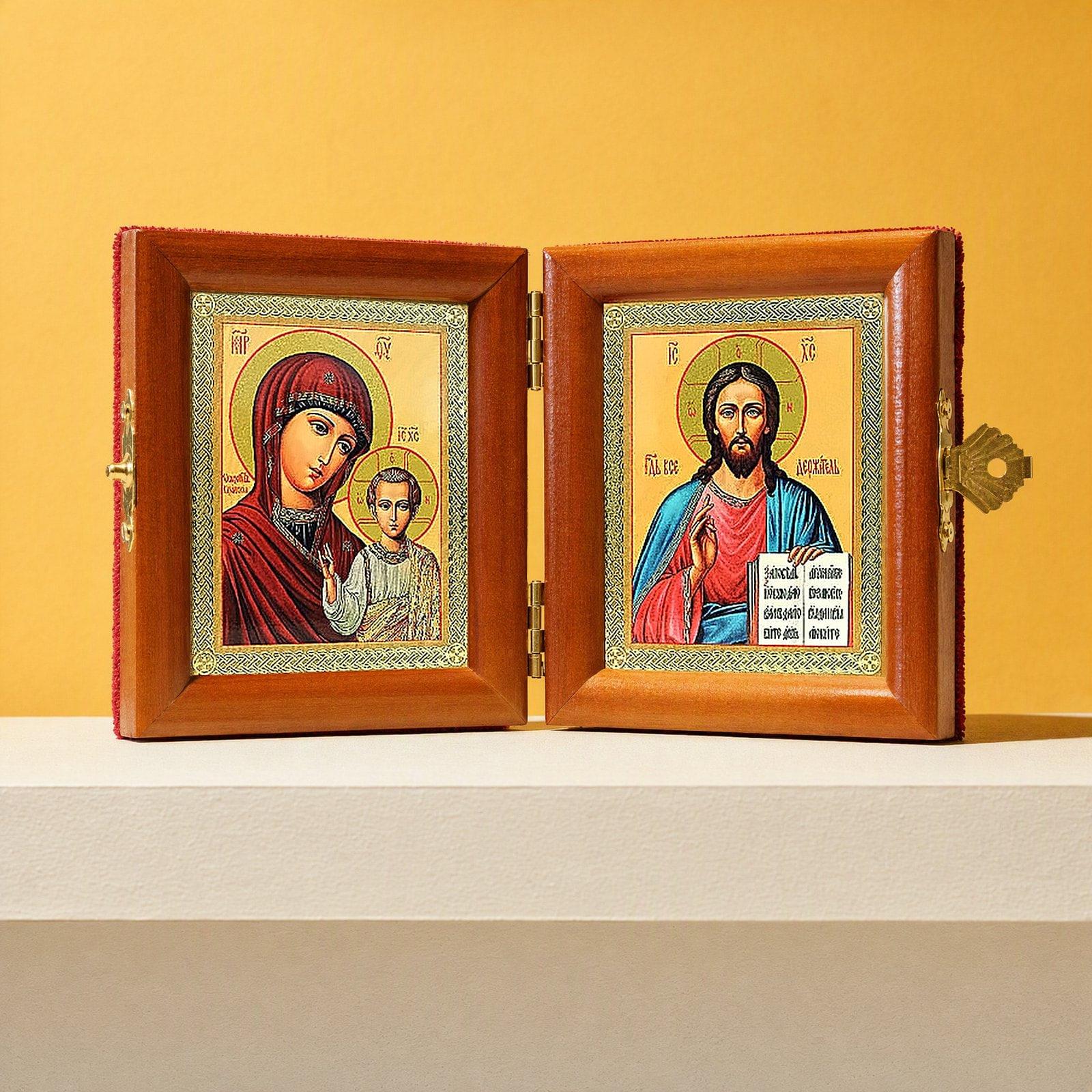 Díptico plegable
 de Cristo Pantocrátor y la Virgen de Kazán
$135$94
CON SEDE EN EE. UU.. ENVÍOS DESDE FLORIDA
Delivery in 5–8 business days.
Questions
What does Hodegetria mean?
“She who shows the Way” or “the Guide,” in Greek. The name comes from the Hodegon monastery in Constantinople, where the original icon was kept, and it fits the image: the Mother of God points to Christ, the Way.
What is the difference between the Hodegetria and the Eleousa?
In the Hodegetria the Child sits upright on her arm, facing us and blessing, and she points to Him. In the Eleousa, or Tenderness, she holds Him cheek to cheek, as in the Vladimir icon. The first shows who He is; the second, her love.
Did St Luke paint the Hodegetria?
Church tradition says the first Hodegetria was painted by St Luke and later brought from Jerusalem to Constantinople in the fifth century. The original was lost when the city fell in 1453. Thousands of copies keep its pattern.
Is Our Lady of Kazan a Hodegetria?
Yes. The Kazan icon, found in 1579, is a Hodegetria shown close up: the Mother of God bends her head toward the Child, who stands before her blessing. Smolensk, Tikhvin, Iveron and Czestochowa icons are Hodegetrias too.
Where should a Hodegetria icon go?
In the icon corner, to the left of Christ as you face them, at eye level. A small folding Hodegetria fits a bag or the car, and many people carry one when they travel, since she is called the Guide.
Which hand does the Mother of God hold Christ with?
Usually her left, pointing with her right. Some icons reverse it, with the Child on her right arm; they are still Hodegetrias. The Child holds a scroll and raises His right hand in blessing.