Orthodox icons for sale: how to choose one
The best Orthodox icon to buy is the one that fits the place it will stand and the subject you want. This page shows 9 icons from the Lampada shop, each with its price.
How they are made. Every icon here is a print or has an embossed cover. The catalogue says printed on aged wood, printed under glass, or an embossed gold-tone or silver-tone cover, and Lampada does not call any of them hand-painted. Wikipedia says icons are most commonly painted in egg tempera on wood panels, and can also be cast, carved, embroidered or printed.
Begin with the three icons of a prayer corner: Christ, the Mother of God and the saint of your name.
- Christ Pantocrator, under a gold-tone cover, standing on its own, or with the open Gospel.
- The Mother of God, under a gold-tone cover, or printed in a shaped scroll frame.
- A saint by name, with the Guardian Angel, in a folding diptych: St Matthew the Apostle and St Nicholas the Wonderworker. More saints are on the page of Guardian Angel icons.
Then the form. A small gold-tone plate that stands on its own, small enough for a desk, a car or a bag. A folding icon of Christ and the Mother of God, in two arched frames that close like a book, and a pair of hinged panels printed on aged wood.
What an Orthodox icon is
An Orthodox icon is a holy image made for prayer: Christ, the Mother of God, a saint or a feast of the Church, shown in a fixed, traditional way so that anyone who knows icons can tell who it is. It is not a portrait in the modern sense. Faces are calm, the background is often gold, and the name of the person is written on the icon itself, as with IC XC for Jesus Christ.
In an Orthodox home the icon is the center of prayer. The family stands before it, lights a candle or a lamp, crosses themselves and kisses it. The Church teaches that this honor is not given to wood and paint but passes to the person shown. That is why a printed icon, rightly made and kept, is used in prayer just as a painted one is. More on the difference from Western religious art in Orthodox icons and Catholic icons.
The Orthodox iconographer and how icons are made
The painter of an icon is an iconographer. The traditional method is egg tempera on a wooden panel coated with gesso, often with gold leaf for the background and the halos, and a layer of oil varnish at the end. Iconographers work from the established image of each subject, the way the Church has shown it for centuries, and many pray and fast while they work. In English an icon is often said to be “written” rather than painted.
Icons are also cast in metal, carved, embroidered, set in mosaic and printed, and every one of these is used in Orthodox homes and churches. Read how icons are made for the steps, or the guide to hand-painted Orthodox icons if you want one made by hand.
How to tell a good icon
| Form | What it is | Good for |
|---|---|---|
| Printed on wood | The image printed and mounted on a wooden board | A first icon, the icon corner |
| Printed under glass in a frame | A print behind glass, often in a folding frame | Travel, a gift by name |
| Embossed metal cover | A print with a raised gold-tone or silver-tone cover over all but the faces and hands | A shelf, a gift that catches the light |
| Hand-painted | Egg tempera on a gessoed panel, made by an iconographer | An heirloom, a church |
Whatever the form, check four things. The image is the traditional one, not a modern painting with a halo added. The name is written on it. The print is sharp, with no pixel edges on the faces. The backing is solid, so it stands or hangs straight for years.
Where an icon is kept, and why
OrthodoxWiki calls the icon corner the family’s place of worship, and lists an icon of Christ, an icon of the Theotokos and an icon of the family’s patron saint as what it holds, usually in a room’s north-east or south-east corner or on a wall that faces east. It says icons have been used for prayer from the first centuries, and that the first Sunday of the Great Fast celebrates the restoration of their veneration. Wikipedia notes that Greek Orthodox can mean the whole communion, so a search for Greek Orthodox icons is a search for these. An Orthodox priest can bless an icon here before it ships.
Sizes, and where each one goes
- Small orthodox icons of a few inches, like our gold-tone plate, go on a desk, in a car or in a bag.
- Standing icons, like the Christ Pantocrator and Mother of God under gold-tone covers, suit a shelf or a first icon corner.
- Folding icons close like a book for travel and open on a bedside table; see folding wooden icons.
- Saint icons by name are the gift that is already addressed to its owner: find the saint in Guardian Angel icons.
Keep any icon out of direct sun, away from a fireplace or radiator, and dust it with a soft dry brush. The guide to caring for an icon covers the rest.
What we carry
These are the icons on this page, each at its live price:
- Christ Pantocrator under a gold-tone cover, standing on its own: $69. With the open Gospel: $69.
- The Mother of God under a gold-tone cover: $69. Printed in a shaped scroll frame, about 14 × 9 cm: $64.
- A saint by name with the Guardian Angel, in a folding diptych: St Matthew the Apostle at $89 and St Nicholas the Wonderworker at $89.
- The small gold-tone plate of the Mother of God holding Jesus: $69.
- A folding icon of Christ and the Mother of God in two arched frames: $74. Two hinged panels printed on aged wood: $59.
With the Blessing, they run from $59 to $89 on this page. More icons for the home are in icons for the icon corner. Orders arrive in 5–8 business days: US-based, ships from Florida.
Choose by place, by subject and by name
A first icon for a home is Christ or the Mother of God, and a saint by name is the gift that is already addressed to its owner.
 Ikona
Pravoslavna ikona Isus Hristos Pantokrator
zlatna boja · drvena$99$69 Ikona
Pravoslavna ikona Isus Hristos Pantokrator
srebrno-zlatna boja$99$69 Ikona
Pravoslavna ikona Bogorodice
zlatna boja · drvena$99$69 Ikona
Pravoslavna ikona Bogorodica i Hristos
drvena ikona 14x9 cm$92$64 Ikona
Pravoslavna ikona Bogorodica s Isusom u naručju
zlatna boja$99$69 Ikona
Pravoslavna ikona Isus Hristos i Bogorodica
sklopiva drvena$106$74 Ikona
Pravoslavna ikona Bogorodica s Mladencem Isusom Hristom
drvena$85$59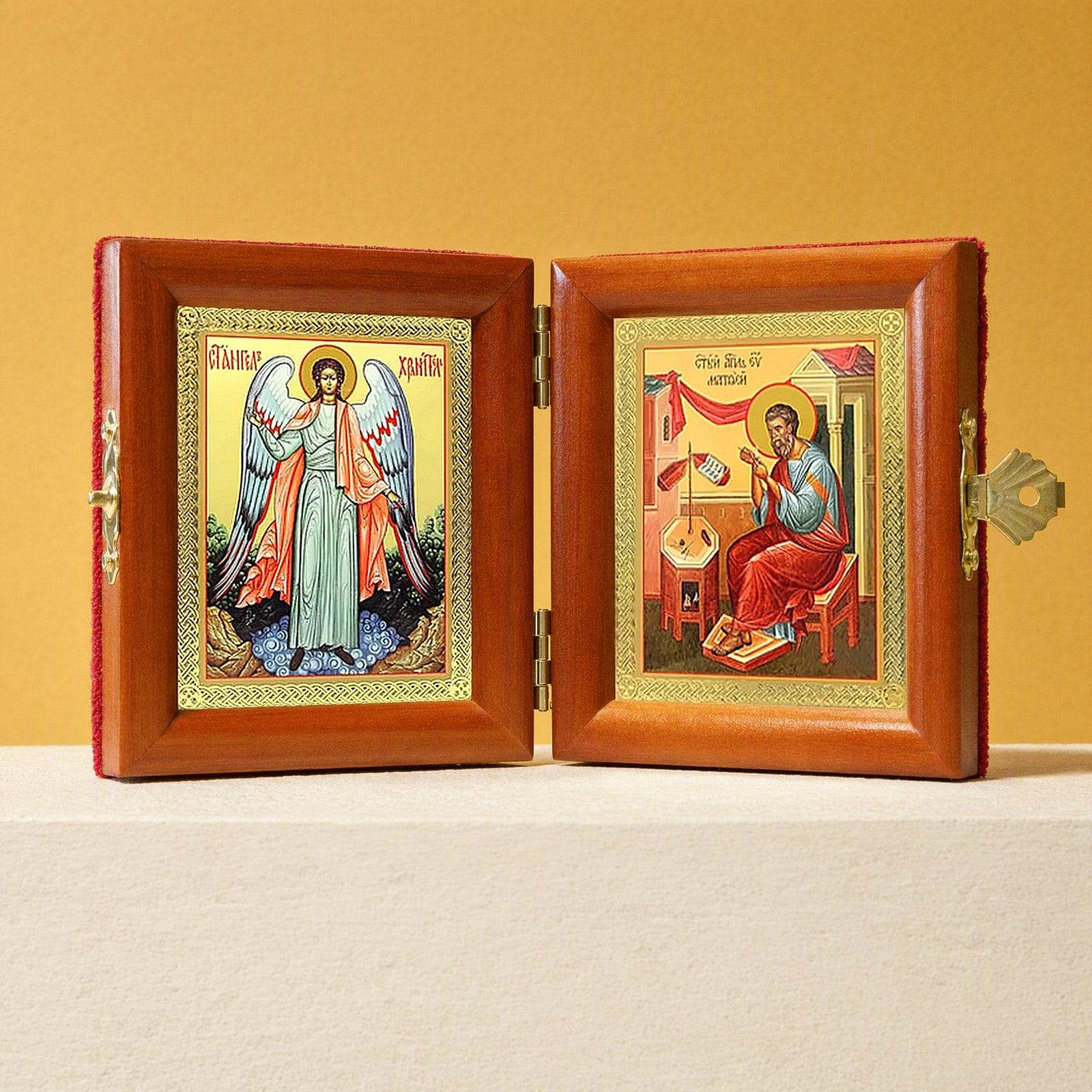 Sklopivi diptih
Sveti apostol Matej i Anđeo Čuvar
sklopivi diptih$128$89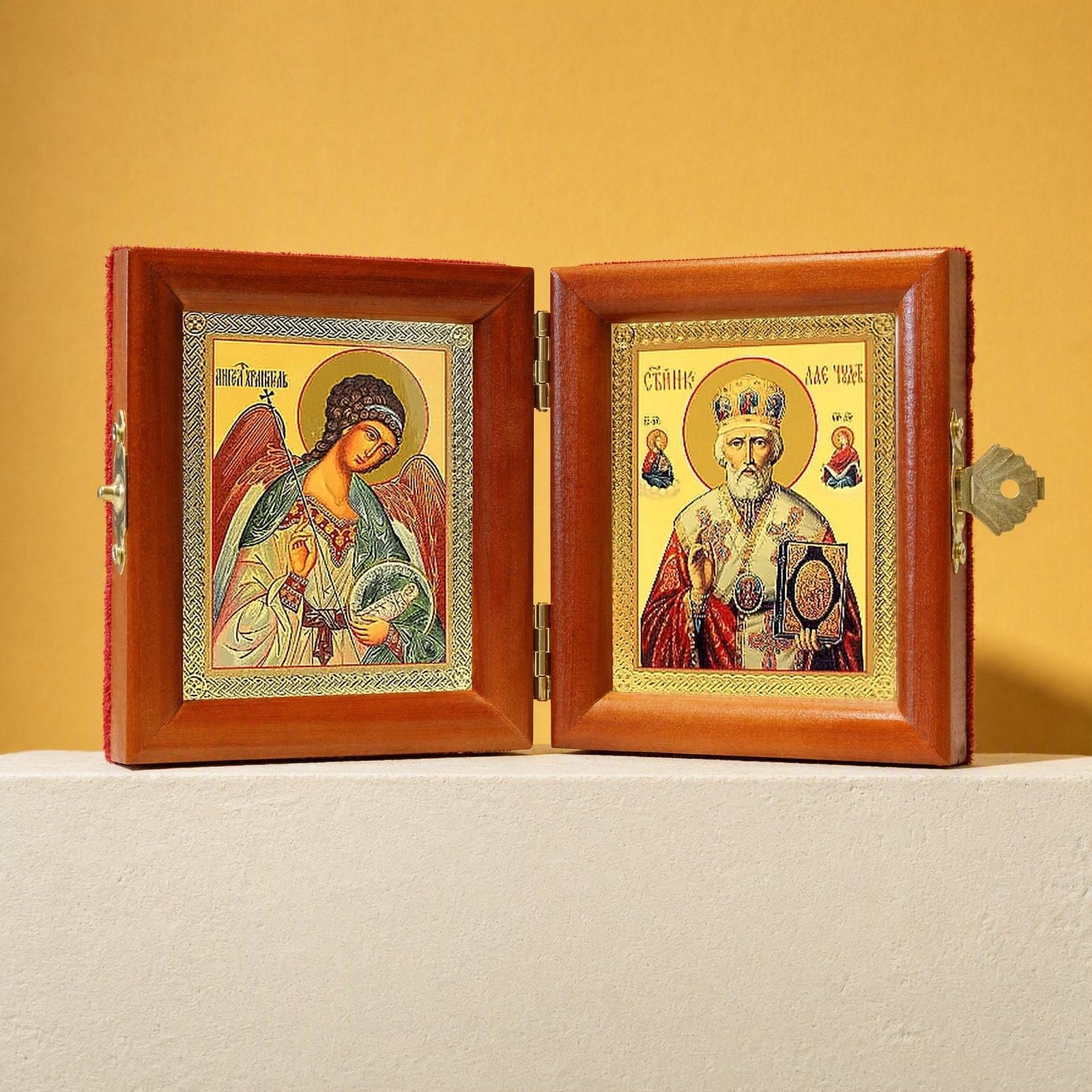 Sklopivi diptih
Sveti Nikola Čudotvorac i Anđeo Čuvar
sklopivi diptih$128$89
SA SEDIŠTEM U SAD. ŠALJEMO IZ FLORIDE
Delivery in 5–8 business days.
Questions
Where can I buy Orthodox icons?
At Lampada, which is an Orthodox gift shop with crosses, icons and sets, all imported. Each icon on this page shows its price on its card, and an Orthodox priest can bless it before it ships.
What is the best Orthodox icon to buy?
No single icon is best. OrthodoxWiki lists Christ, the Theotokos and the family’s patron saint as the icons of a prayer corner, so begin with Christ Pantocrator or the Mother of God, then add a saint by name.
Are these icons hand-painted?
No. They are printed or have embossed covers, and Lampada does not call them hand-painted. A few hand-painted icons are now in the catalogue, and the page on hand-painted Orthodox icons says what to look for.
What are Greek Orthodox icons?
Wikipedia gives three uses of the words Greek Orthodox, the whole Orthodox communion, the Greek-language churches in it, and the Church of Greece. The icons here are Orthodox icons in the widest sense.
Which icon is smallest?
The gold-tone plate of the Mother of God holding Jesus, about 6.8 × 5.2 cm (2⅝ × 2 in), which stands on its own. The catalogue calls it small enough for a desk, a car or a bag.
What is an Orthodox icon?
An Orthodox icon is a holy image of Christ, the Mother of God, a saint or a feast, made in a fixed traditional style and used in prayer. The faithful light a candle before it, cross themselves and kiss it; the honor, the Church teaches, passes to the person shown.
What does an Orthodox iconographer do?
An iconographer paints icons, traditionally in egg tempera on a wooden panel coated with gesso, often with gold leaf. Iconographers follow the established image of each subject rather than inventing one, and many pray and fast while they work.
Where should I put my first Orthodox icon?
In an icon corner, ideally on a wall that faces east, at eye level or a little above, where the family can stand to pray. A shelf with a small lamp or candle is enough to begin. Keep it away from a fireplace, a radiator and direct sun.