Jeweled cross necklace, the crux gemmata and what it means
A jeweled cross has a Latin name, crux gemmata. Wikipedia describes it as a form from the art of the early Church and the early Middle Ages, with the cross, or its front face at the least, covered mainly with jewels, and says the term is not usually used for later crosses, least of all small ones worn as jewelry. Lampada sells no cross set with gems; the nearest have studded ends or sit over enamel.
The famous ones are in museums: the Cross of Justin II of the sixth century, now in the Vatican Museums, the Cross of Lothair of the tenth century in the treasury of Aachen Cathedral, and the Cross of Cong in Ireland. On a real cross the back is often engraved with the Crucifixion, the arms often flare at their ends, and small jewels or gold letters, alpha and omega, may hang from them.
In mosaics the jeweled cross rises on a hill before a view of Jerusalem, and Wikipedia reads it as the New Jerusalem, the heavenly city. It also reads as a Christian Tree of Life, with shoots at the corners, and where four rivers run down the mound beneath it, they stand for the four Gospels. At Sant’Apollinare in Classe, in a mosaic of 549, the cross stands for Christ himself.
Among our crosses, the silver-tone cross with studded ends is $64. The crucifixes over red and black enamel are $54 in silver-tone and $49 in gold-tone, each on a dark bead necklace. The catalogue does not describe any of them as set with stones.
A cross of victory, in the mosaic and in the Orthodox view
Wikipedia calls the jeweled cross one of the first pictures of a paradox, that the instrument of an execution becomes the vehicle of Christ’s triumph. OrthodoxWiki says that Orthodox believers see the crucified Christ in just this way, as the Victor and the King reigning from the Tree. We offer the two statements side by side and draw no line between them. A jeweled cross in early art was a large public image, while a cross for the neck is a quiet one. Each cross here can receive an Orthodox priest’s blessing as it ships, which makes the three $88 to $103.
The most decorated crosses we carry
For a cross with more detail than a plain one, the studded silver-tone cross at $64 is the most ornamented on a chain, and it has no stones to lose.
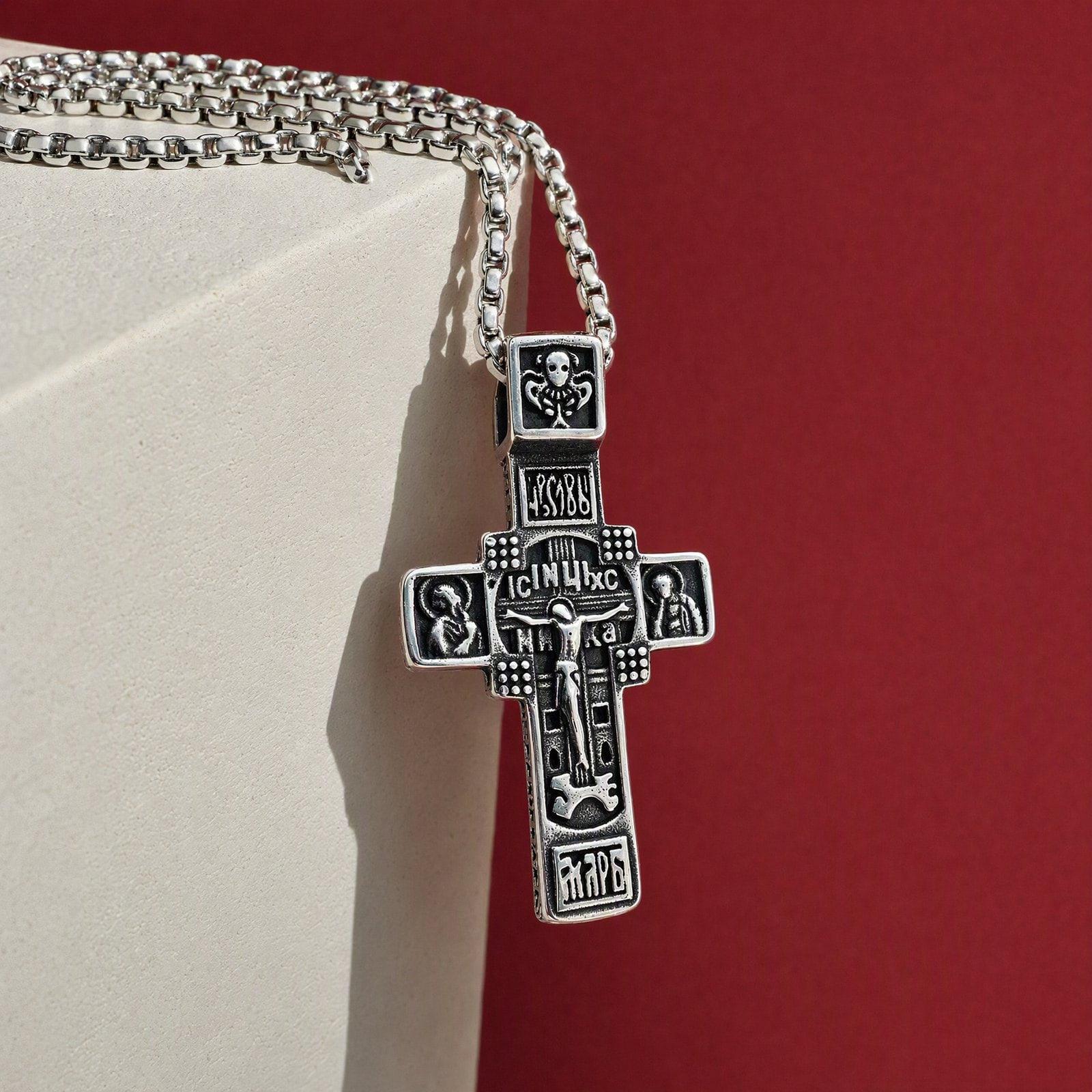 Krst
Studded Ash
srebrna boja · lančić 60cm · nerđajući čelik$92$64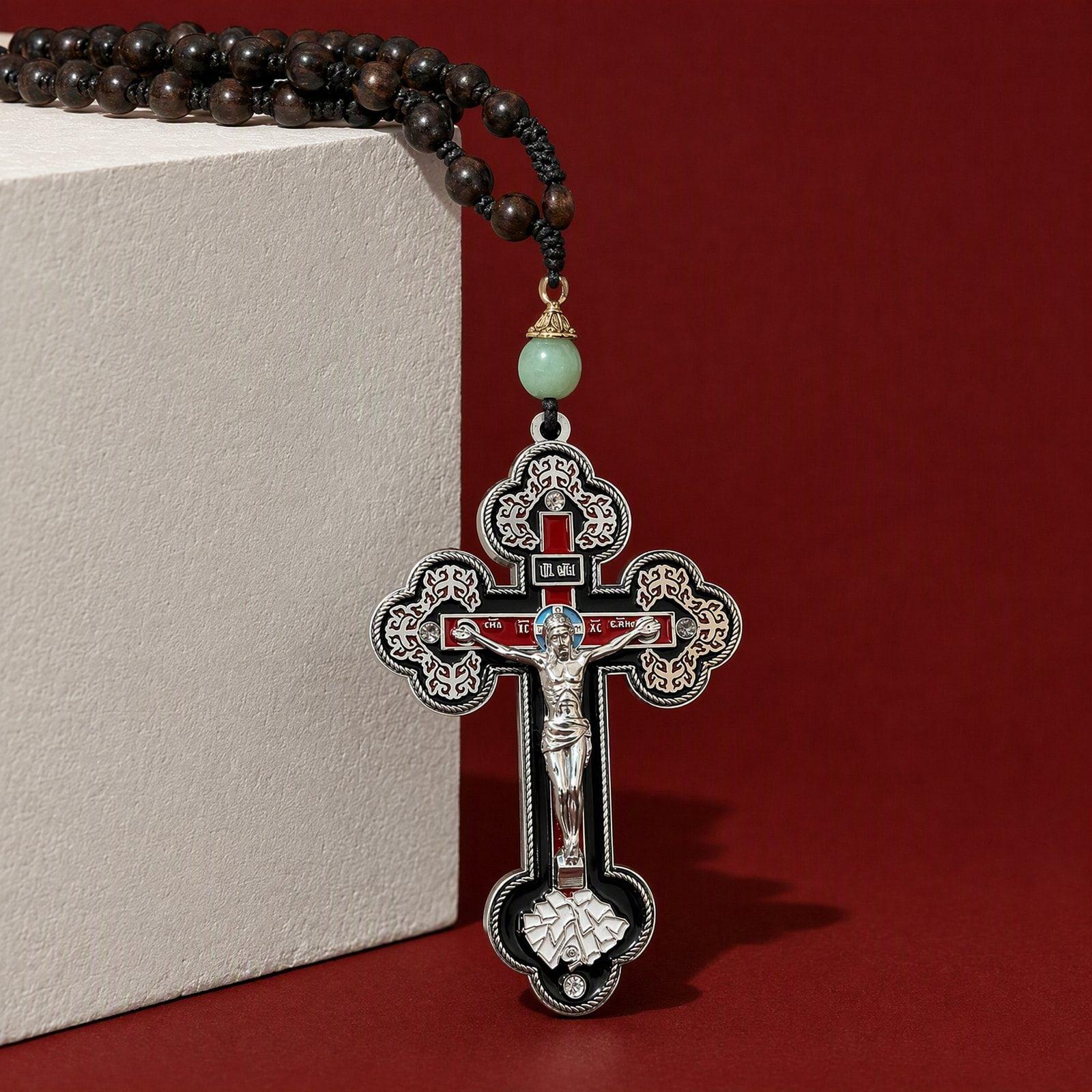 Krst
Eden Bright
srebrna boja$78$54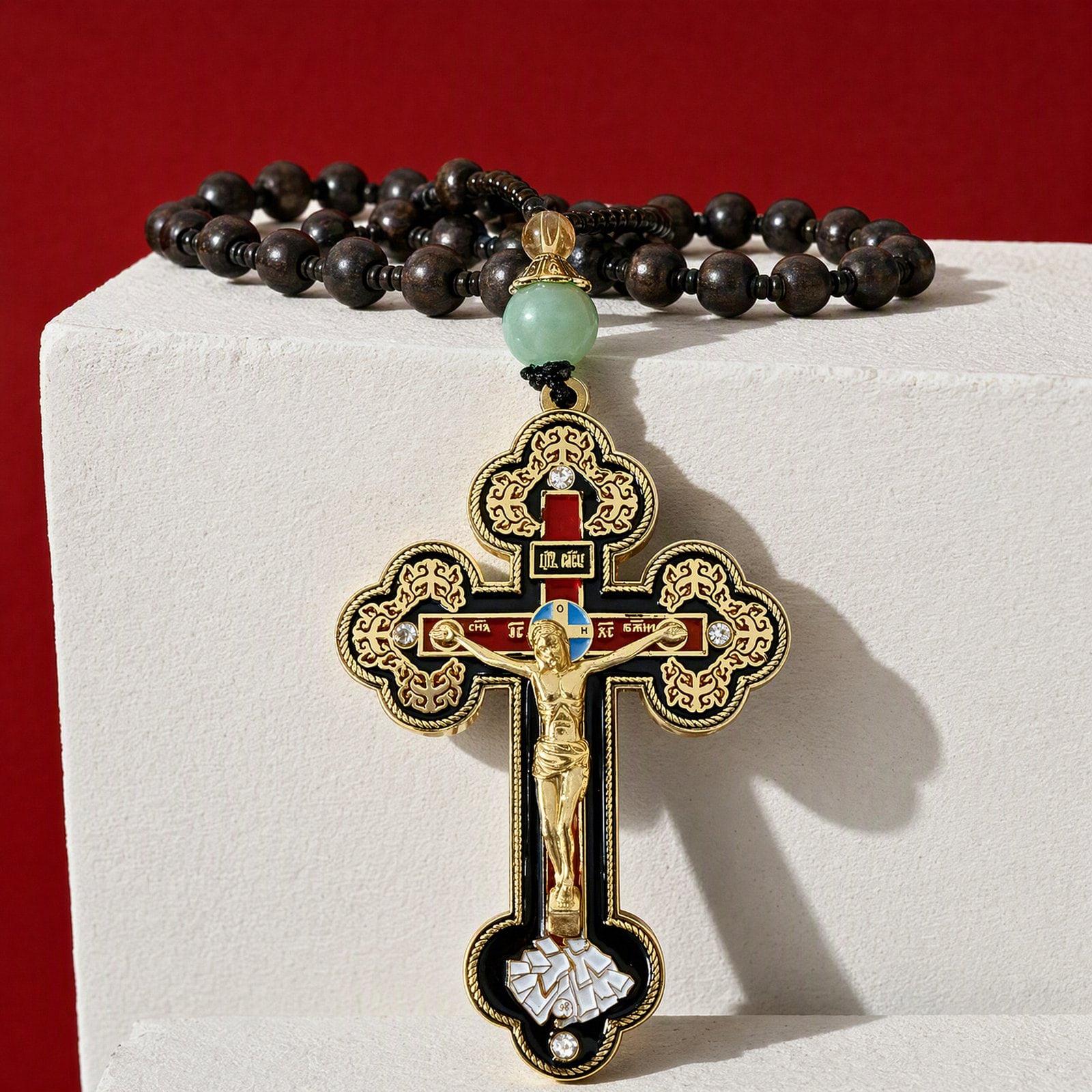 Krst
Eden Lamplight
zlatna boja$70$49
- Blessing, $39. Blessed by an Orthodox priest before it ships.
- Gift packaging, $20
Questions
What is a crux gemmata?
It is Latin for a jeweled cross. Wikipedia describes a cross, or its front face at the least, covered mainly with jewels, as a form from the early Church and the early Middle Ages.
Is a jeweled cross necklace a crux gemmata?
Not by Wikipedia’s usage. It says the term is not normally used for crosses of later periods, and especially not for small crosses that count as jewelry.
What do the jewels on a cross mean?
Wikipedia gives several readings. The cross can stand for the New Jerusalem, for a Tree of Life, or for Christ himself, and four rivers below it can stand for the four Gospels.
Why do some jeweled crosses have thirteen gems?
Wikipedia says that is not especially typical, but a cross with thirteen probably stands for Christ and the twelve Apostles. Early examples more often have a good many more.
Does Lampada sell a jeweled cross?
No cross of ours is described as set with gems. The closest are the silver-tone cross with studded ends at $64 and the enamel crucifixes at $54 and $49.