INRI Meaning: what it is and how Orthodox Christians use it
INRI is a symbol that Christians of East and West both know. Here are the facts the reference sources give, followed by the Orthodox use and the Western use, each in its own place.
- What it is. INRI is the initialism of the Latin inscription Iesus Nazarenus, Rex Iudaeorum, in English Jesus the Nazarene, the King of the Jews.
- In the Gospels. John 19:19 to 19:20 says Pilate had the title written and fixed to the cross, in Hebrew, Latin and Greek; Matthew 27:37 also mentions it.
- The Greek form. The Greek wording is abbreviated ΙΝΒΙ.
- Where it sits. On a two-barred cross the shorter upper bar is widely held to stand for the sign with these letters.
- The initialism in use. The abbreviation INRI by itself, not the whole Latin sentence, is recorded by the 10th century, for example on the Gero Cross at Cologne, around 970.
- The relic. A walnut board kept in a Roman church is claimed to be the title from the cross; its authenticity is disputed, and three radiocarbon tests dated it between 980 and 1146.
- The Spanish word. In Spanish ‘inri’ also names a taunt, as in ‘para más inri’, to add insult to injury.
In Western churches. In Western Christianity nearly all crucifixes, and a good many crucifixion pictures, include a small plaque or parchment (the titulus) above Christ’s head lettered only INRI.
Facts come from Wikipedia (Jesus, King of the Jews, Two-barred cross and Titulus Crucis) and OrthodoxWiki (Cross), put into our own words.
INRI in Orthodox worship and art
Eastern Orthodox and Eastern Catholic churches use the Greek letters ΙΝΒΙ. Some Eastern images change the title to ‘The King of the World’ or ‘The King of Glory’; the article says this reflects the tradition that icons show spiritual reality, not the physical scene. The Romanian Orthodox Church writes INRI, because the Romanian abbreviation is the same as the Latin. OrthodoxWiki notes that a lot of Orthodox churches put up a cross with three bars, the short top bar standing for the notice fixed above Christ.
Crucifixes under the title King of Glory
The Eastern wording the sources mention is the title King of Glory. Two crucifixes carry it above Christ: $54 in gold-tone and $64 in silver-tone with studded ends, and an Orthodox priest can bless either. With the Blessing, $93 and $103 respectively.
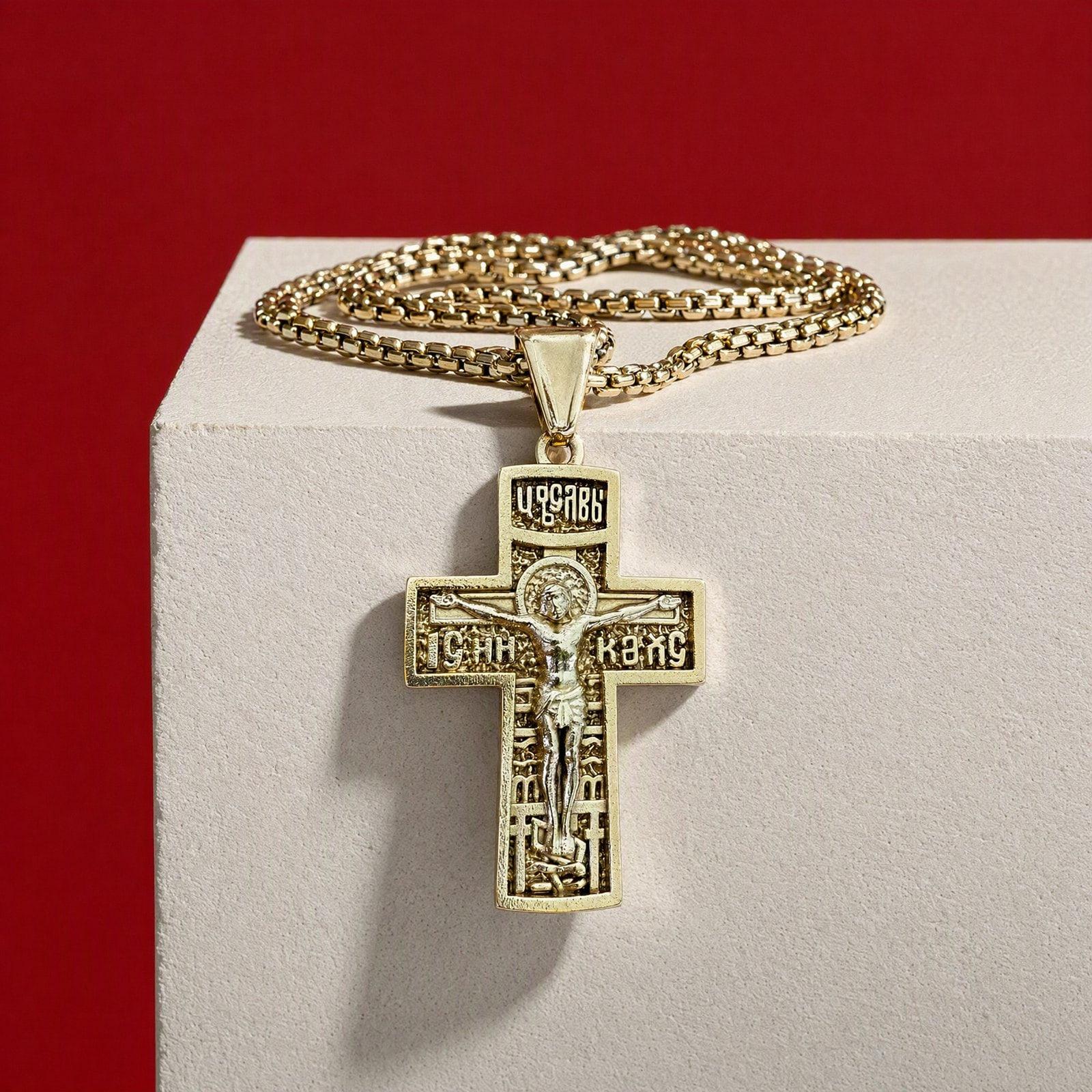 Σταυρός
Glory Lamplight
Χρυσό χρώμα · Ανοξείδωτο ατσάλι$78$54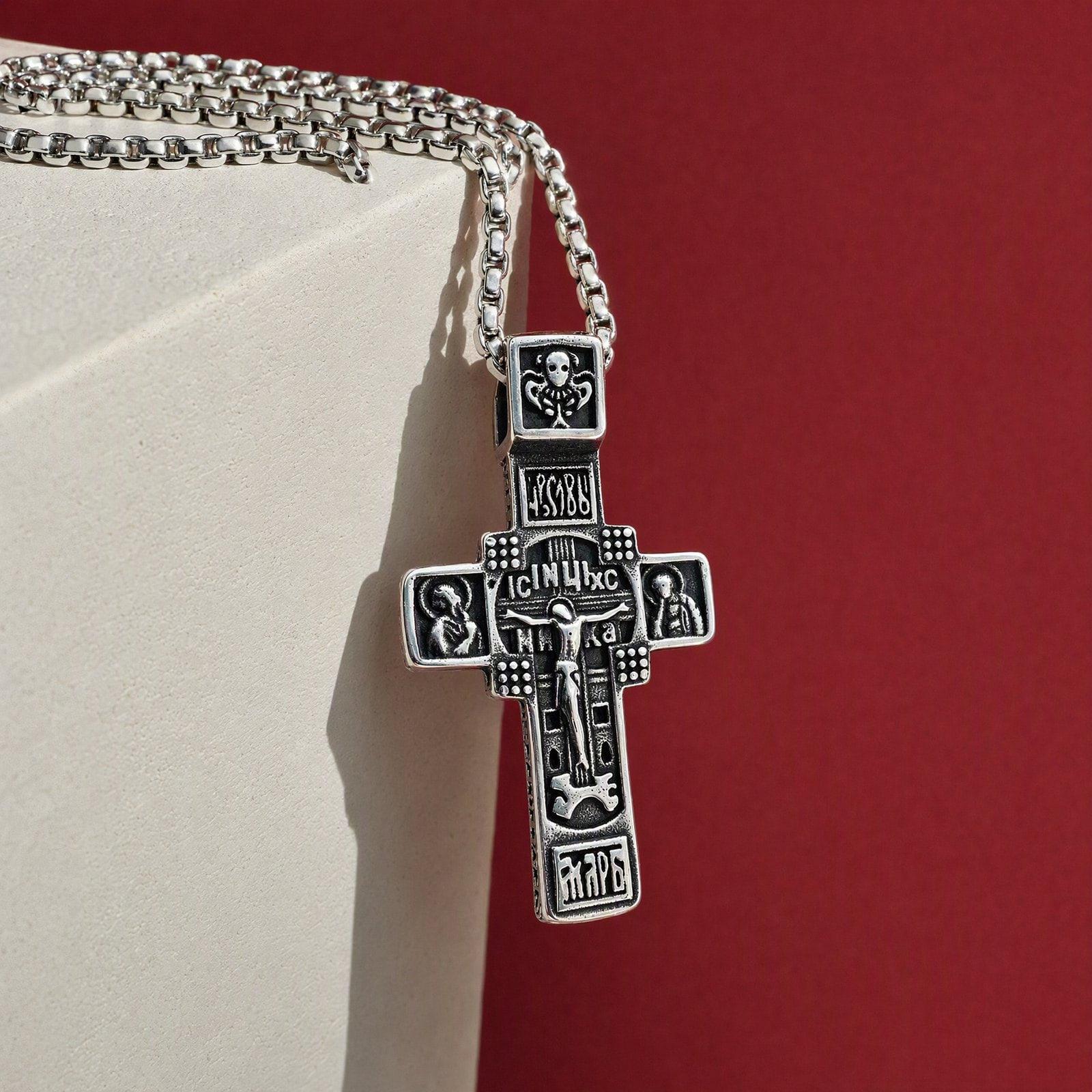 Σταυρός
Studded Ash
Ασημί χρώμα · Αλυσίδα 60 εκ. · Ανοξείδωτο ατσάλι$92$64
- Blessing, $39. Blessed by an Orthodox priest before it ships.
- Gift packaging, $20
Questions
What is INRI as a Christian symbol?
INRI is the initialism of the Latin inscription Iesus Nazarenus, Rex Iudaeorum, in English Jesus the Nazarene, the King of the Jews.
What else do the sources say about INRI?
John 19:19 to 19:20 says Pilate had the title written and fixed to the cross, in Hebrew, Latin and Greek; Matthew 27:37 also mentions it.
How does the Orthodox Church treat INRI?
Eastern Orthodox and Eastern Catholic churches use the Greek letters ΙΝΒΙ. Some Eastern images change the title to ‘The King of the World’ or ‘The King of Glory’; the article says this reflects the tradition that icons show spiritual reality, not the physical scene.
Do Western churches use INRI as well?
In Western Christianity nearly all crucifixes, and a good many crucifixion pictures, include a small plaque or parchment (the titulus) above Christ’s head lettered only INRI.
Does Lampada sell anything that shows INRI?
No item in the catalogue is described as INRI, going by the titles and descriptions. The items on this page are the nearest we carry.