Victor: name meaning and name day
Victor’s name day is 11 November on the New Calendar and 24 November on the Old Calendar, the day the Church keeps the martyrs Menas, Victor, Vincent and Stephanida. Yonge’s History of Christian Names (1884) lists Victor with the sense conqueror.
| Name | Saint | Name day |
|---|---|---|
| Victor | Holy Martyrs Menas, Victor, Vincent and Stephanida | 11 November on the New Calendar, 24 November on the Old |
The saints. Four martyrs share this day. The OCA places Victor at Damascus under Marcus Aurelius, who ruled from 161 to 180. A persecution began, and Victor would not make the offering to the old gods that the law required, so he was tortured, and the OCA says he came through unharmed. Stephanida, a young Christian married to one of the torturers, saw this and openly confessed Christ; she was sentenced to a cruel death when she was fifteen. Victor was beheaded, and the OCA says both were buried there. By his prayer, it adds, a sorcerer gave up sorcery and became a Christian.
Vincent, according to the OCA, was a pupil and then the deacon of the Spanish bishop Valerian, and spoke for him before the judges when Dacian arrested them under Diocletian. He was tortured on a cross and with fire, sang Psalms in his cell at night, and died in the year 304. Menas was born in Egypt and held a post in Phrygia; when an edict ordered everyone to worship idols he withdrew to a mountain to fast and pray, and at about fifty he came down into the city and declared that there is only one true God.
The name. Yonge lists Victor as a man’s name in German, French and English and gives its root as Latin, with the sense conqueror. We quote it for that and nothing more. Our index keeps these spellings with the name: Victor, Vittorio, Viktor and Vitor, and in Greek Βίκτωρ and Βίκτωρας.
Two calendars. New Calendar parishes keep 11 November; parishes on the Old Calendar keep the feast thirteen days later, on 24 November.
Four who would not give way
All four of these martyrs are remembered for refusing the same thing, offering sacrifice to idols, though they lived in different countries and different centuries. That gives a Victor several lives to read on his day, and a family might choose one aloud, for instance Vincent’s singing of Psalms in prison. OrthodoxWiki says a name day is best kept at the Liturgy or another service, with the saint’s troparion added to the family’s prayers and the icon displayed, and that gifts are often given. Because the name means conqueror, many households light a candle and say that the martyrs conquered by staying faithful.
A gift for Victor’s name day
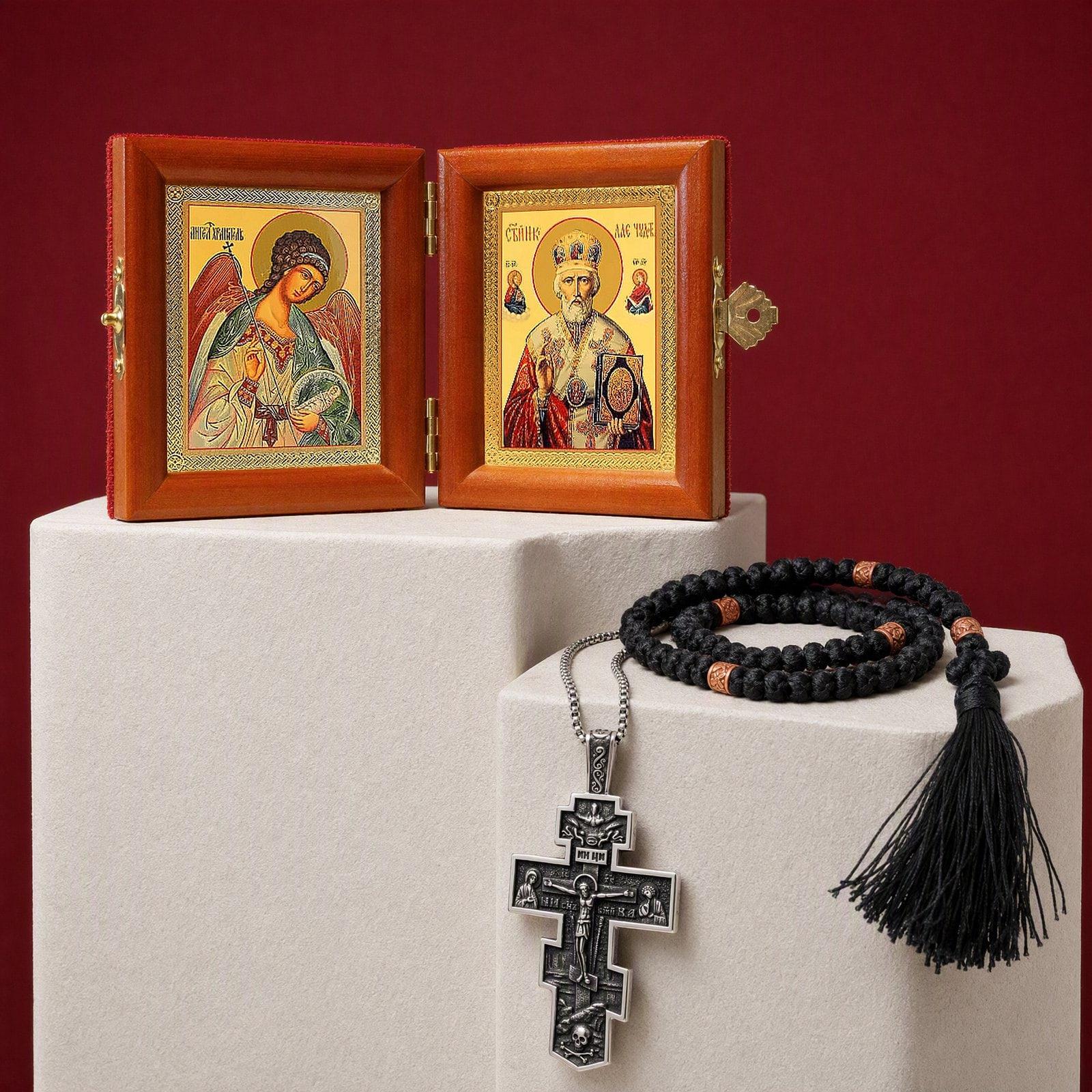
The Name-Day Gift Set is a folding icon, a stainless steel crucifix and a prayer rope, and the story of the saint’s life and feast day, sent to you by email, at $149. With the Blessing by an Orthodox priest, $198 (normally $262).
- Blessing, $49. Blessed by an Orthodox priest before it ships.
- Gift packaging, $20
Questions
When is Victor’s name day?
11 November on the New Calendar and 24 November on the Old Calendar. It is the feast of the martyrs Menas, Victor, Vincent and Stephanida, and Orthocal shows the day on both calendars.
What does the name Victor mean?
Yonge’s History of Christian Names (1884) lists Victor as a man’s name in German, French and English, with the sense conqueror, from Latin. The page reports that book and adds no meaning of its own.
Who was Saint Victor?
A martyr of Damascus in the second century. The OCA says he would not make the offering to the old gods that the law demanded under Marcus Aurelius, and that Stephanida, a girl of fifteen, confessed Christ after seeing him and also died.
Is Victor a biblical name?
No figure of Scripture is named Victor in the sources we read. The saints of this day are martyrs of the early Church, so the page treats the name as a name of that age.